
‘SelectScience offers a portal to learn about the newest technologies of our field’
Linda Lee, senior research scientist at C4 Therapeutics, describes how lab equipment reviews help to accelerate scientific progress
24 Mar 2021
Editorial article


Lab product reviews can change the world by helping other scientists find the best equipment to accelerate their vital work. Here at SelectScience®, we are dedicated to promoting peer-to-peer communication that will make the difference – but we couldn’t do it without our esteemed reviewers. In this regular new feature, we put the spotlight on some of our most dedicated and impactful reviewers and find out what inspires them to keep sharing their knowledge with the global scientific community.
For this week’s ‘Reviewer in the Spotlight’, we speak with Linda Lee, senior research scientist in the Cell Pharmacology group of C4 Therapeutics. Here, Linda tells us about the pivotal role scientific communication has played in her company and her current research focus. Furthermore, she explains why lab equipment reviews are becoming increasingly important, helping her keep up to date with the newest technologies in her field, simplifying choice and freeing up scientists’ time.
Tell me about your role and your current research
I am a senior research scientist in the Cell Pharmacology group of C4 Therapeutics. C4 Therapeutics is committed to transforming the treatment of cancer, neurological, and other important diseases with novel early-stage therapies called ‘targeted protein degraders’ that destroy, rather than inhibit, disease-causing proteins. Our approach to medicine harnesses the innate machinery of the cell to attack disease-causing proteins and potentially bring deep and durable responses to patients. My role in the Cell Pharmacology group is to design, validate, optimize, and execute high-throughput cell-based assays for various projects. The assay types are chosen based on the specific target C4T is working on, but in general, include phenotypic assays such as viability or target engagement assays such as HTRF or NanoBRET. Depending on project needs, we will engineer cell lines with techniques such as lentiviral transduction or CRISPR. Therefore, it is important in my role to stay on top of the newest technologies in the field to improve our screening pipeline.
What inspired you to get into the world of science?
I am originally from Taiwan and my family immigrated to the United States when I was 15 years old. When I was in Taiwan, I was not particularly interested in science because I was more focused on studying literature and history at the time. However, after enrolling in high school in the US, my science teachers completely changed my view. I really enjoyed the lectures, especially biology, and had a lot of fun running experiments in the lab. I decided to major in biology when I enrolled in college and I was fascinated by the complex cellular systems in our own bodies after taking molecular biology courses. Then, I was fortunate enough to begin working in an immunology lab as an undergraduate with a great mentor. My advisor and mentor helped me find a niche doing cellular research and I have been focusing on that area ever since.
Why is communication vital in science?

Communication is vital in science because that is how knowledge spreads to the community. We can learn from each other’s research, including failures and success, and inspire each other to innovate and push the community forward as a whole. C4 Therapeutics’ inception is a great example of scientific communication and innovation. C4 Therapeutics’ goal is to develop a new modality of treatment based on Dr. Jay Bradner’s pioneering research on protein degradation. Some of the members of C4T’s board of directors learned about Dr. Bradner’s research through scientific publications and networking and decided to start a company focused on harnessing the power of protein degradation as a new modality of treatments for patients. They would not have learned about Dr. Bradner’s research without the tradition of open communication within the scientific community.
Why do you think lab equipment reviews are important?
Lab equipment reviews are important because lab equipment has become more and more essential to scientific research. Without PCR instruments, it would not have been possible to derive the genetic sequence of COVID-19 and without qPCR instruments, it would not be possible to run the COVID-19 tests for patients on a meaningful timescale. Not to mention without automation technology, we would not be able to run as many COVID-19 tests as the labs around the world are currently processing daily. However, there are many instruments out there that provide similar functions and it would be quite difficult for someone to evaluate all of the available options before purchasing one. Therefore, lab equipment reviews offer researchers a chance to learn about other scientists’ experiences with the instruments they are interested in before committing to a purchase.
What’s your favorite piece of lab equipment?
I manage the automation system in my lab, so I have a couple of favorites: Echo, the acoustic dispenser by Labcyte (now Beckman Coulter), and Acell, the benchtop robot by HighRes Biosolutions. Echo allows us to screen compounds in cell-based assays at nL quantities, which conserves the number of compounds we need to use, keeps the percentage of dimethyl sulfoxide (DMSO) in the cells low and avoids the need for pre-dilution compound plates.
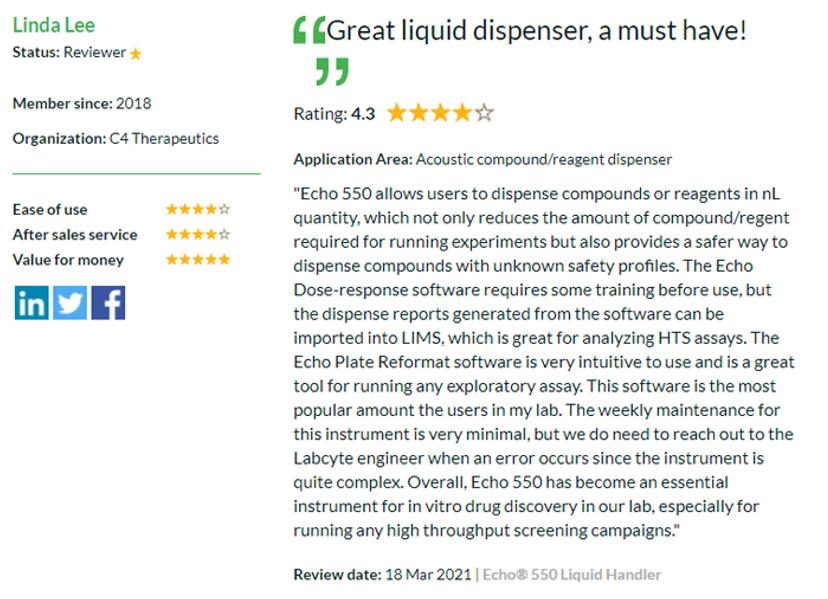
The acoustic dispenser combined with the ACell allows assay ready plates (cell-based assay plates pre-dosed with compounds) to be made without human handling of the compound plates. This practice increases the safety for scientists and is especially important since the majority of the compounds we work with are novel, which means that a full understanding of their safety profile is not yet known. Using an automation system also allows us to expand our high-throughput screening capability and can enable compound library screens or cell panel studies to be run routinely even in a relatively small company.

How do SelectScience reviews help you with your research?
SelectScience offers a portal to learn about the newest technologies of our field, find the products we need, and read about other users’ experiences with the product of interest. The website helps us narrow down our search of suitable products and means we can spend more time in the lab instead of researching equipment options online.
What would you like to achieve in your work?
I would like to see one of the compounds I work on eventually go through a clinical trial and become an approved treatment for the patients. Drug discovery is a very long process, and the success rate has historically been relatively low. I have been in the industry for over a decade now and only a few of the projects I worked on have made it to the clinical trial stage, but I have yet to see one make it to the finish line. It will be great to see one of them become a commercially available treatment for patients and help improve or even cure the disease they are suffering from.
Would you like to feature in our Reviewer Spotlight? Write your review here to be in with a chance >>
Related products
Request Quote for All Products
Echo® 550 Liquid Handler
Beckman Coulter Life SciencesImagine preparing assay plates for siRNA screening, compound screening with biochemical and cell-based assays, PCR reactions and more all on a single liquid handling platform, with no tips and no cross-contamination. Labcyte has developed new acoustic droplet ejection (ADE) parameters that deliver built-in intelligence to enable users to transfer many different fluid types from a single instrument. All Echo systems come pre-calibrated so that you can switch among different fluid types with just a click of the mouse. No further adjustment is required for you to be productive immediately. These developments combine the latest discoveries in wavelength, power and timing requirements for ADE with real-time fluid measurement at multiple points during a run. The resulting algorithms solve some of the most significant liquid handling challenges with volatile, low-surface tension and/or meniscus-shifting fluids. Volumetric accuracy and precision for all fluids tested so far—including buffers, nucleic acid and protein solutions, surfactants, serum and cell culture media—are comparable to established performance with DMSO. The Echo® 550 liquid handler introduced the world to acoustic droplet ejection (ADE). This award-winning instrument remains the proven choice for low-volume liquid handling in leading pharmaceutical and biotechnology companies worldwide. Like the Echo 520 and Echo 555 liquid handlers, the Echo 550 uses "touchless" ADE transfer technology. ADE uses sound energy to transfer 2.5 nL droplets from Echo-qualified 384- and 1536-well source plates into 96-, 384-, 1536- and 3456-well destination plates. This unique touchless technology eliminates consumable tip costs, washing, and cross-contamination. Unsurpassed volumetric precision (≤ 8% CV) and accuracy (≤ 10% CV) ensure superior results. Independent studies have shown that Echo liquid handlers eliminate false negatives due to sample loss on tip surfaces in low-concentration transfers. Like the Echo 555 liquid handler, the Echo 550 liquid handler reports both fluid volume and DMSO hydration. Applications: Compound management Compound screening siRNA screening Biochemical assays Cell-based assays PCR Genotyping Gene expression