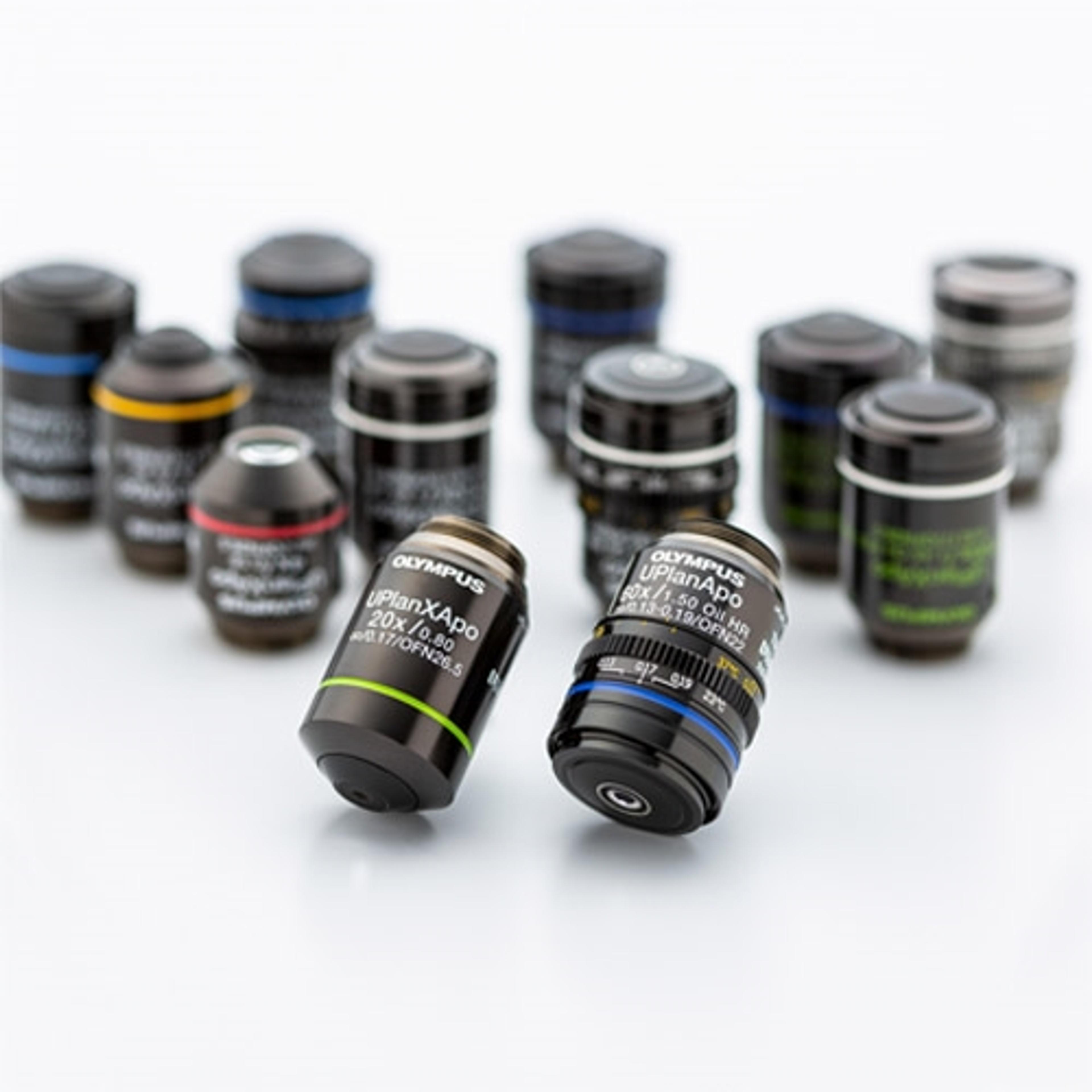
See the truth with Olympus X Line high-performance objectives

Olympus Life Science used an innovative manufacturing technique to create a new line of objective lenses

16 Mar 2022
Rory Shadbolt
Publishing / Media

Product news

Objectives are arguably the most important microscope components; you could even think of them as the heart of the system. Not only are they responsible for primary image formation, but they have significant influence over raw image quality. When we consider that improved image quality leads to more meaningful data, the importance of quality objectives is clear.

There are three key areas to optical performance: image flatness, numerical aperture (NA), and chromatic correction. While image flatness determines the uniformity and clarity of an image throughout the field of view, NA is a measure of an objective’s ability to gather light, which improves resolution and brightness. Finally, chromatic correction determines the lenses’ ability to focus different wavelengths of light on the same spot, thereby escaping chromatic aberration.

Until recently, objective optical performance has been limited by a trade-off between these three key areas. Not anymore.

Olympus’ innovative manufacturing technique used to create X Line objectives has ushered in the production of ultrathin lenses, allowing more lenses to be packed into each objective housing. This results in simultaneous improvement of all three key performance areas and enables the acquisition of high-resolution, high-quality images over a much larger field of view.

See the truth with Olympus X Line high-performance objectives. They not only enhance the power of various microscopy techniques—ranging from brightfield to fluorescence, TIRF, and super-resolution—but provide greater access to more meaningful data across a wide range of applications.

Want the latest science news straight to your inbox? Become a SelectScience member for free today>>
Links

Tags

Light MicroscopyLight microscopes or optical microscopes are used to visualize microscale objects under magnification, including cells, clinical specimens and materials. Lab equipment for light microscopy includes confocal microscopes, fluorescence microscopes, zoom and stereo microscopes. Microscope slides and imaging reagents are available for visualizing samples, as well as various microscope stages and incubators for large or temperature-sensitive samples. Find the best light microscopes in our peer-reviewed product directory: compare products, check customer reviews and receive pricing direct from manufacturers.Fluorescence MicroscopyFluorescence microscopy has become an essential tool in biology, as well as in materials science. The application of many fluorochromes has made it possible to identify cells and sub-microscopic cellular components with a high degree of specificity. Using multiple fluorescence labels, different probes can simultaneously identify several target molecules.MicroscopyMicroscopy is a technique used to observe small objects in detail, from cells to materials, using light or electron microscopes. It enables researchers to examine structures with high resolution, aiding in fields such as biology, medicine, and materials science. With advanced microscopy techniques, scientists can gain insights into cellular processes, tissue structures, and material properties. Explore the best microscopy solutions in our peer-reviewed product directory, compare products, read customer reviews, and get pricing directly from manufacturers.Objective LensDigital ImagingDigital imaging is a technique that captures images of biological and chemical samples in high resolution, often using advanced cameras and sensors. This technology is crucial in microscopy, diagnostics, and quality control. Explore digital imaging systems in our peer-reviewed product directory; compare products, check reviews, and get pricing directly from manufacturers.
See the truth with Olympus X Line high-performance objectives