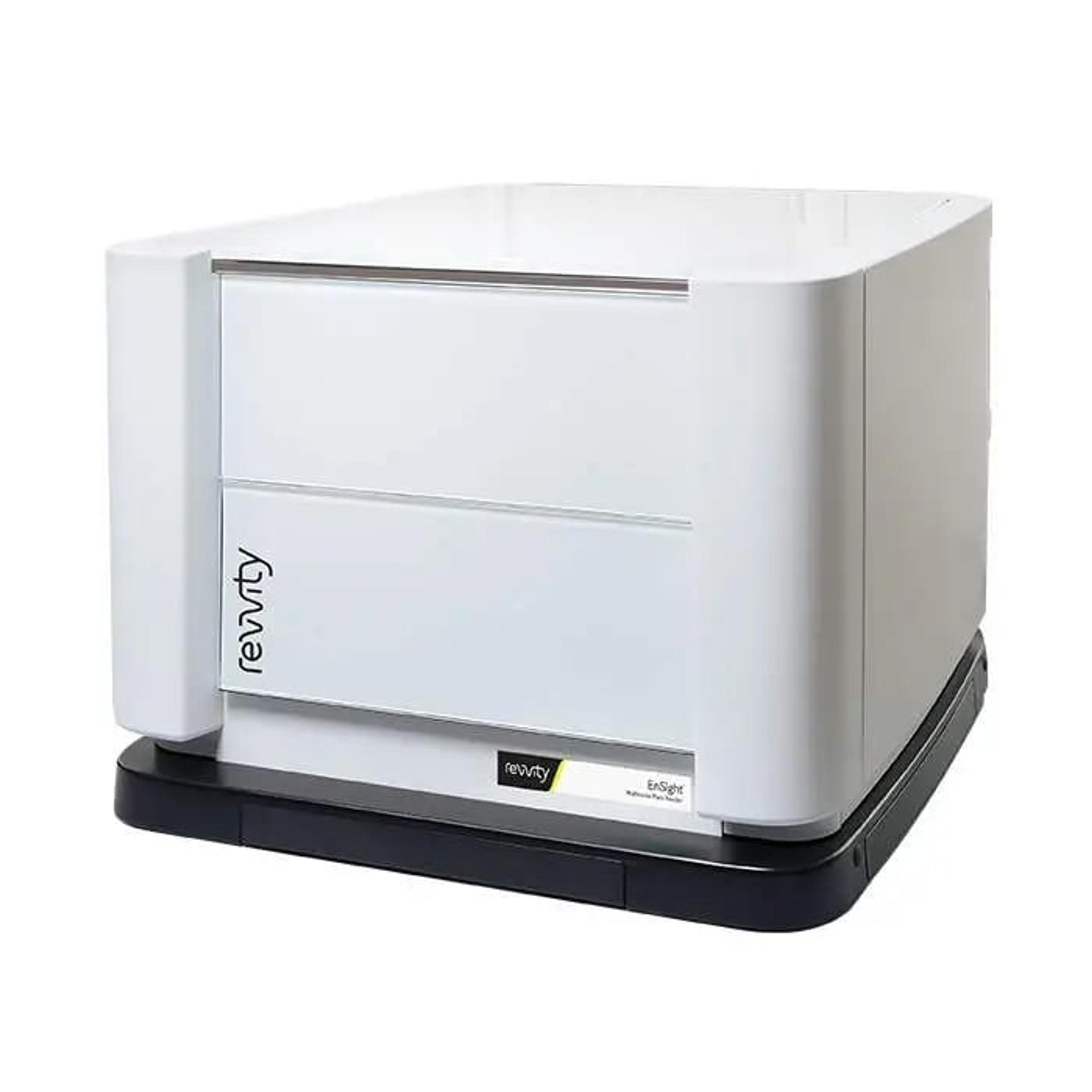
See how the New EnSight™ System can Accelerate Your Research at ELRIG Drug Discovery and Miptec

26 Aug 2014

Kerry Parker
CEO

Product news

Visit PerkinElmer at booth K5+K6 at ELRIG Drug Discovery, Manchester, UK, September 2-3, and booth C61 at Miptec, Switzerland, September 23-25, to see the new EnSight™ Multimode Plate Reader…

EnSight™ Multimode Plate Reader is the first benchtop system to offer well-imaging alongside label-free and labeled detection technologies. The EnSight™ supports a broad range of applications, in areas such as cancer, cytotoxicity, biotherapeutics, epigenetics and primary/stem cells, with a unique combination of technologies:

• Well-imaging
• Epic® Label-free
• Alpha Technology
• Ultra-Sensitive Luminescence
• Absorbance (filter and monochromator)
• Fluorescence (top- and bottom-reading)
• Time-Resolved Fluorescence (TRF)

The combination of technologies for target-based and phenotypic approaches allows you take a truly orthogonal approach to your research. Not only can you perform a wide range of assays on a single system, but you can also confirm your findings using different technologies for greater confidence that your results are biologically relevant, not biased to a technology.

Discover how EnSight can enable more predictive data earlier in the drug discovery process, by visiting our booths at both shows.

EnSight™ Multimode Plate Reader

Revvity

The EnSight ® multimode plate reader offers HTS Alpha and Ultra-sensitive Luminescence technologies alongside conventional multimode detection technologies. When equipped with a quad monochromator, the EnSight plate reader can improve performance for absorbance and fluorescence detection. In addition, stacker and robotic interface options are available, ideal for automation. The system’s modular design, combined with workflow-based Kaleido™ data acquisition and analysis softwar

(1)

Links

Tags

High-Throughput ScreeningHigh-throughput screening (HTS) is an automated drug discovery technique for identification of active compounds against a compound library. Use HTS readers and integrated assay preparation / analysis workstations to screen your compounds. Identify active compounds against various HTS libraries, including membranes, proteins and peptides and HTS cell lines. Find the best high-throughput screening products in our peer-reviewed product directory: compare products, check customer reviews and receive pricing direct from manufacturers.Microplate Readers / DetectorsMicroplate readers are used to automate the detection and analysis of labeled or label-free components in microplates during assays or live-cell monitoring. Microplate readers are generally distinguished by their mode of detection. Types include absorbance, luminescence, fluorescence intensity, fluorescence polarization, TRF / FRET and multimode microplate readers. Microplate readers deliver a high throughput of samples by reading multiple wells simultaneously, with the 96-well format the most commonly used. As a result, microplate readers are often used in the drug discovery, bioassays, research and pharmaceutical industries for screening applications. Microplate loading can also be automated, with robotic microplate stackers to increase throughput. Find the best microplate readers in our peer-reviewed product directory: compare products, check customer reviews and receive pricing direct from manufacturers.ADME-ToxicologyADME-toxicology (ADME-Tox) studies are used in pharmacology and pharmacokinetics to assess the activity/toxicity of drugs <i>in vivo</i> or <i>in vitro</i>. Find bioassays for absorption, distribution, metabolism, and excretion of drug molecules including cytotoxicity, transporter/permeability, metabolism and activity assays as well as hepatocytes and cell lines for ADME. Find the best ADME-toxicology products in our peer-reviewed product directory: compare products, check customer reviews and receive pricing direct from manufacturers.Cell-Based AssaysCell-based assays are used to monitor the presence, quantity and activities of a desired cellular analyte including drug molecules or biomarkers. This can reveal information on cell health (apoptosis, cytotoxicity, viability and proliferation assays), cell metabolism, cell migration and cell signaling mechanisms. Find the best cell-based assay products, kits and equipment with our peer reviewed product directory: compare products, check customer reviews and receiving pricing direct from manufacturers.High-Content ScreeningHigh-content screening (HCS), also known as high-content analysis (HCA), is a high-throughput technique used in drug discovery to identify substances that alter the phenotype of cells. HCS uses fluorescent microscopic imaging and automated image analysis to investigate cellular events such as apoptosis, cell viability, GPCR activation, oxide production, neurite outgrowth, and cell signaling. Find the best fluorescent labeling reagents, cellular assays, and high-content imaging systems in our peer-reviewed product directory: compare products, check customer reviews and receive pricing direct from manufacturers.ELRIGFluorescence Based AssayFluorescence based assays are widely used in life science research and high-throughput screening to measure a broad range of cellular activities.MipTec