Scientists’ Choice Awards<sup>®</sup> Winners Announced for General Lab, Separations and Spectroscopy

Orbitrap inventor Prof. Alexander Makarov and anti-doping expert Prof. Francisco Radler among the winners recognized during a ceremony at Pittcon 2017

8 Mar 2017
Christian Hall
Administrator / Office Personnel

Expert insights

Scientists' Choice Awards® The annual Scientists' Choice Awards® celebrate the laboratory products and manufacturers that make a difference to the industry. Scientists are invited to nominate, vote and review online.

SelectScience® is delighted to announce the winners of the 2017 Scientists’ Choice Awards® for General LabSeparations and Spectroscopy. Scientists around the world were invited to participate by nominating, voting and reviewing online. Winners and nominees were celebrated during a special ceremony held on March 7 at the Pittcon 2017 International Conference and Expo in Chicago, USA. Read on to discover the winners of these coveted awards and highlights from this exciting event.

Best New General Laboratory Product

SelectScience revealed the Eppendorf Centrifuge 5920 R as your chosen winner for the Best New General Lab Product of 2016, as nominated and voted for by scientists around the world.Do you use this centrifuge in your laboratory? Share your thoughts with other scientists by reviewing the Eppendorf Centrifuge 5920 R today!
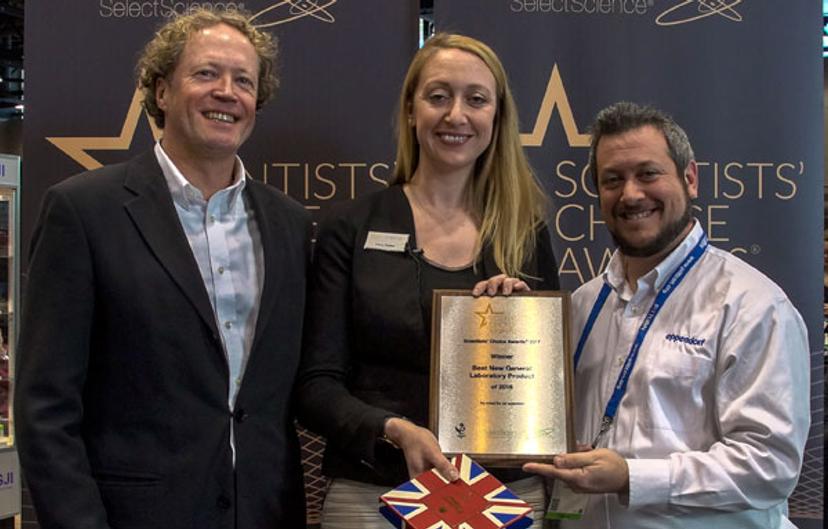
Christian Rohrer and Matthew Lieber accept the award for Best New General Lab Product

Matthew Lieber, Product Manager at Eppendorf, accepted the award; “It is a great pleasure to accept this award on behalf of the entire Eppendorf corporation. This new product was a result of a lot of engineering expertise. It’s especially important because we know what the voting process is here –this is voted on by scientists. It’s important for Eppendorf that we’re reaching our scientists and creating products that do make their processes better.”

Runners Up

Best New Spectroscopy Product

Bruker Daltonics won the award for Best New Spectroscopy Product of 2016 with its timsTOF™ ion mobility-mass spectrometer. If you’ve used a timsTOF™, leave a review for your peers, it’s easy.

Thorsten Thiel, VP Bruker Biospin Group, accepts the award on behalf of Bruker Daltonics

“We appreciate what SelectScience does to educate our customers to make their decisions easier and more efficient,” said Thorsten Thiel PhD., Vice President, Bruker Biospin Group.

Runners Up

Best New Separations Product

Finally, the 1260 Infinity II LC system from Agilent Technologies won the Best New Separations Product of 2016. Are you a 1260 Infinity II LC user, then why not write a review?

Helmut Schulenberg-Schell, Director Business Development, Agilent Technologies accepts the award

Runners Up

Video of the Year

In the prestigious Video of the Year category, Prof. Francisco Radler from the Brazilian Doping Control Laboratory, with Thermo Fisher Scientific were the chosen winners for a video highlighting how state-of-the-art mass spectrometry is being used in the fight against doping in sport.
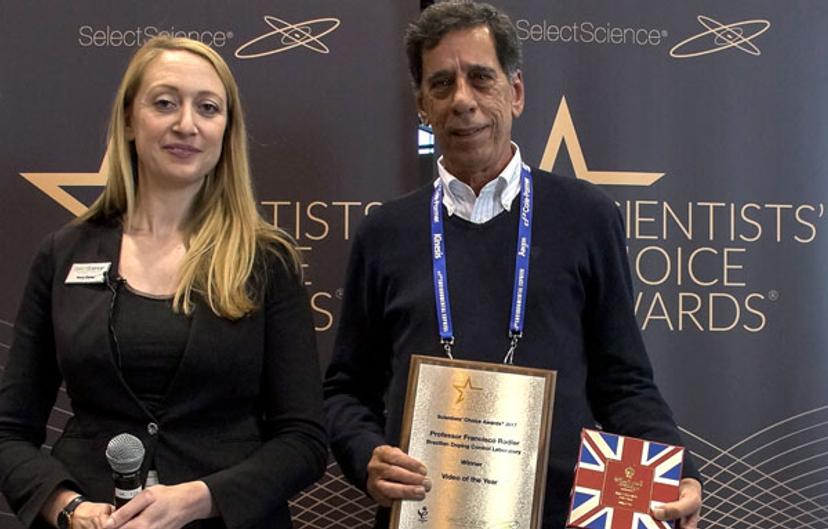
Luiz Bravo accepts the Video of the Year Award on behalf of Professor F. Radler

Article of the Year

It was Alexander Makarov, inventor of the Orbitrap mass spectrometer and Director of Global Research at Thermo Fisher Scientific who picked up the award for Article of the Year. The article looked at how the Hong Kong Jockey Club, a world-class drug-testing facility, uses 24 state-of-the-art mass spectrometers to analyze thousands of samples to stay on the winning side in keeping horseracing clean.
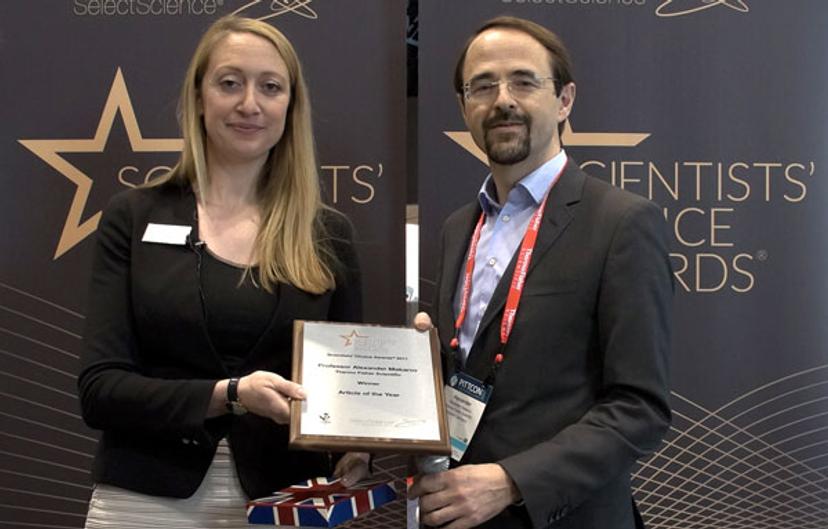
Orbitrap inventor Alexander Makarov accepts the Article of the Year Award

Professor Alexander Makarov, Director of Global Research, Thermo Fisher Scientific, gave a short acceptance speech; “It’s very surprising to have such an award. I consider it as an acknowledgement of the inroads the Oribtrap mass spectrometer has made in anti-doping analysis. All major international competitions are now using Orbitrap to achieve lower limits of detection for prohibited substances. I think that this is quite symbolic and important that we are able to make any type of cheating in competitions impossible.”

Best Webinar Series of the Year

In a brand new award this year, the Best Webinar Series of the Year, Agilent Technologies scooped the award for its Biopharmaceuticals Webinar Series Solutions in Biopharmaceutical Discovery and Development, which ran for 10 episodes over the course of 2016.

Webinar of the Year

SelectScience revealed Laboratory Safety “Safe Storage of Chemicals” as the individual Webinar of the Year, run by Merck KGaA. In the webinar participants learned how to improve their chemical storage practices in the laboratory through practical advice, case studies and video clips.
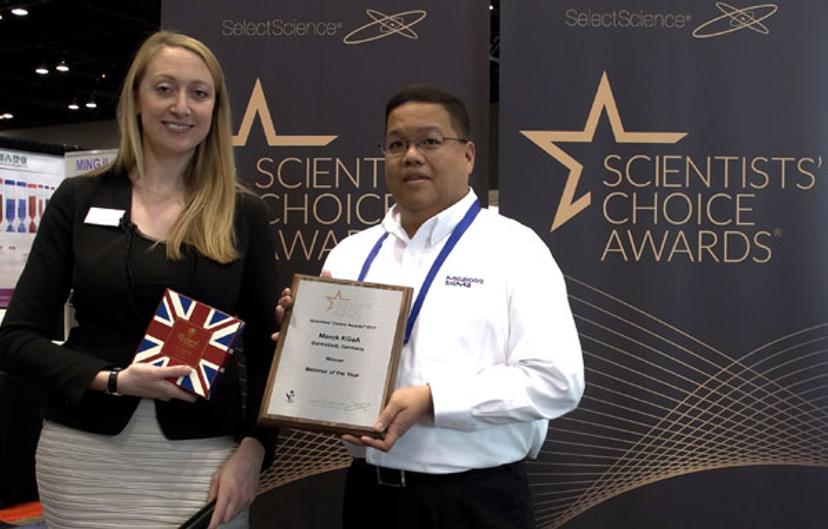
Merck KGaA accepts the Webinar of the Year Award

Email of the Year

The Email of the Year winner was announced as BINDER for Good Laboratory Practice: Free White Paper. The email offered a free whitepaper download to readers on the topic of good laboratory practice-compliant testing in the laboratory.
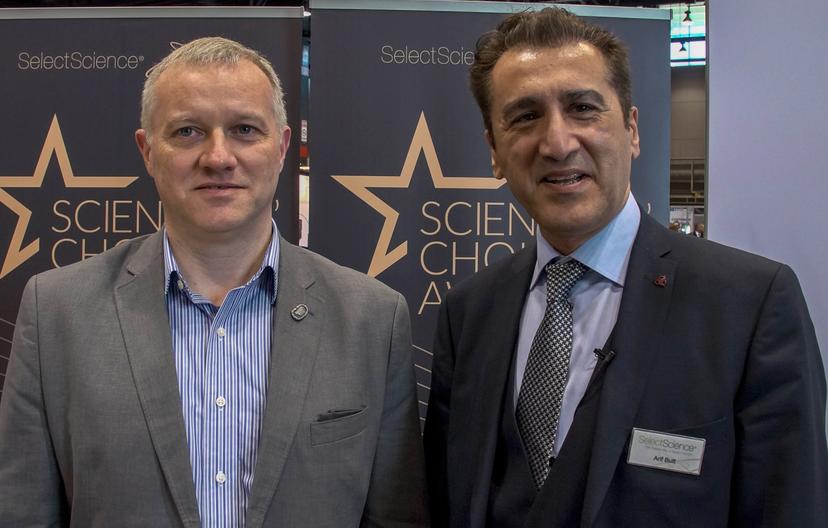
BINDER President Uwe Ross (left) accepts the award for Email of the Year

Reviewers’ Choice Award™ – Instrument of the Year

Picking up the Instrument of the Year was Wyatt Technology Corp. for its DAWN HELIOS II Multi-Angle Light Scattering Detector. The product is designed to provide high sensitivity and a wide range of measurements.

Philip Wyatt (center), with his two sons, accept the Instrument of the Year Award

Reviewers’ Choice Awards™ – Company of the Year & Customer Service of the Year

SelectScience announced Thermo Fisher Scientific as the Company of the Year, while Customer Service of the Year was awarded to Eppendorf.

Dan Shine, Thermo Fisher Scientific, accepts the award for Company of the Year

Dan Shine, President Analytical Instruments Group, Thermo Fisher Scientific, commented; “It means so much to us and our company because comes from our customers. We try and build a customer-centric mentality into everything we do and awards like this really recognize the fact we’re doing a good job with that.”
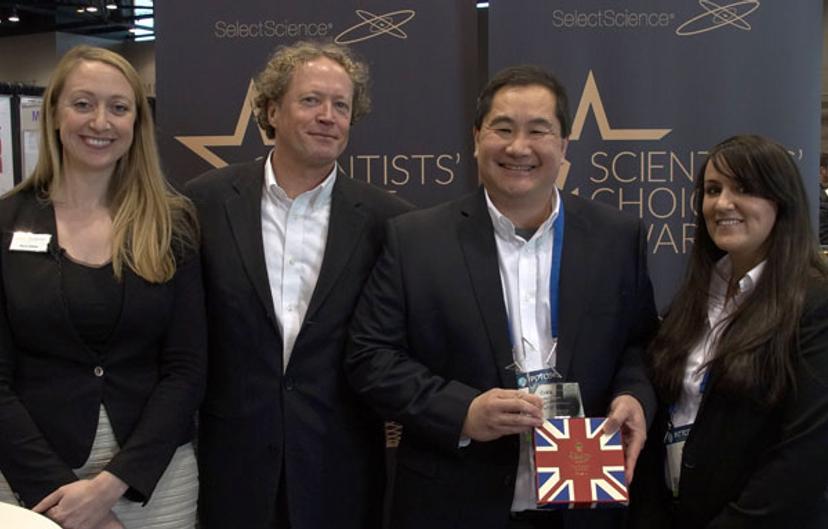
Craig Chin, Eppendorf, accepts the award for Customer Service of the Year

Visit the Scientists' Choice Awards website for more information. For news, live updates and interviews from the expo, visit the Pittcon 2017 Special Feature.

Links

Tags

AutosamplersAutosamplers are automated sample loaders used with a number of separation and analytical techniques. HPLC autosamplers use automated partial or full-loop injection systems and place samples in vials or microplates for analysis. Autosamplers can also be used for elemental analysis. Features to consider include repeatability, syringe capacity, footprint and temperature controls.  Capillary ElectrophoresisCapillary electrophoresis (CE) is used to separate molecules based on charge, size and hydrophobicity. Pressure, voltage or a vacuum is used to introduce the sample to fused silica capillaries. Fluorescence, UV/Vis, UV or diode array detectors are used to visualize components. Types of CE systems include capillary electrochromatography (CEC), capillary zone electrophoresis and capillary gel electrophoresis. Find the best capillary electrophoresis equipment in our peer-reviewed product directory: compare products, check customer reviews and receive pricing direct from manufacturers.Flash ChromatographyFlash chromatography is a fast-preparative column chromatography technique used for separation and purification of liquid analytes. Flash chromatography systems use small silica gel particles for separation and a pressurized gas for driving the solvent through the column or pre-packed cartridge. Find the best flash chromatography equipment in our peer-reviewed product directory: compare products, check customer reviews and receive pricing direct from manufacturers.Gas ChromatographyGas chromatography (GC) is an analytical technique used to separate and quantitate mixtures of small and volatile compounds. Gas chromatographs or GC systems include components such as GC columns, detectors, pumps and autosamplers. Choose from packed or capillary GC columns, flame ionization (FID), photoionization (PID) electron capture detectors and selective or non-selective detectors. Find the best gas chromatographs in our peer-reviewed product directory: compare products, check customer reviews and receive pricing direct from manufacturers.UHPLC and HPLCHigh performance liquid chromatography (HPLC) and ultra high performance liquid chromatography (UHPLC), also known as UPLC, are analytical techniques used to separate, identify and quantitate components of complex mixtures including biological samples such as proteins and lipids as well as chemical mixtures of pesticides, drugs and oils. Both techniques are liquid chromatographic methods but differ by operating pressures (HPLC < 6000 psi < UHPLC ). Components of HPLC and UHPLC systems include columns, detectors, pumps, autosamplers and column heaters. Explore a range of UHPLC and HPLC columns for your specific sample needs including reverse phase, normal phase, ion exchange, HILIC, ion exclusion and size exclusion columns. For more specialized HPLC, explore FPLC, countercurrent LC and simulated moving bed systems. Find the best UHPLC and HPLC equipment in our peer reviewed product directory: compare products, check customer reviews and receive pricing direct from manufacturers.Ion ChromatographyIon chromatography, also known as ion exchange chromatography, is a high-performance liquid chromatographic technique used for the separation and identification of ions or polar molecules in a sample, including proteins, nucleotides and amino acids. Equipment includes ion exchange columns, ion exclusion columns, ion chromatography systems, pumps, and detectors. Find the best ion chromatography equipment in our peer-reviewed product directory: compare products, check customer reviews and receive pricing direct from manufacturers.Sample PreparationSample preparation can improve the quality and speed of separation techniques. Products to assist sample preparation include filtration equipment, evaporators, membranes and sieves.Size Exclusion ChromatographySize exclusion chromatography (SEC) is a liquid chromatographic technique used to separate and identify molecules based on their size, including polymers, proteins, nanoparticles & nucleic acid. SEC is further subdivided into gel filtration chromatography (GFC) and gel permeation chromatography (GPC) when an aqueous or organic mobile phase is used respectively. HPLC-based SEC systems and columns are available for analytical separation alongside SEC spin columns or filters to prep samples for many protocols. Find the best size exclusion chromatography equipment in our peer-reviewed product directory: compare products, check customer reviews and receive pricing direct from manufacturers.Atomic Absorption / Emission SpectroscopyAtomic absorption spectroscopy (AAS) and atomic emission spectroscopy (AES) — also called optical emission spectroscopy (OES) — are used to detect the elemental constituents in samples. Both techniques involve the atomization of a sample. Atomic absorption spectrometers may use a flame or furnace to create an atomic vapor of the sample before irradiation with spectral light. Optical emission spectrometers may use a flame, inductively coupled plasma (ICP), microwave plasma (MP) or spark arcs to atomize and excite the sample. At higher excitation energies, electrons can be emitted instead of photons, which can be useful for samples that can’t be atomized and for surface analysis. Explore electron spectroscopy equipment such as Auger spectrometers and photoelectron spectrometers for surface elemental analysis of samples. Find the best atomic absorption, photoelectron and optical emission spectrometers in our peer-reviewed product directory: compare products, check customer reviews and receive pricing direct from manufacturers.Fluorescence SpectroscopyFluorometers and spectrofluorometers (also called fluorescence spectrometers) are used to measure the intensity and wavelength of fluorescent light emitted from a sample after excitation by illumination. Spectrofluorometers utilize monochromators to select the desired wavelengths, whereas filter fluorometers employ a set of filters. Spectrofluorometers for measuring steady-state fluorescence and lifetime fluorescence (or time-resolved fluorescence) are available, as well as fluorescence microscopes and microplate readers. Find the best fluorescence spectroscopy products in our peer-reviewed product directory: compare products, check customer reviews and receive pricing direct from manufacturers.Infrared / IR SpectroscopyInfrared (IR) spectroscopy measures the interaction of infrared light with a sample, including transmission, reflectance & absorbance, facilitating the identification of analytes. Equipment used for quantitative analysis includes Fourier-transform infrared (FTIR) spectrometers, infrared cameras, FTIR gas analyzers, as well as attenuated total reflectance (ATR) accessories and pellet or film presses. Find the best IR spectroscopy products in our peer-reviewed product directory: compare products, check customer reviews and receive pricing direct from manufacturers.LC-MSLC-MS (liquid chromatography-mass spectrometry) systems and equipment are used for separation and quantitative analysis of complex mixtures, combining liquid chromatography and mass spectrometry. Quantify proteins, contaminants, pesticides or screen for drug metabolites with a high level of sensitivity. LC-MS systems and equipment include reverse phase, normal phase and specialized columns integrated with various MS detectors such as time-of-flight (TOF), quadrupole, orbitrap or ion trap mass analyzers. LC-MS/MS instruments equipped with a qTOF or triple quadrupole analyzer give greater sensitivity and resolving power to your analysis. Find the best LC-MS equipment in our peer-reviewed product directory: compare products, check customer reviews and receive pricing direct from manufacturers.Mass SpectrometryMass spectrometry (MS) is a powerful analytical technique used to identify and quantify molecules based on the mass-to-charge ratio of gas-phase ions. It provides detailed information about the structure, composition, and properties of compounds and is widely used across fields such as environmental monitoring, materials science, drug discovery and development, food and beverage testing, and wider chemical research. Key MS techniques include tandem mass spectrometry (MS/MS), liquid chromatography–mass spectrometry (LS-MS) and inductively coupled plasma (ICP-MS). Choosing from these wide range of techniques and technologies can be a daunting task, so keep up to date with scientific applications, performance expectations, and customer reviews here all in one place. Visit our product directory to receive quotes direct from the manufacturer. Near Infrared SpectroscopyNear-infrared (NIR) spectroscopy measures the interaction of near-infrared light with a sample, including transmission, reflectance and absorbance, facilitating the identification of analytes. Measurements can be conducted using a Fourier-transform near infrared (FT-NIR) spectrometer, while there are also UV-Vis- NIR spectrophotometers that measure a broader spectrum of wavelengths. Find the best NIR spectroscopy products in our peer-reviewed product directory: compare products, check customer reviews and receive pricing direct from manufacturers.NMR and EPR SpectroscopyNuclear magnetic resonance (NMR) spectroscopy is used to resolve the local chemical environment of atomic nuclei with spin, revealing information on molecular structure, dynamic processes and chemical reactions of organic molecules, from proteins to synthetics. Electron paramagnetic resonance (EPR) also known as electron spin resonance (ESR) spectroscopy is used to detect and quantify paramagnetic species in a sample, including free radicals as transition metal ions. By immersing the sample in a strong magnetic field, both NMR and EPR spectrometers probe the sample with either radio waves or microwaves respectively. A range of benchtop, solid-state and time domain NMR spectrometers & EPR spectrometers are available, as well as NMR tubes, NMR solvents, software, coils, and magnets. Find the best NMR & EPR equipment in our peer-reviewed product directory: compare products, check customer reviews and receive pricing direct from manufacturers.