Sartorius completes acquisition of Novasep’s chromatography division

Acquisition enables Sartorius to continue to develop optimized systems for membrane-based chromatography technology

9 Feb 2022

Blake Forman
Content Creator

Industry news

Sartorius has announced that, through its subgroup Sartorius Stedim Biotech, it has closed the acquisition of the Novasep chromatography division as of February 7, 2022, following approval by the U.S. Federal Trade Commission. The transaction had already been agreed upon at the beginning of 2021. The business acquired generated sales of around 40 million euros in 2020 at a double-digit profit margin; final figures for 2021 are not yet available. The majority of the approximately 100 employees work at the Pompey site in eastern France and some in the USA, China, and India.

The portfolio acquired comprises chromatography systems primarily suited for smaller biomolecules, such as oligonucleotides, peptides, and insulin, as well as innovative systems for the continuous manufacturing of biologics. Since 2018, Novasep and Sartorius have also been jointly developing optimized systems for a membrane-based chromatography technology.

As the acquisition is expected to generate additional non-organic sales revenue growth of around 1 percentage point in 2022, Sartorius has updated its sales revenue forecast for the current year as follows: Consolidated sales revenue is now expected to increase by about 15 percent to 19 percent (previously about 14 percent to 18 percent), with non-organic growth from acquisitions projected to contribute about 2 percentage points (previously about 1 percentage point). The company’s underlying EBITDA margin remains forecasted at about 34 percent this year.

For the Bioprocess Solutions Division, the company now forecasts sales revenue growth of about 17 percent to 21 percent for 2022 (previously about 16 percent to 20 percent), with non-organic growth from acquisitions contributing around 2 percentage points (previously around 1 percentage point). The division’s underlying EBITDA margin is still expected to be around 36 percent. The 2022 forecasts for the Lab Products & Services Division remain unchanged: Accordingly, the company continues to project sales revenue growth of about 6 percent to 10 percent, including a non-organic growth contribution from acquisitions of around 1 percentage point, and an underlying EBITDA margin of around 26 percent for the division.

All forecasts are based on constant currencies.

Want the latest science news straight to your inbox? Become a SelectScience member for free today>>

SARTOFLOW® Study

Sartorius Group

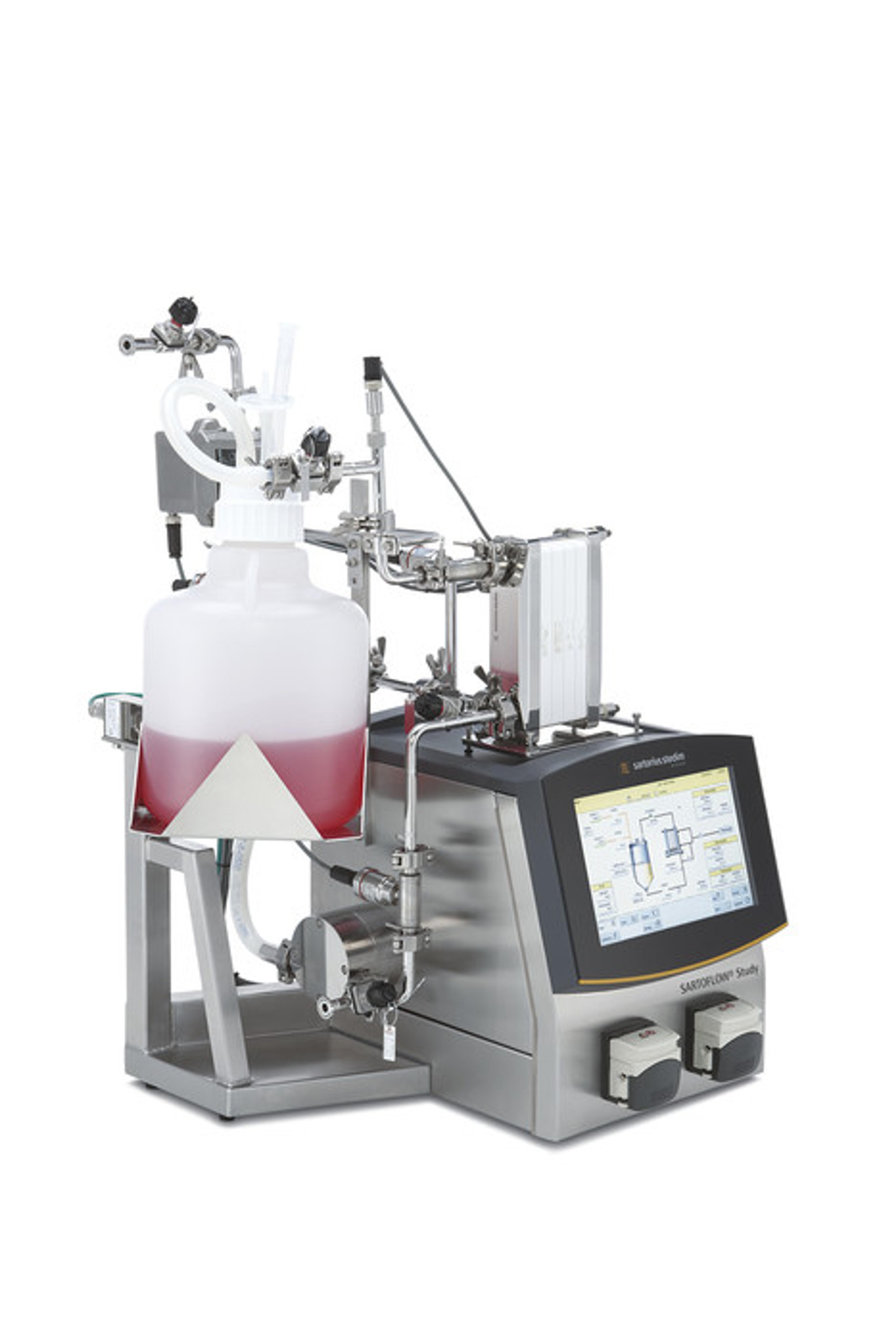
The SARTOFLOW® Study will prove to be your best assistant in ultra- and diafiltration applications.This manual benchtop Crossflow system has been optimized for ultrafiltration, microfiltration and diafiltration applications used in many downstream processes. It will assist you by conveniently displaying interactive prompts for easy guidance through entire sequences. That will enable you to be more productive during the purification of monoclonal antibodies, vaccines or protein solutions.

(0)

Links

Tags

UHPLC and HPLCHigh performance liquid chromatography (HPLC) and ultra high performance liquid chromatography (UHPLC), also known as UPLC, are analytical techniques used to separate, identify and quantitate components of complex mixtures including biological samples such as proteins and lipids as well as chemical mixtures of pesticides, drugs and oils. Both techniques are liquid chromatographic methods but differ by operating pressures (HPLC < 6000 psi < UHPLC ). Components of HPLC and UHPLC systems include columns, detectors, pumps, autosamplers and column heaters. Explore a range of UHPLC and HPLC columns for your specific sample needs including reverse phase, normal phase, ion exchange, HILIC, ion exclusion and size exclusion columns. For more specialized HPLC, explore FPLC, countercurrent LC and simulated moving bed systems. Find the best UHPLC and HPLC equipment in our peer reviewed product directory: compare products, check customer reviews and receive pricing direct from manufacturers.LC-MSLC-MS (liquid chromatography-mass spectrometry) systems and equipment are used for separation and quantitative analysis of complex mixtures, combining liquid chromatography and mass spectrometry. Quantify proteins, contaminants, pesticides or screen for drug metabolites with a high level of sensitivity. LC-MS systems and equipment include reverse phase, normal phase and specialized columns integrated with various MS detectors such as time-of-flight (TOF), quadrupole, orbitrap or ion trap mass analyzers. LC-MS/MS instruments equipped with a qTOF or triple quadrupole analyzer give greater sensitivity and resolving power to your analysis. Find the best LC-MS equipment in our peer-reviewed product directory: compare products, check customer reviews and receive pricing direct from manufacturers.NanoLCNano LC is a nano scale liquid chromatography technique typically used for proteomic applications. The nano refers to the very low flow rate of the mobile phase in the system. The advantage of nanoLC is its high sensitivity. Often the system is integrated with a mass spectrometer in nano LC-MS or nano LC-MS/MS. When using nanoLC equipment consider column choice, software and accurate and precise flow rate control.ChromatographyChromatography is a powerful technique used to separate and analyze components of mixtures based on their chemical properties. It is widely used in fields like biochemistry, pharmaceuticals, and environmental analysis. By exploiting differences in the interaction of substances with a stationary phase and a mobile phase, chromatography enables precise purification and quantification of compounds. Whether you're working with complex biological samples or industrial chemicals, chromatography is essential for obtaining high-quality results. Browse our peer-reviewed product directory to find the best chromatography systems, compare products, read customer reviews, and get pricing directly from manufacturers.BiotherapeuticsBiotherapeutics are proteins and other compounds (such as nucleic acids) produced by living organisms that have uses as therapeutics or in <i>in vivo</i> diagnostics. The most well-known example of a biotherapeutic product, and the first to be approved for therapeutic use, was recombinant human insulin.BiologicsBiologics are medical products derived from living organisms, including vaccines, gene therapies, and monoclonal antibodies. These treatments are key to modern healthcare, especially in oncology and autoimmune diseases. Explore biologics research tools in our peer-reviewed product directory; compare products, check reviews, and get pricing directly from manufacturers.