
SARS-CoV-2 detection in wastewater: All your questions answered
Watch this on-demand webinar to explore a complete analysis workflow of SARS-CoV-2 in wastewater
26 Aug 2021Expert insights
Dr. Christine Gräfe, Product Manager Nucleic Acid Extraction, Analytik Jena
Monitoring wastewater for SARS-CoV-2 can be a valuable data resource for effective COVID-19 management. Recently published research has demonstrated that these analyses can provide a macro picture of the level of infection in a geographical area and facilitate the early identification of infection hotspots.
In this on-demand SelectScience® webinar, Dr. Christine Gräfe discusses the benefits of monitoring SARS-CoV-2 and other biological parameters in wastewater, the challenges of performing these analyses, and solutions to overcome them.
Read on for the live Q&A session or register to watch the webinar at a time that suits you.
Q: Which preparation steps and programming efforts are required for nucleic acid extraction performed by InnuPure C16 touch?
CG: The InnuPure C16 touch is a closed system which means that it has to be used with dedicated kits and there are ready-to-use protocols available. This means no programming is necessary and the kits come with pre-filled reagents within the reagent plates. What you have to do is open the sealed cavities using a piercing tool and then load your sample. Next, choose your predefined protocol within the software interface and then just start your automated extraction procedure.
Q: Does the workflow meet the requirements of the recommendations for SARS-CoV-2 surveillance by the European Commission released on March 17, 2021?
GC: There are some general requirements that refer to sample collection. The samples have to be collected at the inlets and as we are using the liquid station sampler we fulfill this requirement. Then there are some regarding the detection based on PCR, specific requirements to the assay, the number of cycles that are used, and the inclusion of the standards. All these requirements can be met by the presented workflow with the IDEXX assay on the qTOWER3.
There is also the option that sequencing could be done for the analysis of variants. This is not included in our workflow, however, this is also possible if you would like to use PCR-based assays. There are specific assays available that can detect SARS-CoV-2 variants by PCR and these have also been tested on the qTOWER3.
Q: How many samples per working day can be processed using this workflow?
CG: First of all, you have to do the enrichment step which is done by the filtration and then the preparation of the filter for the homogenization. This takes 5 to 10 minutes per sample altogether. You can also include the acidification step which is around 10 minutes. So, if you had 16 samples, you would need around 120 minutes for the sample preparation. The homogenization itself only takes 2 minutes.
Next comes extraction. For this, you have to load your samples into the reagent plates, which only takes around five minutes. The extraction process itself takes 77 minutes for 16 samples in parallel. Lastly, you do the PCR set up which takes about 20 to 30 minutes, and you pipette a complete 96-well plate within those 30 minutes and the PCR run takes 60-70 minutes.
So, you can run two times 16 samples in a working day in parallel and one PCR run for the 32 samples. Since you have to do duplicates for the PCR, you need to have your 96-well plate so you can process your 32 samples.
By using the liquid handling platform CyBio FeliX you can extract up to 96 samples within approximately 80 minutes. In addition, the CyBio FeliX can also be used to automatically setup the qPCR reaction. Automatically pipetting a complete 96 well PCR plate by CyBio FeliX will for example require 22 minutes only.
Q: What diameter of syringe filter can I use to extract RNA from wastewater?
CG: The filtration unit that we use in our workflow is by Sartorius and it works really well. The diameter of this filtration unit is 4.9 centimeters. We have quite a big surface area and we can nicely process this filter within our lysis tubes for homogenization.
Q: Could you explain a little bit more about how this workflow helps with the prevention of crises?
CG: You don't have to only focus on SARS-CoV-2 in your wastewater sample, you can check for any pathogen you are interested in. For example, if you have established your wastewater monitoring system, a new pathogen or a new virus could be discovered. You could establish this workflow for this specific new pathogen very fast and track and monitor exactly where this virus might come up. With this information, you could quickly take actions in order to prevent the further spreading of the virus or pathogen of interest.
Q: Could we use the extraction of SARS-CoV-2 from wastewater to isolate new variants?
CG: Yes, we can. We do the enrichment by filtration using an electronegative filter membrane. This has been used in different studies which showed that viruses can be effectively absorbed into the membrane and will be enriched. You can also look at the different viruses, they will also be extracted via this workflow, and you can then screen for specific variants.
Q: Is there a particular type of wastewater that you used during your analyses?
CG: The data which I showed was wastewater samples generated from the inlets and wastewater treatment plants.
Q: Are there any drawbacks to this method or any areas for improvement?
CG: The wastewater treatment plants usually have a filtration unit already present and it is better to have the filtration by overpressure compared to vacuum because it is more powerful.
However, when it came to sample throughput, the enrichment step by filtration is a limiting factor in the workflow because you will need 5 to 10 minutes per sample. The alternatives are not really faster for sample throughput. If you have ultrafiltration then you can only handle a couple of samples in parallel and then you are blocked for four hours or even more. This is actually a very good solution to have, as it is quite a compact format and easy to handle.
Find out more about monitoring SARS-CoV-2 in wastewater >>
SelectScience runs 10+ webinars a month across various scientific topics, discover more of our upcoming webinars>>
Related products
Request Quote for All Products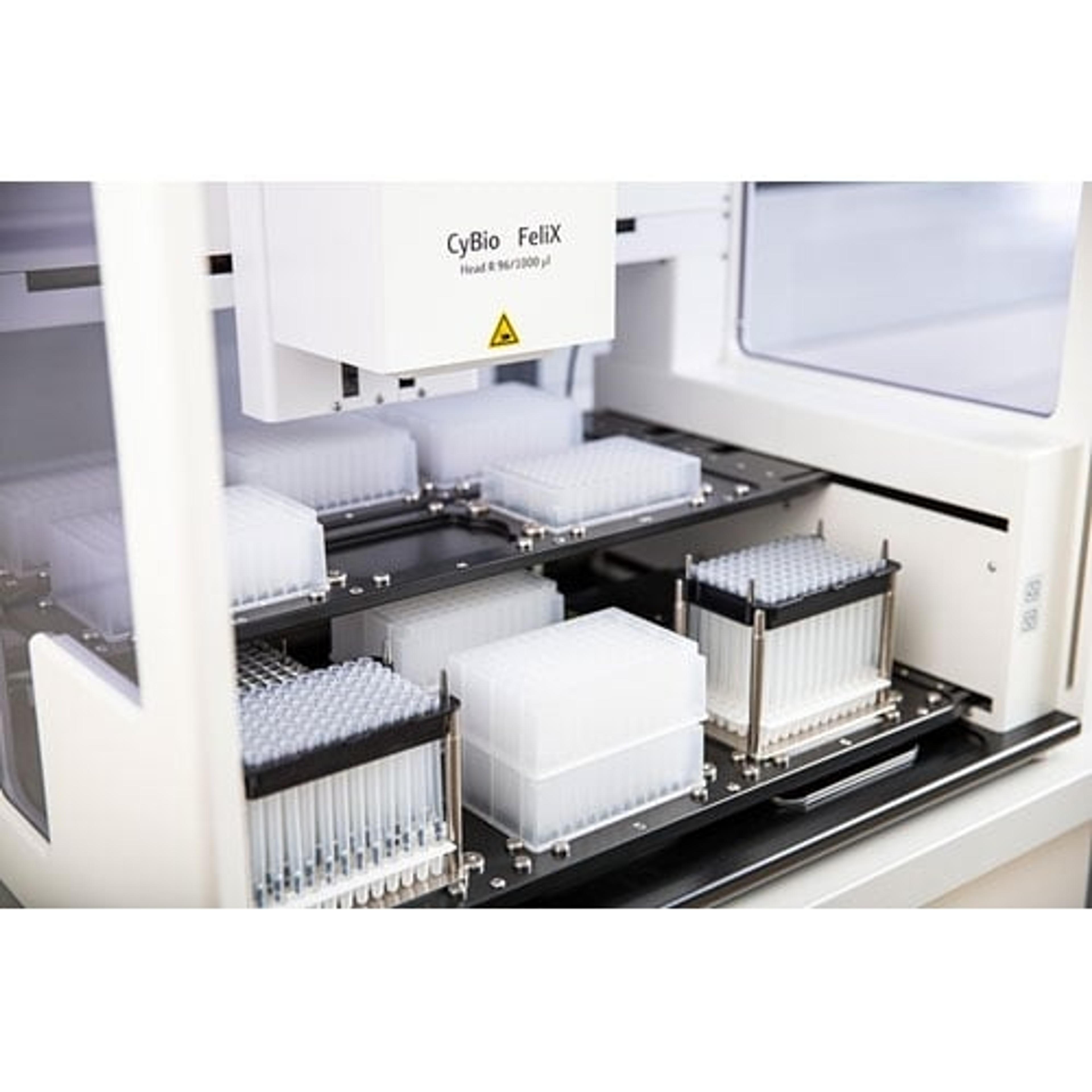
CyBio FeliX
Analytik Jena GmbH+Co. KGCyBio FeliX – Flexible Benchtop Liquid Handling Flexible pipetting platform for fully automated single to multichannel liquid handling. Discover the new accompanying CyBio FeliX SELECT Head with 8 independent channels and volumes for your hit picking, normalization and pooling applications.