
Roche and GE Healthcare launch NAVIFY Tumor Board
First collaboration product includes medical imaging capabilities to enable more personalized treatment decisions in cancer care
14 Aug 2019
Product news
Roche has announced the release of NAVIFY Tumor Board 2.0, the first collaboration product from its partnership with GE Healthcare. Incorporating medical image viewing and storage capabilities with other patient data, the product is designed to enable tumour boards - multi-disciplinary teams who determine treatment plans for cancer patients - to have a more comprehensive view of each patient in one place.
Bringing together patient medical records from various systems for review by tumour boards can be timeconsuming and cumbersome. The integration of GE Healthcare’s medical image viewer into NAVIFY Tumor Board v2.0 enables radiologists to upload their patient records to the same dashboard where patient files from other disciplines in the cancer care team are stored.
Having complete patient diagnostic information in one location helps specialists use the limited time they have during tumour boards to review all relevant files quickly and align on the best possible treatment plan for each cancer patient.
“This new version of NAVIFY Tumor Board is the first product developed in partnership with GE Healthcare and demonstrates our shared vision of accelerating personalized healthcare,” said Michael Heuer, CEO Roche Diagnostics. “Our mutual focus is on delivering clinical decision support solutions that enable healthcare professionals to make faster, more confident decisions, allowing more personalized treatment based on truly integrated diagnostics.”
“We are delighted to announce the first major milestone of our ongoing collaboration with Roche, as we work together to enable precision healthcare. Workflows around tumour boards can be inefficient, and we hope this single, holistic dashboard - including patient data and images - will enable oncology teams to align more quickly on the most optimal diagnosis and treatment plan for the benefit of each patient,” said Tom McGuinness, President and CEO, GE Healthcare Imaging.
The partnership combines Roche expertise in advanced lab testing and the GE Healthcare leadership in medical imaging and monitoring to provide an ecosystem of workflow solutions and apps on an industry-first shared integrated diagnostics platform. The companies are aiming to design products to enable seamless integration and analysis of comprehensive lab and medical imaging data, patient records, medical best practice, real time monitoring and the latest research outcomes. Clinicians will then have confidence that they are making the best possible treatment decision for each patient.
The new version of NAVIFY Tumor Board is initially available in the United States and Canada with additional markets to follow in the near future.
Do you use Roche products in your lab? Write a review today for your chance to win a $400 Amazon gift card>>
Related products
Request Quote for All Products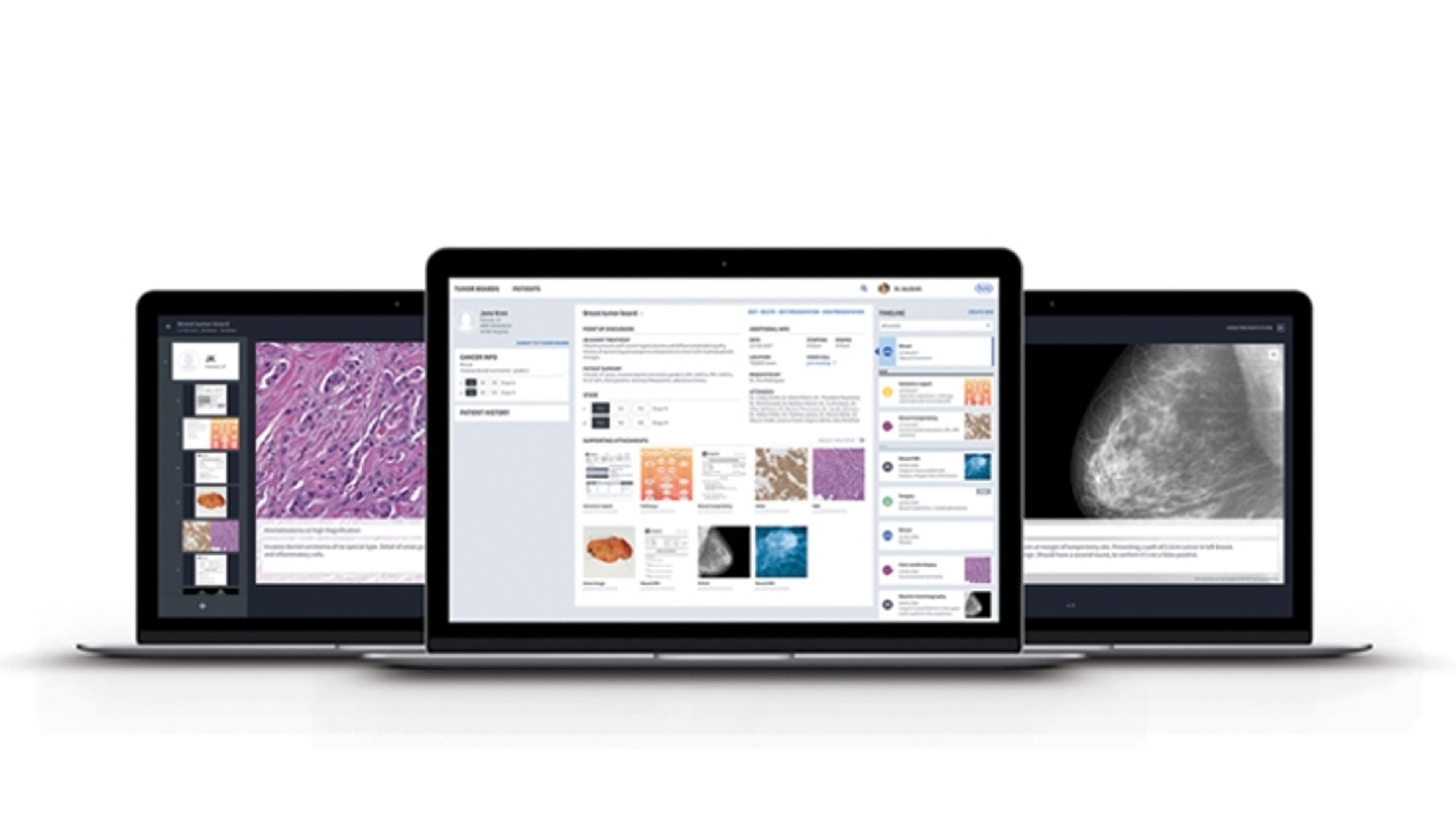
NAVIFY Tumor Board
A web-based oncology care team workflow tool that presents patient data in a dashboard and standardizes processes to foster collaboration on patient treatment decisions.