
Rigaku Publishes Method for Quantitative Analysis of Ferrosilicon by WDXRF
Rigaku Publishes Method for Quantitative Analysis of Ferrosilicon by WDXRF
15 Jan 2016Product news
A new application report from Rigaku describes the analysis of ferrosilicon by WDXRF using the fusion bead correction function, which corrects for the effects of loss or gain on ignition.
Rigaku Corporation has published an application report describing accurate ferrosilicon analysis by wavelength dispersive X-ray fluorescence (WDXRF). Application Note XRF1026 demonstrates ferrosilicon analysis using the Rigaku ZSX Primus III+ WDXRF spectrometer, which is optimized for process control of steel making and ferrosilicon production. The report covers sample preparation, method calibration and repeatability.
Iron alloys with 15% to 90% silicon content are known as "ferrosilicon." They are used to reduce metals from their oxides and to deoxidize steel and other ferrous alloys, thereby preventing loss of carbon from the molten steel. Analyses of ferrosilicon, as well as of slag and raw materials, are required in the control of the steel making process. X-ray fluorescence is the most common method for analyzing ferroalloy, slag, steel and added materials due to its rapid analysis capabilities, as well as its ability to measure both bulk metal and powders.
The metallic elements in ferrosilicon would be converted to oxides using conventional bead fusion methods, so a special fusion technique was developed for this method. Measurements were performed using the ZSX Primus III+ spectrometer with a 3 kW Rh target X-ray tube. The analyzer features tube-above optics, where the X-ray tube is located above the sample, reducing the risk of instrument contamination or damage. The ZSX Primus III+ spectrometer is ideal for iron and steel making process control, including for cast iron and alloy steels, where both bulk metal and powder samples are analyzed as part of the process control protocol.
The system software is based on Rigaku’s flow bar interface, which leads the user through a series of procedures step by step and provides various statistical process control functions ideally suited to the steel industry. The software has a fusion bead correction function that can accommodate differences in weight ratio among sample, flux and oxidation reagent, loss and gain on ignition and inter-element effects.
The results confirm that ferrosilicon with wide ranges of composition can be properly analyzed by the fusion method using the fusion bead correction function, and that very precise analysis of the elements in ferrosilicon can be rapidly performed using the ZSX Primus III+ spectrometer. It is also possible to analyze other ferroalloys, steels and powders, such as slag, with excellent precision.
To see the application report on Rigaku’s website click here.
About Rigaku
Since its inception in Japan in 1951, Rigaku has been at the forefront of analytical and industrial instrumentation technology. Rigaku and its subsidiaries form a global group focused on general-purpose analytical instrumentation and the life sciences. With hundreds of major innovations to their credit, Rigaku companies are world leaders in X-ray spectrometry, diffraction, and optics, as well as small molecule and protein crystallography and semiconductor metrology. Today, Rigaku employs over 1,100 people in the manufacturing and support of its analytical equipment, which is used in more than 70 countries around the world supporting research, development, and quality assurance activities. Throughout the world, Rigaku continuously promotes partnerships, dialog, and innovation within the global scientific and industrial communities.
Related products
Request Quote for All Products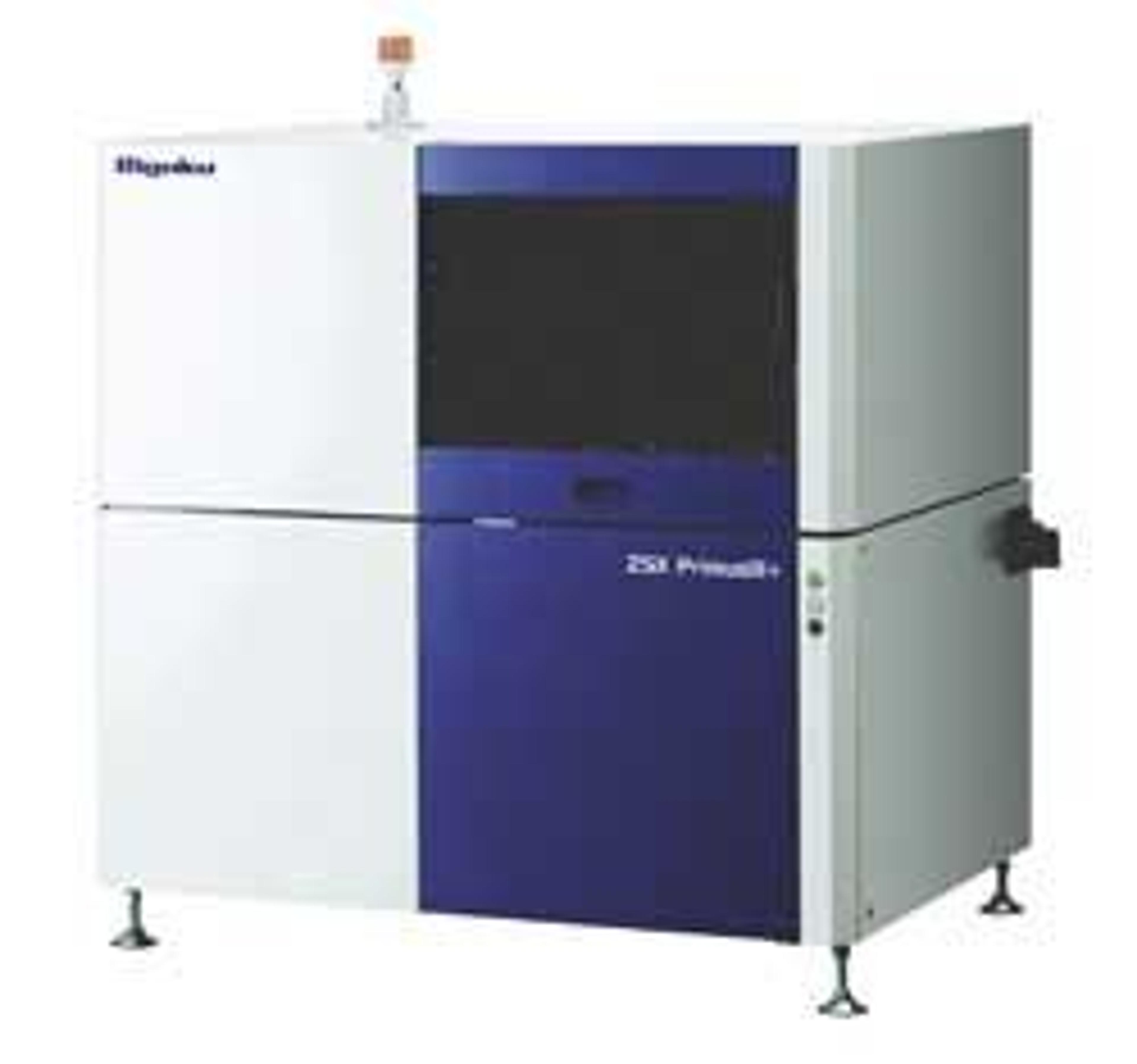
ZSX Primus III+
Rigaku CorporationRigaku ZSX Primus III+ delivers rapid quantitative determination of major and minor atomic elements, from oxygen (O) through uranium (U), in a wide variety of sample types — with minimal standards. ZSX Primus III+ features an innovative optics-above configuration. Never again worry about a contaminated beam path or down time due to sample chamber maintenance. The optics-above geometry eliminates cleaning worries and increases up time.The high precision positioning of the sample ensures that the distance between the sample surface and X-ray tube is kept constant. ZSX Primus III+ performs high-precision analysis using a unique optical configuration designed to minimize errors caused by non-flat surfaces in samples such as fused beads and pressed pellets.EZ-scan allows users to analyze unknown samples without any prior setup. This time saving feature requires only a few clicks of the mouse and a sample name to be entered. Combined with SQX fundamental parameters software, it provides the most accurate and rapid XRF results possible. SQX is capable of automatically correcting for all matrix effects, including line overlaps.ZSX Primus III+ Features: Analysis of elements from O to U Tube above optics minimizes contamination issues Small footprint uses less valuable lab space High precision sample positioning Special optics reduce errors caused by curved sample surfaces Software tools for statistical process control (SPC) Evacuation and vacuum leak rates can be optimized for throughput