
Rigaku Introduces New Compact High-Performance WDXRF Spectrometer
5 Sept 2012Product news
Rigaku announced the release of the Supermini200 wavelength dispersive X-ray fluorescence (WDXRF) spectrometer. This is an enhanced version of the Rigaku Supermini, the popular benchtop WDXRF spectrometer and the newest addition to the broadest line of laboratory XRF instruments available today.
Elemental analysis is among the most important fundamental measurements made for industrial quality control and research and development. Wavelength dispersive X-ray fluorescence is one of the most powerful and well-established nondestructive techniques for elemental analysis. It has numerous advantages, including light element sensitivity, exceptional elemental resolving power, and low limits of detection. Rigaku’s new Supermini200 combines all of the advantages of traditional WDXRF elemental analysis systems in a smaller, more economical package. Unlike other techniques, such as ICP and AA, no chemical preparation step is required, making sample preparation and cleanup much simpler.
The Supermini200 incorporates a number of advancements from the original Supermini, including newly designed and simplified software and an improved footprint. EZ Analysis is a new software feature that simplifies everyday, routine operation. A single interface contains comprehensive information about the status of samples, data measurement and analysis parameters, as well as a running output of results. The EZ Scan software module enables analysis of unknown samples with no prior setup and with only a few clicks of the mouse to get started.
With a size that is 25% that of traditional WDXRF units, the Supermini200 is offered at a price that is approximately half that of floor-standing units. Designed to offer performance and value in a compact package, it is positioned to be the perfect instrument for labs replacing older WDXRF units or as a backup WDXRF system for time sensitive industries.
Related products
Request Quote for All Products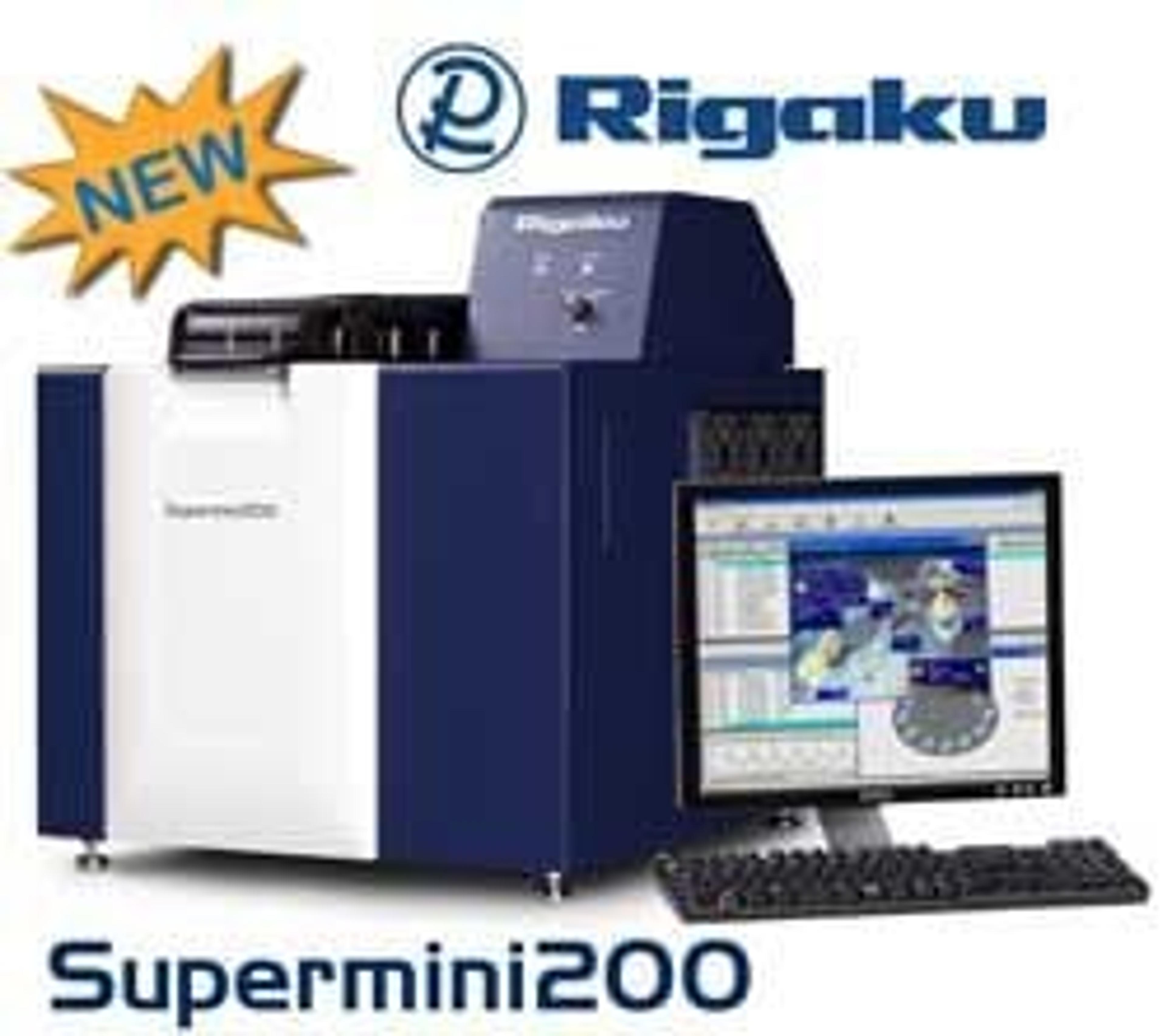
Supermini 200 Benchtop WDXRF Spectrometer
Rigaku CorporationThe new Supermini200 has improved software capabilities as well as a better footprint. As the world's only high-power benchtop sequential wavelength dispersive X-ray fluorescence (WDXRF) spectrometer for elemental analysis of oxygen (O) through uranium (U) of almost any material, the Rigaku Supermini200 uniquely delivers low cost-of-ownership (COA) with high resolution and lower limits-of-detection (LLD). Not only is the Rigaku Supermini200 an affordable choice for your XRF elemental analysis needs, the running costs are also low. P10 gas for the flow proportional detector is the only consumable. The Supermini200 does not require a source of cooling water, plumbing, or an external chiller, thereby decreasing system maintenance and lowering the overall lifetime cost of ownership of the system and yearly budgets for consumables and maintenance.Supermini is the only high powered (200 W) X-ray tube benchtop WDXRF system, providing excellent excitation resulting in lower detection limits and shorter measurement times. A unique and proprietary optical system is also employed to enhance sensitivity beyond the gains of the tube power.Supermini 200 Benchtop WDXRF Spectrometer Features: Analyze oxygen through uranium (O → U) Analyze: solids, liquids, powders, alloys and thin films Atmosphere: air, helium or vacuum X-ray tube: 50 kV, 200 W Pd-anode Primary beam filter: Zr is standard; Al optional Detectors: F-PC and scintillation Crystals: 3-position changer Autosampler: 12-position standard Vacuum: rotary pump standard Power: 100 – 120V (50/60 Hz) 15A or 200 – 240V (50/60 Hz) 10A