
Revolutionizing diagnostics with automated, integrated, and standardized clinical mass spectrometry
Guest editorial by Dr. Benjamin Lilienfeld, Lifecycle Leader Serum Work Area Systems, Senior Vice President, Roche
3 Jan 2025
The cobas® Mass Spec solution
Mass spectrometry has long been an important analytical tool in fields ranging from medicine and environmental science to food safety and forensics. With its high sensitivity and specificity, mass spectrometry has the potential to transform routine diagnostic testing in multiple areas, including therapeutic drug monitoring, drug of abuse testing, and steroid hormone-based disease diagnostics. Yet despite these benefits, it has remained largely underutilized and only offered in specialized laboratories, due to operational complexity requiring highly skilled operators. By automating mass spectrometry these barriers can be overcome, simplifying routine testing, accelerating workflows and making it universally accessible to clinical laboratories and patients.
Pushing the boundaries of clinical mass spectrometry
Roche has developed a new technology that fully automates, integrates, and standardizes mass spectrometry. Created in collaboration with Hitachi High-Tech – Roche’s partner of over 45 years – the new solution makes it possible to bring this powerful analytical technique to the routine clinical lab.
The entire workflow is automated in one system, with a broad assay menu of ready-to-use tests in development, offering standardized performance on a single platform. This would not have been possible without multiple innovations across chemistry, biotechnology, and bioinformatics, as well as software and hardware development.
The technology combines sample preparation, separation, mass spectrometry analysis and result interpretation into one streamlined workflow. To start the workflow, the serum or plasma sample is loaded via the cobas® pro sample supply unit into the system. From then onwards, the entire workflow runs completely automatically. The first step is sample preparation to purify the analytes and remove interfering substances using paramagnetic particles. This is followed by separating the analytes based on liquid chromatography to elute specific components according to the molecules' size and/or polarity. Afterwards, the molecules are ionized and sent to the mass spectrometer, where they are specifically detected and quantified by their mass-to-charge ratio. The final step is the interpretation of the mass spectrometry chromatogram, which is also automated and then translated into the test result.
This automation provides fast, accurate, and precise analysis while increasing productivity and efficiency. The cobas® system has the highest throughput in the clinical mass spectrometry market, which increases the speed at which samples can be processed and results can be delivered. By optimizing the workflow and moving away from batch processing, the waiting time associated with pooling samples can be removed. Sample handling is also fast and easy, which frees up time for lab staff, addresses staff shortages, and reduces the risk of human error. In addition, operators can have minimal contact with biohazardous materials, helping to safeguard their health and safety.
Until now, standardization has been a major issue in mass spectrometry, with labs often running instruments from multiple different vendors, manual steps leading to variations, complex calibration and quality control concepts, and different methods to interpret results. This has made it incredibly difficult to compare results between different instruments or between different labs. Roche’s technology ensures reproducible results with standardised assay protocols traceable to reference methods, ensuring reliable test results no matter when and where patients’ samples are measured.
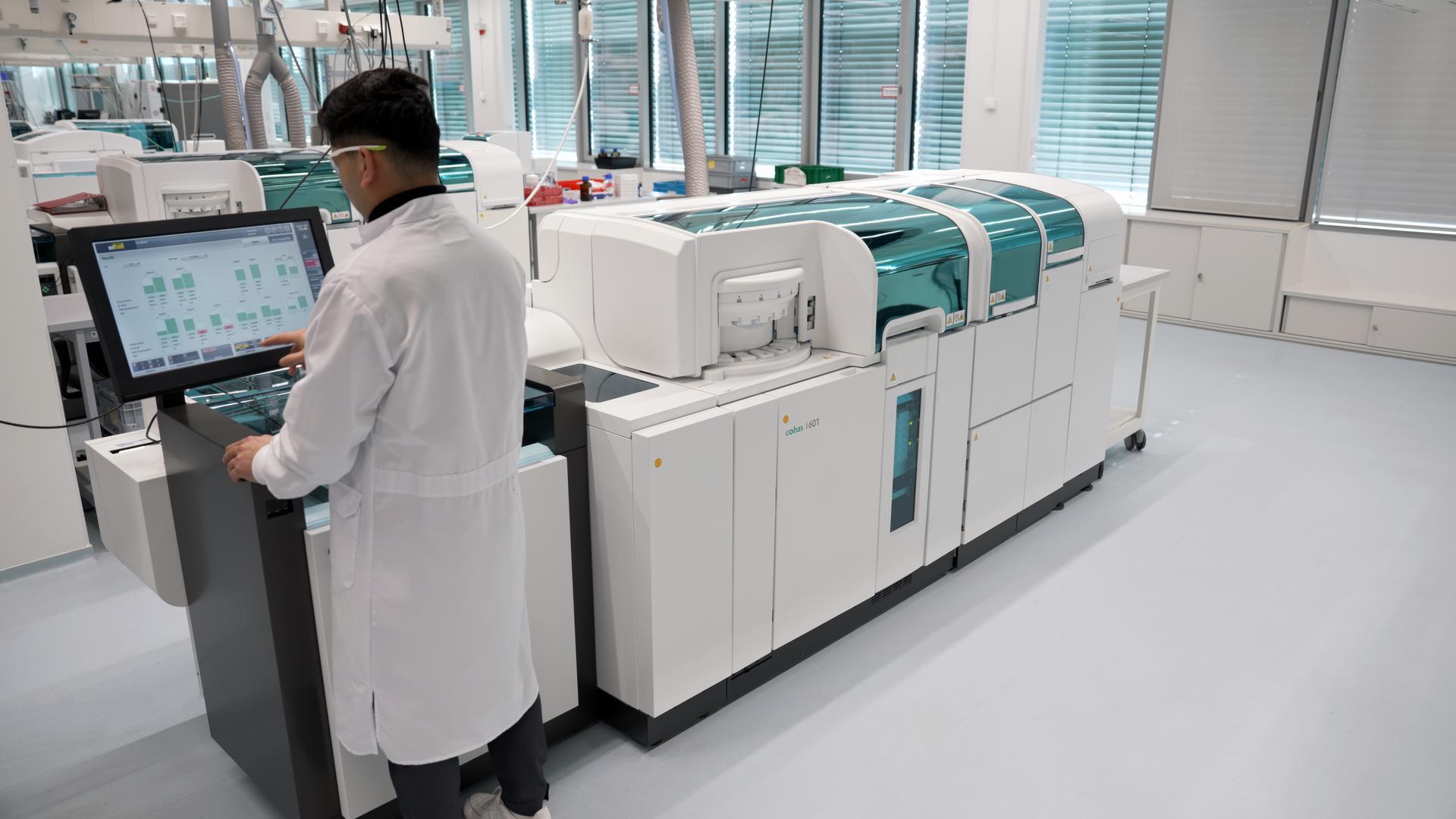
The cobas® Mass Spec solution positioned in the laboratory
For a mass spectrometry solution to be truly integrated, it needs to be able to adapt to a lab’s specific needs, and connect into the broader lab infrastructure. Roche’s technology aims to maximize performance and support labs by ultimately integrating mass spectrometry with other technologies such as clinical chemistry, immunochemistry testing and ion selective electrode (ISE) testing combined with lab automation and IT. Once available, this will enhance the lab’s diagnostic capabilities and enable real-time data for routine testing of patient samples.
The future of automated mass spectrometry in the clinic
Improving efficiency and streamlining operations means that mass spectrometry is no longer exclusively a specialist analytical tool. It can now be integrated as part of the routine lab and benefit from the same automation, making it more accessible to more labs, clinicians and patients.
As mass spectrometry becomes more widely used and generates actionable clinical insights, healthcare professionals will be able to diagnose diseases faster and more accurately, enabling faster and more personalized therapeutic interventions. The sooner patients can receive treatment, the better their prognosis and recovery typically are.
The advent of this innovative technology marks a revolution in clinical diagnostics.
Case Study: Monitoring estradiol in hormone-receptor positive breast cancer
The management of hormone receptor-positive breast cancer often involves endocrine therapies aimed at reducing estradiol levels to inhibit tumor growth. However, with therapy lasting five to ten years, one-third to one-half of women on aromatase inhibitors do not adhere to their prescribed treatments due to severe side effects, such as joint pain and hot flushes.1 Without sufficient estradiol suppression, the risk of relapse doubles.2,3
With estradiol playing a critical role in driving tumor growth, routine measurement could provide clinicians with vital insights into their patients’ response to treatment and encourage adherence by demonstrating the efficacy of the therapy. However, current laboratory methods lack the sensitivity required to detect low estradiol levels. The only method to reliably determine these low levels is mass spectrometry.
The integration of mass spectrometry into standard practice offers the chance for estradiol levels to be accurately monitored, allowing for timely adjustments in therapy. Early detection of inadequate estradiol suppression can help to prevent tumor recurrence and improve outcomes for patients with hormone-dependent breast cancer, providing a tailored response to individual physiological variations and medication interactions.
Related reading: Q&A with Dr. Benjamin Lilienfeld as he discusses Roche mass spectrometry solution launch
References:
- Murphy CC, Bartholomew LK, Carpentier MY, Bluethmann SM, Vernon SW. Adherence to adjuvant hormonal therapy among breast cancer survivors in clinical practice: a systematic review. Breast Cancer Res Treat. 2012;134(2):459–78.
- Dawn L Hershman 1, Theresa Shao, Lawrence H Kushi, Donna Buono, Wei Yann Tsai, Louis Fehrenbacher, Marilyn Kwan, Scarlett Lin Gomez, Alfred I Neugut Early discontinuation and non-adherence to adjuvant hormonal therapy are associated with increased mortality in women with breast cancer; Breast Cancer Res Treat 2011 Apr; 126(2):529-37
- Ingle JN, Cairns J, Suman VJ, Shepherd LE, Fasching PA, Hoskin TL, Singh RJ, Desta Z, Kalari KR, Ellis MJ, Goss PE, Chen BE, Volz B, Barman P, Carlson EE, Haddad T, Goetz MP, Goodnature B, Cuellar ME, Walters MA, Correia C, Kaufmann SH, Weinshilboum RM, Wang L. Anastrozole has an association between degree of estrogen suppression and outcomes in early breast cancer and is a ligand for estrogen receptor α; Clin Cancer Res. 2020 June 15; 26(12): 2986–2996.