
Researchers perform highly accurate physicochemical characterization of small nanoparticles
15 Apr 2021
Industry news
Analytik Ltd report how a multidisciplinary collaborative research effort including researchers at University College Dublin, University of Salford and Royal College of Surgeons have used a DC24000 ultra high-resolution particle size analyzer for accurate physicochemical characterization of small-sized nanoparticles, particularly for the analysis of the particles in the presence of complex biological fluids.
Nanoparticles of 5 nm diameter or smaller are gaining attention in the field of nanomedicine in contrast to larger particles, these nanomaterials offer improved tissue penetration, a reduced accumulation in the liver, and more efficient renal clearance which renders them particularly attractive for reducing the non-specific accumulation and off-target effects.
Despite these exciting potential applications, current limited use of small nanoparticles has been associated with challenges surrounding their physicochemical characterization. In particular when characterizing smaller nanoparticles after bioconjugation, commonly used techniques such are Dynamic Light Scattering (DLS) and Nanoparticle Tracking Analysis (NTA) struggle to analyze such challenging materials due to their detection limit and other issues. In addition, other techniques, such as Fluorescence Correlation Spectroscopy (FCS) or Agarose Gel Electrophoresis (AGE) require particular particle properties such as fluorescence and therefore are not broadly applicable to all nanoparticle types.
Employing proprietary Differential Centrifugal Sedimentation (DCS) technology the DC24000 analyzer is an extremely powerful tool for high-resolution particle characterization, especially in the size range 0.002 micron (2nm) to 10 microns. With the unique ability to resolve very close multi-modal particle distributions, and to distinguish extremely small shifts and changes in particle size, DCS is gaining popularity as a valuable particle sizing technique for nanomedicine applications.
In a recently published paper entitled 'In-depth characterization of the biomolecular coronas of polymer-coated inorganic nanoparticles with differential centrifugal sedimentation' the researchers at the University of Salford show how Differential Centrifugal Sedimentation can be utilized as a high-precision tool for the reliable characterization of functional nanoparticles of different materials. They report upon developing a method to correlate the sedimentation shift with polymer and biomolecule adsorption on the nanoparticle surface, validating their developed core–shell model.
Want the latest science news straight to your inbox? Become a SelectScience member for free today>>
Related products
Request Quote for All Products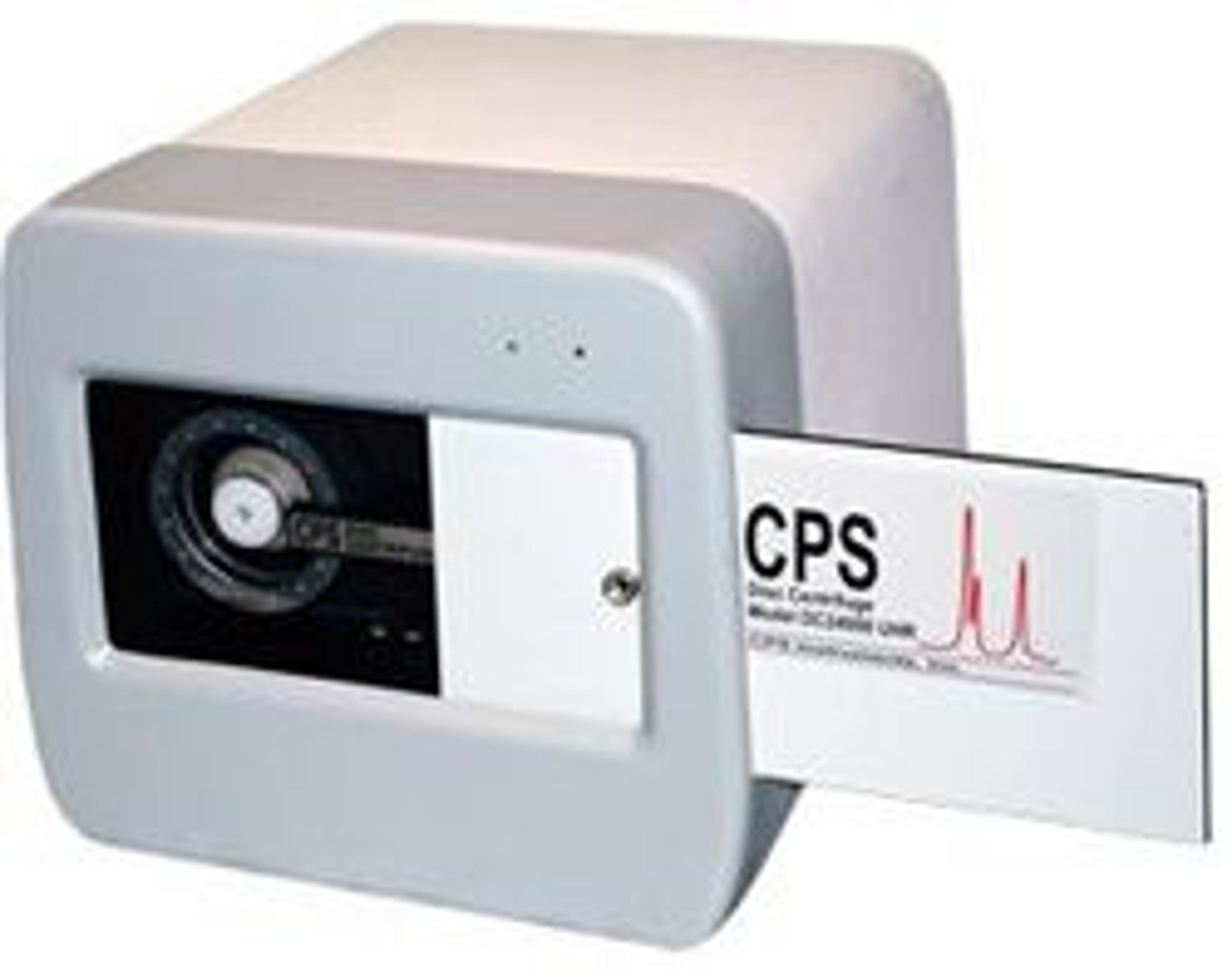
CPS Disc Centrifuge UHR Nanoparticle Size Analyser
Analytik LtdCPS DC24000 UHR nanoparticle size analyser is an effective analytical tool for ultra high resolution, high accuracy measurement of particle size distribution. Highly poly-dispersed particles can be measured in the size range of ~2.0nm to ~75 microns, at 2 to 10 times better resolution than any other particle sizing instrument, regardless of measurement technique.Utilising Differential Centrifugal Sedimentation (DCS), the CPS Disc Centrifuge UHR offers the unique ability to resolve very close multimodal particle distributions and to distinguish extremely small shifts in particle size. Rather than using a predictive algorithm, the instrument physically separates the nanoparticles and then measures them as they pass a light source detector - providing full characterisation in real time.CPS Disc Centrifuge UHR Nanoparticle Size Analyser Features: Ultra high resolution with clean separation of narrow peaks that differ in size by as little as 2% Able to detect and measure very small and subtle changes / differences in particle size Able to measure / monitor nanoparticle coating thickness Very high sensitivity; minimum detection limit below 10-8 gram active sample for narrow peaks Highly reproducible results Dynamic range capability >1000 for measurement of broad and multimodal distributions Measurement of particles of virtually any density Wide range of data presentation options, including multiple distribution overlays