Recovery of Serum Directly from Serum Separator Tubes (SST) for Viral Testing and Archiving

13 Nov 2013
Sonia Nicholas
Managing Editor and Clinical Lead

Product news

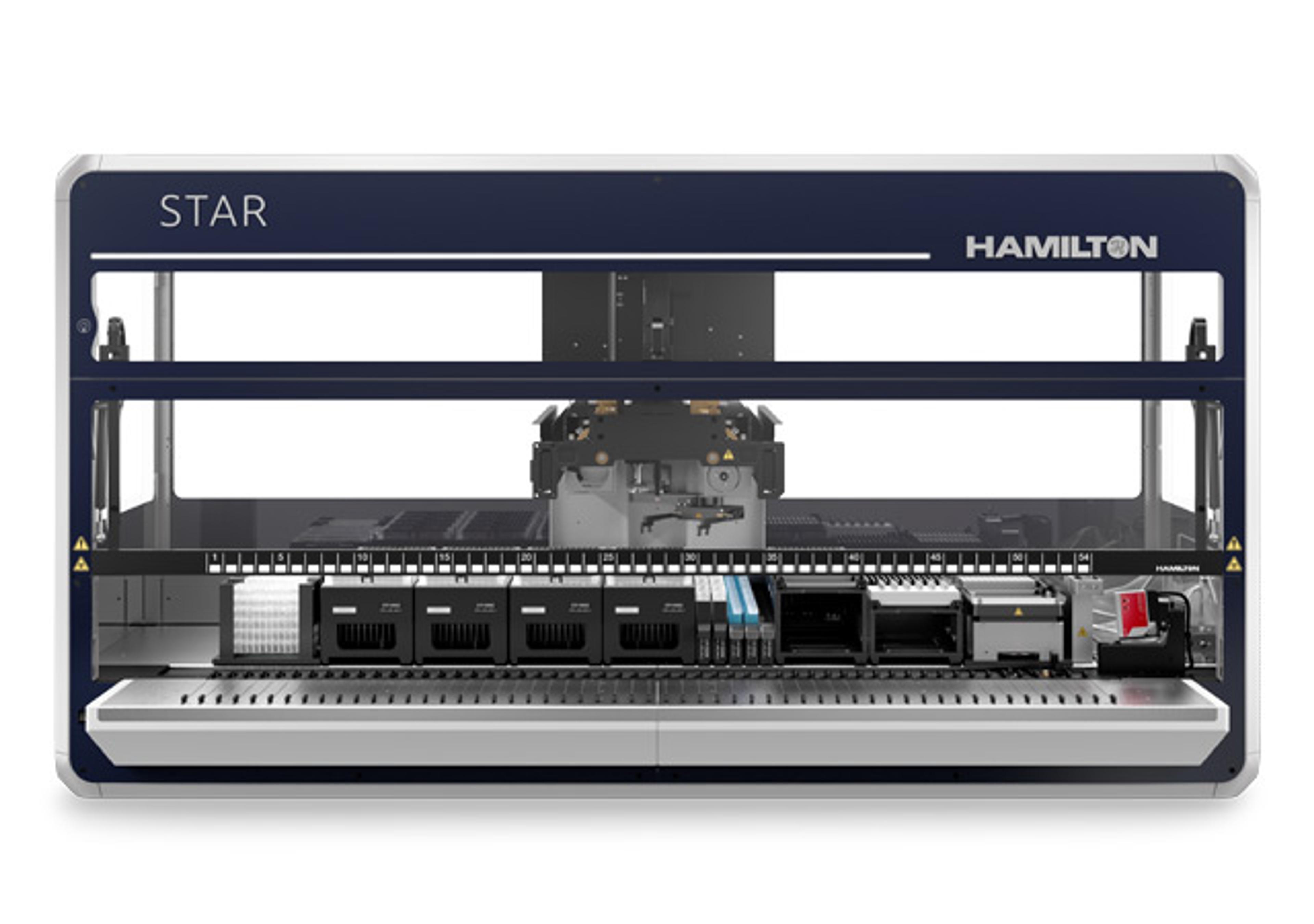
Hamilton have developed a protocol to recover gel free serum directly from serum separator tubes for testing or archiving that uses the Monitored Air Displacement (MAD) feature of the STAR to detect the presence of the gel or blood/buffy coat layer that separates the serum from the red blood cells. This is required for archiving of plasma from tubes with variable volumes of plasma and is often a huge workflow bottleneck in clinical diagnostic laboratories.

The system takes multiple aliquots from the source tube until the gel plug is detected. When the gel plug is detected during the aspiration of an aliquot, the sample is put back into the tube and the sample not used again. The "purity" of the plasma sample and maximum amount retrieved is defined by the size of the aliquot taken on each aspirate step and is user definable. There is balance between size and number of aliquots transferred for each sample and time for the overall process. The system has been used with 300ul tips and 1000ul tips depending on customer requirements. This has been a key implementation in several clinical diagnostic laboratories where this manual step was laborious and prone to human error. This is achieved with full sample bar code traceability.

STARLine configurations can vary from 4 channel STARLet to multi channel (8+) STAR/STARPlus systems. This protocol is performed on a standard Hamilton STARLine instrument without special hardware of software modifications and the front end GUI can be tailored to specific user environments / requirements.

Testing in customer labs has revealed that the same principals could be applied to the aliquoting of EDTA plasma samples where the white blood cell layer that separated the plasma from the red blood cells would start to block the tip and trigger the pressure sensor which would result in the sample being put back into the source tube. The ability to aliquot EDTA samples has also been built into the protocol. You can download the application note here, and click on the ‘request information’ tab below for more details.

Microlab STAR

Hamilton

Experience Automation Your Way. The Microlab STAR Line automates liquid handling tasks from simple to complex with exceptional precision and flexibility so that you can increase throughput, reduce errors, and gain confidence in results.

(75)

Links

Tags

Pipettes and DispensersPipettes and dispensers are essential lab equipment used to dispense measured volumes of liquid accurately. Explore a range of manual and electronic pipettes, including single and multichannel, serological and volumetric pipettes, as well as a range of pipette tips. Bottle-top dispensers are also available for simple and fast solvent dispensing. Find the best pipettes & dispensers in our peer-reviewed product directory: compare products, check customer reviews and receive pricing direct from manufacturers.Blood TransfusionBlood Transfusion involves giving donor blood to a recipient patient. Screening is essential to avoid transfusion reactions. Blood banks use immunohematological techniques to determine rh and ABO blood group, and screen for antibodies using specific antisera. Blood Banks use Direct Coombs Tests (DCT) and Indirect Coombs Tests (IAT) to detect hemolysis and Haemolytic Disease of the Newborn (HDN).HematologyIn Haematology / Hematology, complete blood cell counts (or full blood counts) are obtained using automated blood count analyzers to enumerate blood cell types.  Hematology also encompasses haemostasis and coagulation, thrombophilia and hemophilia, plasma viscosity and ESR analysis, hemoglobinopathies, cell morphology and haematinic measurement.ImmunologyImmunological techniques measure and characterize immune responses. Immunology kits and analysis systems often use techniques such as ELISA, radioimmunoassay (RIA) and immunodiffusion assays, Immunohistochemistry, and flow cytometry. Immunologists use equipment such as flow Cytometers, plate readers, plate washers and fluorescent microscopes.Robotic InstrumentsRobotic instruments can be used for high-throughput automation of many lab processes. Such processes use instruments for assays like cell based assays and ELISA, for sample preparation like shakers, centrifuges and incubators, and for analysis such as sequencing and western blot analyzers. Useful features of robotic instruments include speed, reproducibility, barcode readers, software and automation.Robotic WorkstationsRobotic workstations are automated platforms enabling the user to perform high-throughput, multi-application processes, from sample preparation tasks such as PCR set-up, DNA purification and NGS library preparation, to integrated sample prep and analysis workstations. Automation makes processes consistent, fast, precise and fully walk-away. Find the best robotic workstations in our peer-reviewed product directory: compare products, check customer reviews and receive pricing direct from manufacturers.Clinical ChemistryBiochemistry (or clinical chemistry) involves the analysis of bodily fluids using chemical tests. Techniques used include HPLC, chromatography, spectroscopy, mass spectrometry, immunochemical, electrophoresis, turbidometric / spectrophotometric assay, MRI and ISE analysis. Tests are often carried out on plasma or serum but urine (urinalysis) and fecal specimens are also processed.Clinical MicrobiologyMicrobiology is the study of microorganisms including protists, prokaryotes, fungi, and, often, viruses. Microorganisms are a useful research tool as genetic vectors and, in immunology, for antibiotic susceptibility testing, cellular biology and genetics. Microorganisms commonly grow readily in incubators with microbial culture media; this can contain chromogenic supplements to differentiate between cell lines. Estimate your culture’s density of microorganisms with colony counters, or screen and select colonies for desirable clones with automated colony pickers. Additionally, equipment is available to monitor environments for the presence of microbes and identify with microbial identification instruments. Find the best microbiology products in our peer-reviewed product directory: compare products, check customer reviews and receive pricing direct from manufacturers.Clinical AutomationClinical laboratory automation refers to the use of automated systems in clinical laboratories to increase efficiency, reduce human error, and improve patient care. From sample analysis to total laboratory automation, this plays a critical role in modern diagnostics and laboratory workflows. Explore clinical automation solutions in our peer-reviewed product directory; compare products, check reviews, and get pricing directly from manufacturers.