Quick and Accurate Assessment of CNS Neuroinflammation

2 May 2017

Lois Manton-O'Byrne, PhD
Executive Editor

Product news

Neuroinflammation is a common feature of many diseases of the central nervous system (CNS), including neurodegenerative disorders. A combination of responses from neurons, microglia, astrocytes and peripheral immune cells along with cytokines, chemokines and the complement system constitute the basis for neuroinflammation.

BioLegend offers multiple solutions to assess inflammation in the CNS:

  • Assess immune cell activation
  • Quantitate the levels of inflammatory mediators
  • Evaluate cell death
  • Detect synaptic loss and neuronal degeneration

Immunohistochemistry (IHC) staining using a range of specific cellular markers is a technique which allows important insights into neurological tissue samples. Read on for examples of applications of this technique in neuroinflammation research and the types of cellular markers which could be used for each application.

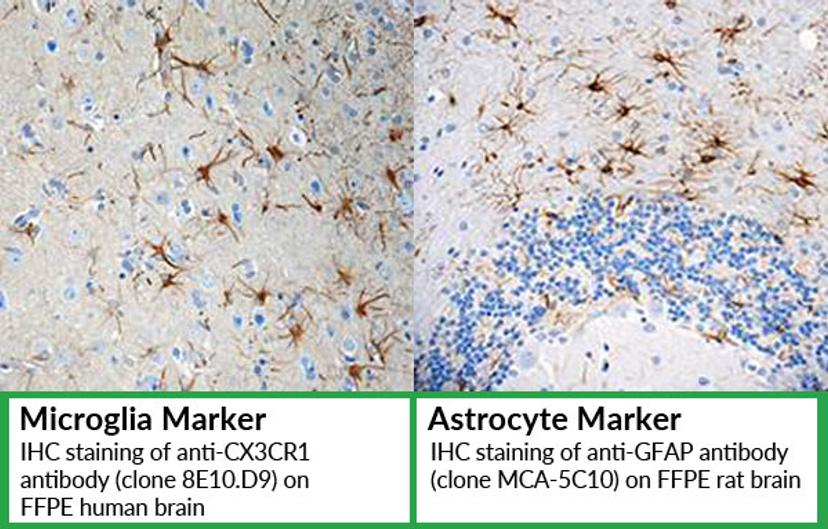
Analysis of cellular phenotype and location

Immunohistochemistry staining with specific cellular markers can be used to detect microglia and astrocytes. These markers allow analysis of cellular phenotype and assessment of cellular location.
 

Detection of neuronal loss

Detect neuronal loss using IHC and antibodies that are commonly used as specific neuronal cell markers;
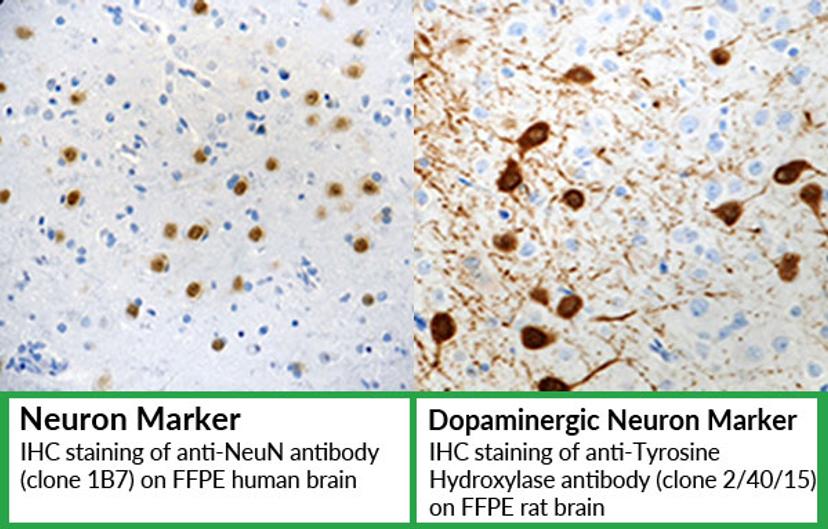
 

Assessment neuronal and synaptic integrity

Antibodies that are suitable for visualization of synapses, axons and dendrites to be used to assess neuronal and synaptic integrity in tissue sections and cell culture models.


Find out more about neuroscience research reagents from BioLegend.

Links

Tags

AntibodiesAntibodies are used in techniques such as confocal and fluorescence microscopy, flow cytometry, ELISA, ELISPOT, immunohistochemistry, western blotting and immunopreciptation. Select specific antigen reactivity, high specific affinity, low non-specific binding, monoclonal or polyclonal, primary or secondary antibodies and associated conjugates such as an enzyme or dye for visualization.Light MicroscopyLight microscopes or optical microscopes are used to visualize microscale objects under magnification, including cells, clinical specimens and materials. Lab equipment for light microscopy includes confocal microscopes, fluorescence microscopes, zoom and stereo microscopes. Microscope slides and imaging reagents are available for visualizing samples, as well as various microscope stages and incubators for large or temperature-sensitive samples. Find the best light microscopes in our peer-reviewed product directory: compare products, check customer reviews and receive pricing direct from manufacturers.NeuroscienceNeuroscience research investigates the neurological mechanisms underlying behavior, neurodegenerative diseases, and other brain conditions. Learn about the innovative technologies for bioimaging, electrophysiology, cell culture, chromatography and other techniques used in this field.Monoclonal AntibodiesMonoclonal antibodies (mAbs) are lab-made molecules that can bind to specific antigens on cells, making them highly effective in treating cancers, autoimmune diseases, and infections. These targeted therapies are transforming the treatment landscape for many conditions. Browse our peer-reviewed product directory to find monoclonal antibodies for research and clinical applications; compare products, check reviews, and get pricing directly from manufacturers.ImmunohistochemistryImmunohistochemistry (IHC) is a technique used to detect specific proteins in tissue samples by using antibodies that bind to target antigens. IHC is widely applied in pathology, immunology, hematology and cancer diagnostics. Explore IHC tools in our peer-reviewed product directory; compare products, check reviews, and get pricing directly from manufacturers.NeurobiologyNeurobiology studies the biology of the nervous system, including the structure and function of neurons, glial cells, and their interactions. It is a key field in understanding neurological disorders such as Alzheimer�s, Parkinson�s, and schizophrenia. Research in neurobiology is essential for developing therapies for these conditions. Browse our peer-reviewed product directory to find the best neurobiology research tools, compare products, check reviews, and get pricing directly from manufacturers.NeurodegenerationNeurodegeneration refers to the progressive deterioration of the structure and function of the nervous system, often seen in diseases like Alzheimer's and Parkinson's. Research focuses on early detection and potential therapies. Explore neurodegeneration research tools in our peer-reviewed product directory; compare products, check reviews, and get pricing directly from manufacturers.
Quick and Accurate Assessment of CNS Neuroinflammation