Proteona Releases New CAR T Product for Combined Single-Cell Proteomic and Transcriptomic Analysis

Based on ESCAPE™ RNA sequencing technology, the latest proteogenomics assay is designed to characterize both RNA and protein expression levels across thousands of single CAR T cells

23 Jun 2019

Cameron Smith-Craig
Cameron Smith-Craig
Pharma and Applied Sciences Editor

Product news

Proteona Pte. Ltd. has announced the launch of its latest ESCAPE™ proteogenomics assay designed specifically for Chimeric Antigen Receptor (CAR) T cell characterization. This is the first commercial product designed to characterize both RNA and protein expression levels across thousands of single CAR T cells.

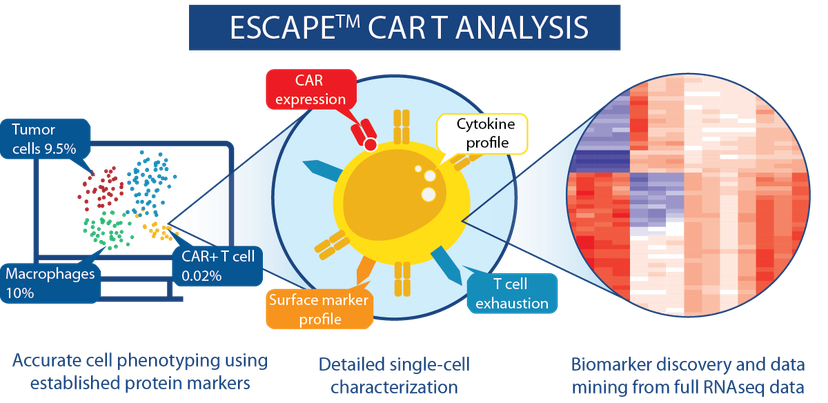
Through the use of simultaneous gene and protein expression analysis, the ESCAPE™ CAR T assay is able to identify CAR positive cells, measure changes in cytokine expression, extensively phenotype cells through measuring the expression of 25 key cell surface proteins and discover new gene expression patterns important for your research. Together with Proteona’s state-of-the-art data analysis support, the ESCAPE™ CAR T assay provides rich information that can be used at all stages of the CAR T workflow, from initial cell collection to post infusion patient monitoring.
“We are excited about releasing our latest product targeted specifically for researchers, CAR T cell manufacturers, and clinicians to evaluate the link between cell characteristics and clinical outcomes. CAR T and cell therapy in general are the most complex therapeutics in use today, and it is absolutely imperative to study the therapy at the level of the single cell. No other technology can perform such detailed profiling of individual cells. Moreover, by working with Proteona, we help you make sense of the vast amount of data collected,” says Dr. Andreas Schmidt, CEO of Proteona.

“As early adopters of the ESCAPE™ CAR T assay, we find it extremely valuable to be able to obtain in depth understanding of CAR T samples on a single cell level,” says Dr. Patrick Schmidt, Principle Investigator at the National Center for Tumor Diseases (NCT) Heidelberg, part of the German Cancer Research Center (DKFZ), who is an expert in CAR T product engineering and manufacturing. “Using only a small amount of blood or bone marrow sample, we get not only an overview of the CAR T cell persistence, but also a snapshot of individual CAR T cell’s activation status and characteristics. This is the most comprehensive tool available both for quality control and for monitoring patient response in clinical studies.”

The Proteona CAR T assay is based on the Enhanced Single Cell Analysis with Protein Expression (ESCAPETM) RNA sequencing technology, which uses DNA-barcoded antibodies to capture proteomic and gene expression data simultaneously at the single cell level. CAR T cells are a promising therapy against aggressive blood cancers and solid tumors. They are manufactured from T cells, immune cells that are able to recognize specific markers on pathogens or abnormal cells and destroy them. To manufacture CAR T, human T cells are harvested and then modified to target specific cancer antigens, so that they are able to find and kill cancer cells once infused back to the patient. CAR T manufacturing is a complex process, and there is a large range of variations in patient response in terms of toxicity and efficacy. It is still not clear what the mechanisms are that determine the safety and functionality of CAR T cell treatment. The new CAR T ESCAPE™ assay now provides the most comprehensive tool to shed light on the complex CAR T mechanisms, opening a new path for the development of safer cell therapies.

The Enhanced Single Cell Analysis with Protein Expression, ESCAPE™ platform, the first commercial service for measuring both gene and protein expression at the single cell level, is a customizable platform with current pre-set panels available for measuring multiple cell types.

Do you use Proteona's products in your Lab? Write a review today for your chance to win a $400 Amazon gift card>>

RNA Isolation for Sequencing

Bio S&T

Bio S&T's high-quality RNA can be used directly for NxGen RNA sequencing as well as other downstream applications that require optimal-quality RNA such as quantitative real-time RT-PCR, microRNA cloning and amplification and Northern blotting.

(0)

Links

Tags

Cell / Tissue CultureCell culture or tissue culture is used to study the biology of cells or tissues and to isolate cellular products in an environment which can be manipulated and well defined. Accurately control your culture environment with bioreactors or culture incubators, bind your cells to a surface or together with an extracellular matrix. Distinguish cell types with differential media or proliferate cells with certain characteristics using selective media. Enrich your media with supplements such as growth factors, sera and vitamins. Find the best cell and tissue culture products, kits and equipment in our peer-reviewed product directory: compare products, check customer reviews and receive pricing direct from manufacturers.HematologyIn Haematology / Hematology, complete blood cell counts (or full blood counts) are obtained using automated blood count analyzers to enumerate blood cell types.  Hematology also encompasses haemostasis and coagulation, thrombophilia and hemophilia, plasma viscosity and ESR analysis, hemoglobinopathies, cell morphology and haematinic measurement.Cell-Based AssaysCell-based assays are used to monitor the presence, quantity and activities of a desired cellular analyte including drug molecules or biomarkers. This can reveal information on cell health (apoptosis, cytotoxicity, viability and proliferation assays), cell metabolism, cell migration and cell signaling mechanisms. Find the best cell-based assay products, kits and equipment with our peer reviewed product directory: compare products, check customer reviews and receiving pricing direct from manufacturers.DNA SequencingDNA sequencing, such as sanger sequencing, is a biological technique that determines the precise order of nucleotide bases in a fragment or template of DNA. DNA sequencers and genetic analyzers are based on capillary electrophoresis, where labeled DNA fragments are electrophoretically separated by size as they migrate through a polymer. Find the best DNA sequencing products, including DNA sequencing kits, genomic libraries and genetic identity kits in our peer-reviewed product directory: compare products, check customer reviews and receive pricing direct from manufacturers.Protein PurificationProtein purification is a vital step in drug discovery, therapeutics, biotech and life science research. The purification process typically involves subcellular or membrane protein extraction with cell lysis kits, separation of proteins from cell debris by filtration or spin columns, and the isolation of proteins of interest from other proteins and impurities with affinity purification (including fusion protein tags and antibody binding proteins A, G and L), immunoprecipitation or chromatographic methods, such as ion exchange, size exclusion and immobilized metal affinity chromatography. All purification methods come in multiple formats for your laboratory needs, including agarose or magnetic beads, resins, columns and filter plates. Find the best protein purification equipment in our peer-reviewed product directory: compare products, check customer reviews and receive pricing direct from manufacturers.Gene Expression and Molecular CloningMolecular cloning is a set of techniques that utilizes vectors to transfer recombinant DNA into host cells and is an essential tool for investigating the expression of genes and proteins in bacterial or mammalian cells. A variety of vectors optimized for gene cloning and expression in a range of host organisms are available, alongside competent cells for genetic replication. Here, you can explore a range of molecular tools, high-quality genomic and cDNA libraries, premade clones, transformation and transfection reagents and mutagenesis or gene expression detection assays and expression arrays. Find the best gene expression and molecular cloning products in our peer-reviewed product directory: compare products, check customer reviews and receive pricing direct from manufacturers.BiomarkersBiomarkers are biological markers which can be measured and evaluated to indicate a biological state. The use of biomarkers in research and diagnosis can indicate a normal or disease state or drug response of cells / tissues. Biomarkers include genetic markers, cell surface markers such as antigens, antibodies or receptors and secreted molecules such as cytokines. An assay system is required for identification of biomarkers. :Protein QuantificationThe detection and quantification of proteins in a sample is vital across life sciences, pharmaceutical research and clinical diagnostics, and a variety of equipment is available to scientists to simplify the workflow. Proteins of interest can be easily labeled and detected on light-based detection instruments. Immunoassay kits allow you to identify a specific protein of interest and protein detection beads or antibody microarrays allow you to identify multiple specific proteins at once. Protein interactions and enzyme activity can also be monitored with protein-protein interaction assays. Additionally, the biophysical characterization of proteins is made easy with biokinetic analyzers. Find the best protein detection and quantification products in our peer-reviewed product directory: compare products, check customer reviews and receive pricing direct from manufacturers.DNA / RNA QuantificationDetection and quantification of nucleic acids is important in molecular biology, cloning, expression, forensics and clinical diagnostics. Nucleic acids can be detected by labeling with colorimetric, fluorescent or radio labels and using in situ hybridization kits to identify specific sequences. Multiple nucleic acids can be detected and quantified at once using RNA / DNA detection beads or RNA / DNA microarrays. Find the best DNA / RNA Quantification products in our peer-reviewed product directory: compare products, check customer reviews and receive pricing direct from manufacturers.Protein ExpressionProtein expression is the utilization of cell machinery for the synthesis of proteins and has become a critical tool in biotherapeutic, genomic, and proteomic research. Produce recombinant proteins with expression vectors in combination with a host cell suitable for high-level protein expression. For production of toxic proteins, consider cell-free expression vectors. Create and monitor post-translational modifications with protein modification kits. Find the best protein expression products in our peer-reviewed product directory: compare products, check customer reviews and receive pricing direct from manufacturers.AntibodiesAntibodies are used in techniques such as confocal and fluorescence microscopy, flow cytometry, ELISA, ELISPOT, immunohistochemistry, western blotting and immunopreciptation. Select specific antigen reactivity, high specific affinity, low non-specific binding, monoclonal or polyclonal, primary or secondary antibodies and associated conjugates such as an enzyme or dye for visualization.ProteomicsProteomics is the systemic bioinformatics study of proteins and amino acids, including their structure, size, function and identification. Tools used in proteomics include chromatography, blotting and gels, protein arrays, mass spectrometry and ELISA and associated analysis software. Analyzers and proteomic systems should be sensitive, high resolution, fast and may be automated for high-throughput.TranscriptomicsRNA-SeqRNA sequencing (RNA-seq) is a next-generation sequencing technique used to analyze the transcriptome, providing insights into gene expression and regulation. This method is essential for genomics, disease research, and personalized medicine. Explore RNA-seq tools in our peer-reviewed product directory; compare products, check reviews, and get pricing directly from manufacturers.