
Promega Launches GenePrint 10 System Designed for Human Cell Line Authentication and Sample Identification
3 Apr 2013
Product news
Promega announces the launch of GenePrint®10 System for human cell line authentication and sample identification. GenePrint 10 includes the eight loci recommended by the ANSI Standard (ASN-0002) Authentication of Human Cell Lines: Standardization of STR Profiling, 1 plus Amelogenin for gender identification and the highly polymorphic D21S11 locus for additional power of discrimination. Short Tandem Repeat (STR) analysis begins with amplification, and the GenePrint 10 System contains all materials necessary to co-amplify human STR loci, using a hot-start thermostable DNA polymerase and a robust buffer compatible with fast cycling and direct amplification from substrates.
Tissue culture cells, important tools in many laboratories, are often misidentified or contaminated with other cells, wasting substantial time, effort and laboratory resources and potentially invalidating published data. To remedy this issue, the National Institute of Health and many journals now recommend or require cell line authentication before grant approval or acceptance for publication, making cell line authentication a very important concern for researchers.
Cell line authentication using the GenePrint 10 System allows researchers to spend less time worrying about the authenticity of their cells and more time advancing their research.
Related products
Request Quote for All Products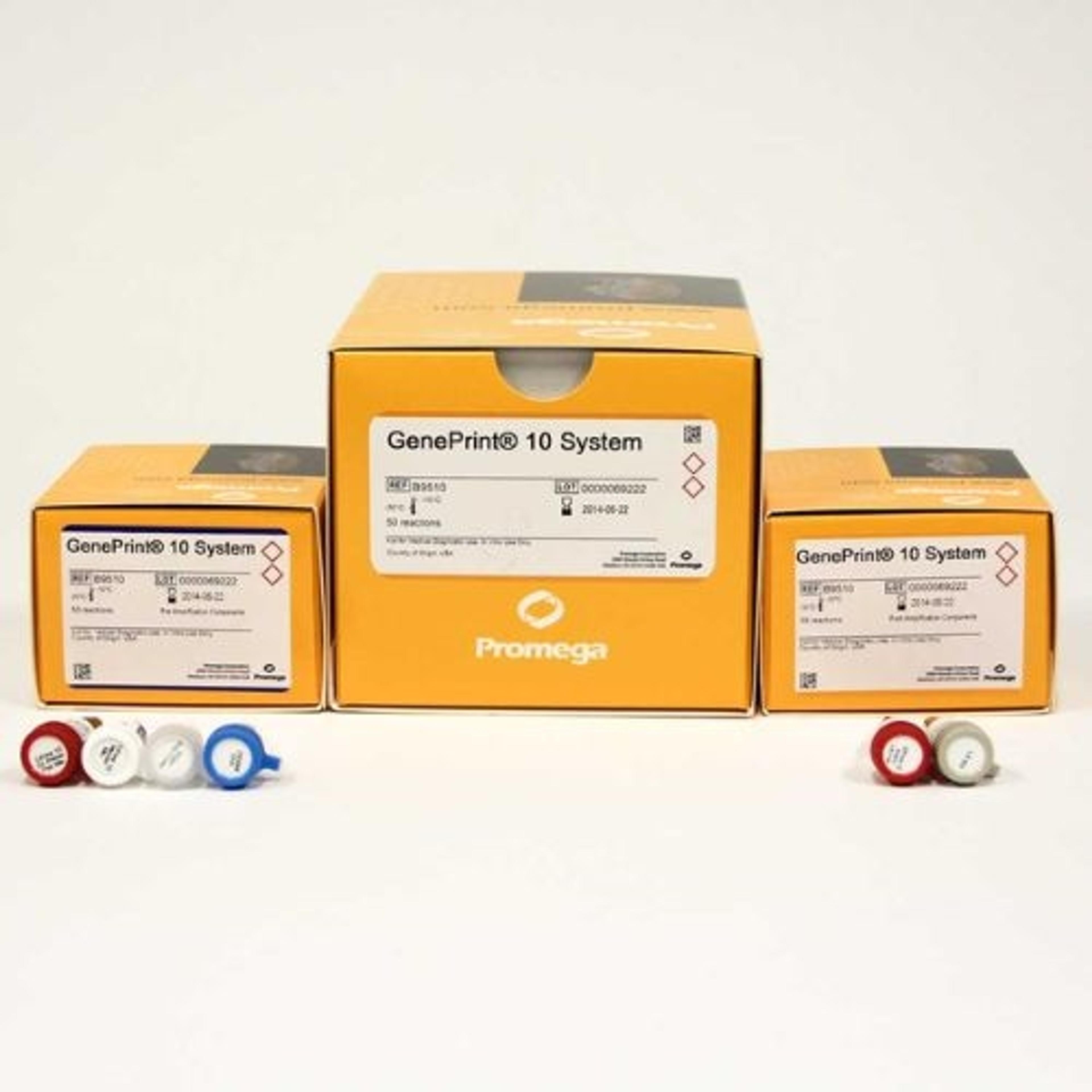
GenePrint® 10 System
Promega Corp.The GenePrint® 10 System is a complete system with all reagents required for successful identification and authentication of human cell lines and detection of cell line contaminants. The GenePrint® 10 System allows co-amplification and three-color detection of nine human loci, including the ASN-0002 loci (TH01, TPOX, vWA, Amelogenin, CSF1PO, D16S539, D7S820, D13S317, and D5S818) as well as D21S11. These loci collectively provide a genetic profile with a random match probability of 1 in 2.92 x 10^9. The GenePrint® 10 System contains all materials necessary to amplify human STR loci, Following amplification, STR alleles are detected by capillary electrophoresis (CE), and protocols are provided for a wide range of CE instruments including the ABI PRISM® 3100 and 3100-Avant Genetic Analyzers and Applied Biosystems® 3130, 3130xl, 3500 and 3500xL Genetic Analyzers. An internal lane standard and allelic ladder also are provided to determine the size of each amplified product and positively identify alleles during subsequent data analysis using GeneMapper®, GeneMapper® ID, GeneMapper® ID-X software or GeneMarker® HID. The resulting STR profile is compared to the cell line’s reference standard to confirm cell line identity. GenePrint® 10 System Features: Co-amplification and detection of nine STR loci, including the loci recommended by the American Tissue Culture Collection (ATCC) Standards Development Organization Workgroup (ASN-0002) plus Amelogenin Direct amplification of DNA samples from storage card punches Amplification of up to 10ng of DNA template Automatic assignment of genotypes