
Phenomenex Expands Range of HPLC/UHPLC Columns
22 Mar 2017Industry news
Phenomenex Inc., a leader in the research and manufacture of advanced technologies for the separation sciences, introduces a new 5 µm particle size to its family of Kinetex F5 pentafluorophenyl propyl (PFP) core-shell columns, extending the versatility of F5 to preparative LC and purification work.
Kinetex F5 is a robust PFP core-shell phase that overcomes reproducibility and performance limitations of other PFP and F5 products on the market and significantly reduces method development time with its dynamic and responsive chemical functionality. With five retention mechanisms and five separation modes, Kinetex F5 is an effective orthogonal alternative to the widely used C18 and C8 phases. Kinetex F5 is an ideal solution for HPLC/UHPLC development work with its combination of polar and non-polar interactions, including hydrogen bonding, electrostatic, hydrophobic, aromatic and steric/planar mechanisms. The versatility of this phase gives scientists the ability to use reversed phase, 2D-LC, HILIC, SFC or even 100 percent aqueous separation modes.
Now available in three particle sizes – 1.7, 2.6, and the new 5 µm – Kinetex F5 is fully scalable from UHPLC to HPLC to preparative chromatography, making method transfer seamless between different lab or site instrumentation. The new F5 5 µm media is also available in high-performance Axia™-packed preparative columns from 21.1 mm to 50 mm ID.
Kinetex F5 delivers all the advantages of Phenomenex’ Core-Shell Technology including better resolution, higher efficiency, easy method transferability and cost savings from reduced solvent consumption. The new 5µm particle delivers performance that is comparable to or better than 3 µm conventional fully porous media, at lower backpressures. Users who upgrade existing 5 µm methods to Kinetex 5µm F5 can achieve greater performance at the same backpressure.
“Our F5 media is an excellent orthogonal tool for many applications,” explains Simon Lomas, strategic marketing manager for Phenomenex. “The ability to scale and easily transfer methods from UHPLC to HPLC to preparative LC enables users to apply the versatility of this media across the board.”
Related products
Request Quote for All Products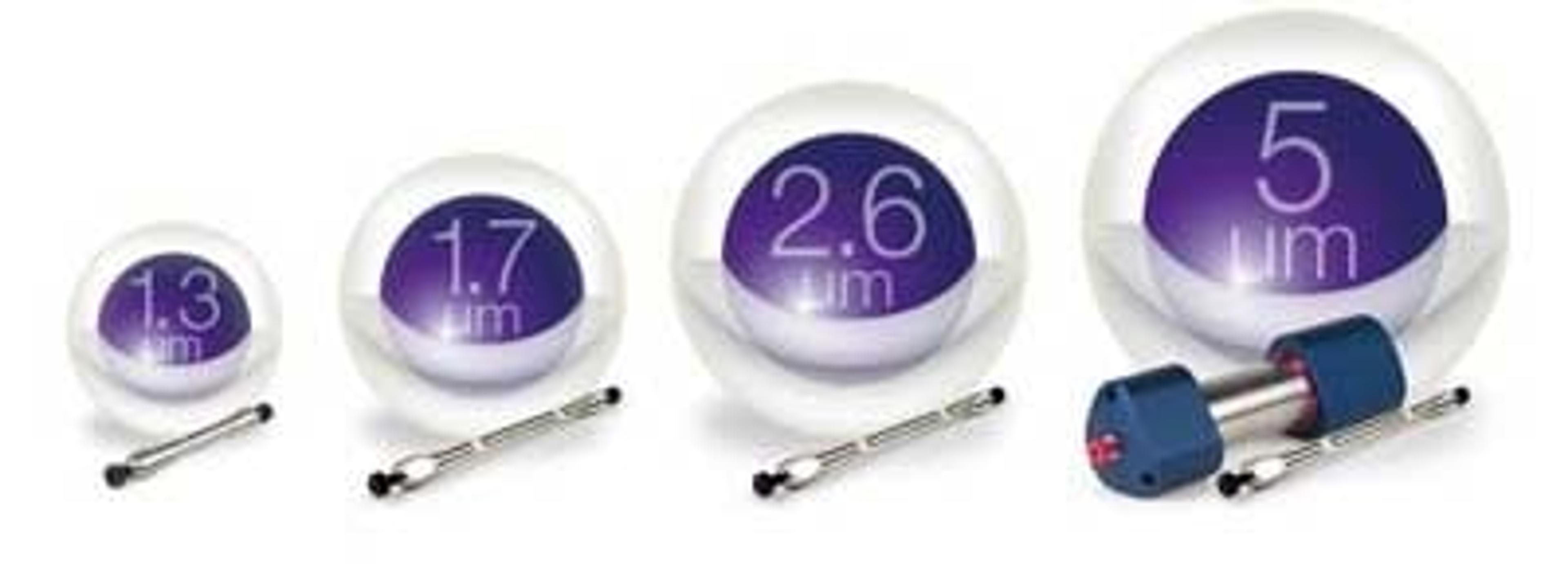
Kinetex F5
Phenomenex IncHighly reproducible pentafluorophenyl phase exception for halogenated, conjugated, isomeric, or highly polar compounds.