
Peer Review Research Demonstrates Benefits of Chromatrap Solid State ChIP Technology
Studies demonstrate pioneering research possible using ChIP technology
30 May 2016
Product news
Chromatrap reports on 3 further customer papers published in different prestigious peer reviewed journals, which cite how its proprietary solid state Chromatin Immunoprecipitation (ChIP) technology has enabled ground breaking research.
A recent study published in Drug Metabolism & Deposition (1) looks at “The role of Chromatin structural changes in regulating human CYP3A ontogeny. Variability in drug metabolizing enzyme developmental trajectories contributes to inter-individual differences in susceptibility to chemical toxicity and adverse drug reactions, particularly in the first years of life. Factors linked to these inter-individual differences are largely unknown, but molecular mechanisms regulating ontogeny are likely involved. To evaluate chromatin structure dynamics as a likely contributing mechanism, age-dependent changes in modified and variant histone occupancy were evaluated within known CYP3A4 and 3A7 regulatory domains.
Results of research published in the Journal of Immunology (2) review how 'Moderate alcohol induces stress proteins HSF1 and hsp70 and inhibits pro-inflammatory cytokines resulting in endotoxin tolerance'. Researchers discuss how binge or moderate alcohol exposure impairs host defense and increases susceptibility to infection due to compromised innate immune responses. However there is a lack of consensus on the molecular mechanism by which alcohol mediates this immunosuppression. In this research paper by the Department of Medicine, University of Massachusetts Medical School it is shown that cellular stress proteins HSF1 and hsp70 play a mechanistic role in alcohol-mediated inhibition of the TLR4/MyD88 pathway.
A third paper, published in Biochim Biophys Acta (3), discusses the results of research by the Center for Molecular Medicine at Xiangya Hospital in China who were studying 'FOXM1 and androgen receptor co-regulate CDC6 gene transcription and DNA replication in prostate cancer cells' The focus of this research looked at CDC6 which is a key component of the DNA replication initiation machinery, and how its transcription is regulated by E2F or androgen receptor (AR) alone or in combination in prostate cancer (PCa) cells. Through both over-expression and knockdown approaches, the researchers found that in addition to its effects on the E2F pathway, the cell proliferation specific transcription factor FOXM1 stimulated CDC6 transcription in cooperation with AR.
Launched worldwide in 2012 - Chromatrap® solid-state ChIP technology has been shown by a growing number of research groups worldwide to be more efficient than conventional bead-based methods. This is because the solid phase porous polymer, functionalized with either protein A or G, provides a greater surface area for chromatin antibody binding with very low non-specific binding. In addition, it uses a spin column approach, offering significant speed, process and carry-over advantages over sepharose or magnetic beads. DNA pull down with Chromatrap® is up to 25 times more than conventional methods, whilst the signal to noise ratio for DNA enrichment is 2 to 3 times better, even with low chromatin samples between 50ng to 3000ng per immunoprecipitation.
References:
1. Drug Metabolism & Disposition, Feb 26th 2016; Nicholas L Giebel et al, Departments of Pediatrics and Pharmacology & Toxicology, Medical College of Wisconsin, and Children’s Research Institute, Children’s Hospital and Health Systems, Milwaukee WI USA
2. Journal of Immunology, August 2015; 193(4): 1975–1987; Sujatha Muralidharan et a.l Department of Medicine, University of Massachusetts Medical School, Worcester, MA 01605, USA
3. Biochim Biophys Acta 2014;1839(4). 297-305; Liu et al. Center for Molecular Medicine, Xiangya Hospital, Central South University, 87 Xiangya Road, Changsha, Hunan Province 410008, People's Republic of China.
Related products
Request Quote for All Products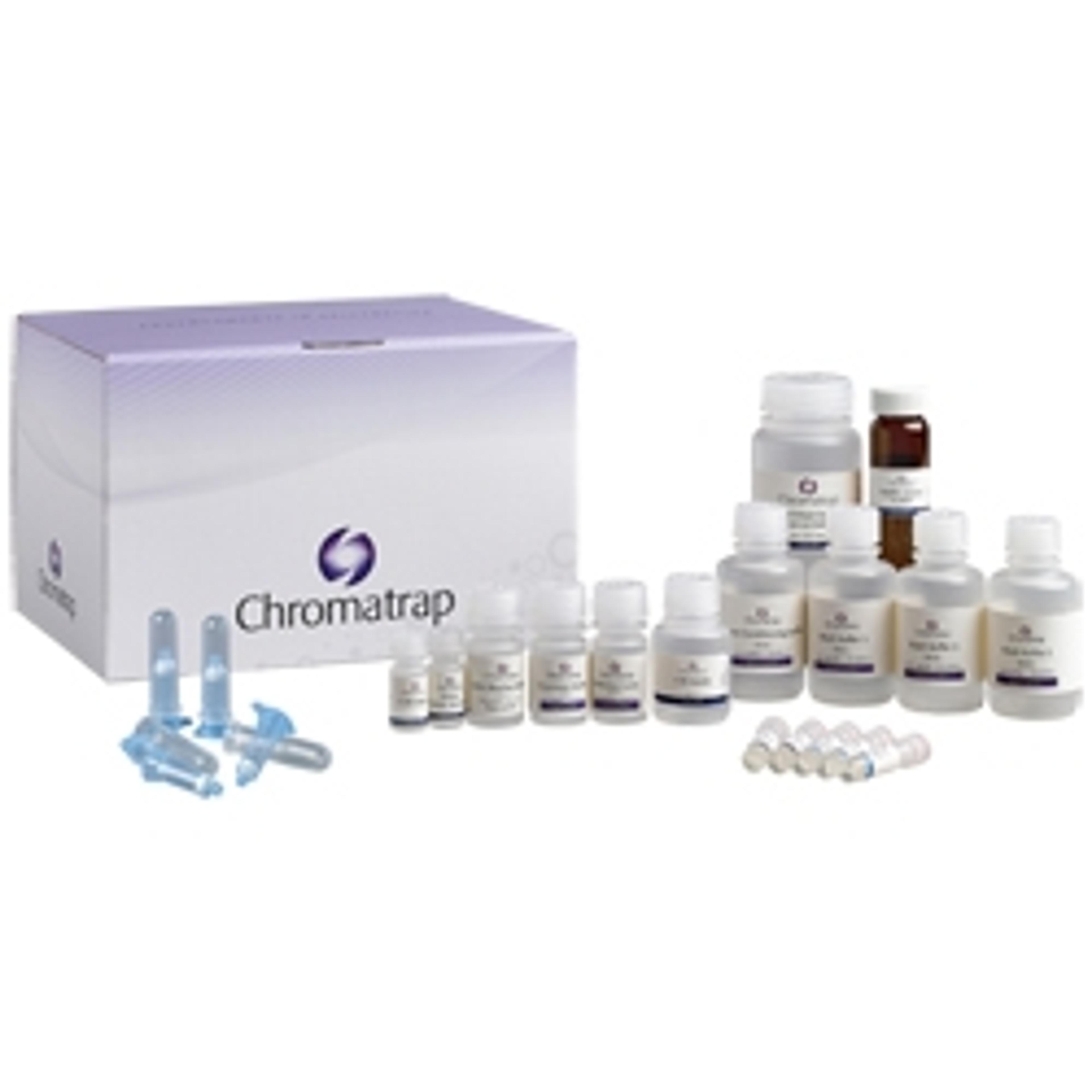
Chromatrap® FFPE ChIP Kit
ChromatrapEpigenetic identification and targeting in clinical FFPE tissues is a crucial step for potential epigenetic therapeutics and personalized medicine therapies. FFPE is a standard method to archive and preserve medical tissue biopsy samples. These archives, kept in many hospitals world-wide, are a huge, rich and untapped sample resource for genetic research. Due to the cross-linking of proteins by formaldehyde, FFPE tissues present a particular challenge for ChIP analysis. In addition, the small size and delicate nature of the tissue, and the difficulty in extracting samples from paraffin, used to provide tissue support after preservation, can damage complex cellular complexes such as chromatin. ChIP assays from these samples have therefore proved time consuming and difficult. Chromatrap® FFPE ChIP kit overcomes these issues and provides the following benefits: Provides greater flexibility and more IPs per sample Works across a range of FFPE samples, human and animal Available in 96-well plate or spin column format Works equally well with high and low abundant marks Provides sufficient DNA to perform library preps for ChIP-seq assays