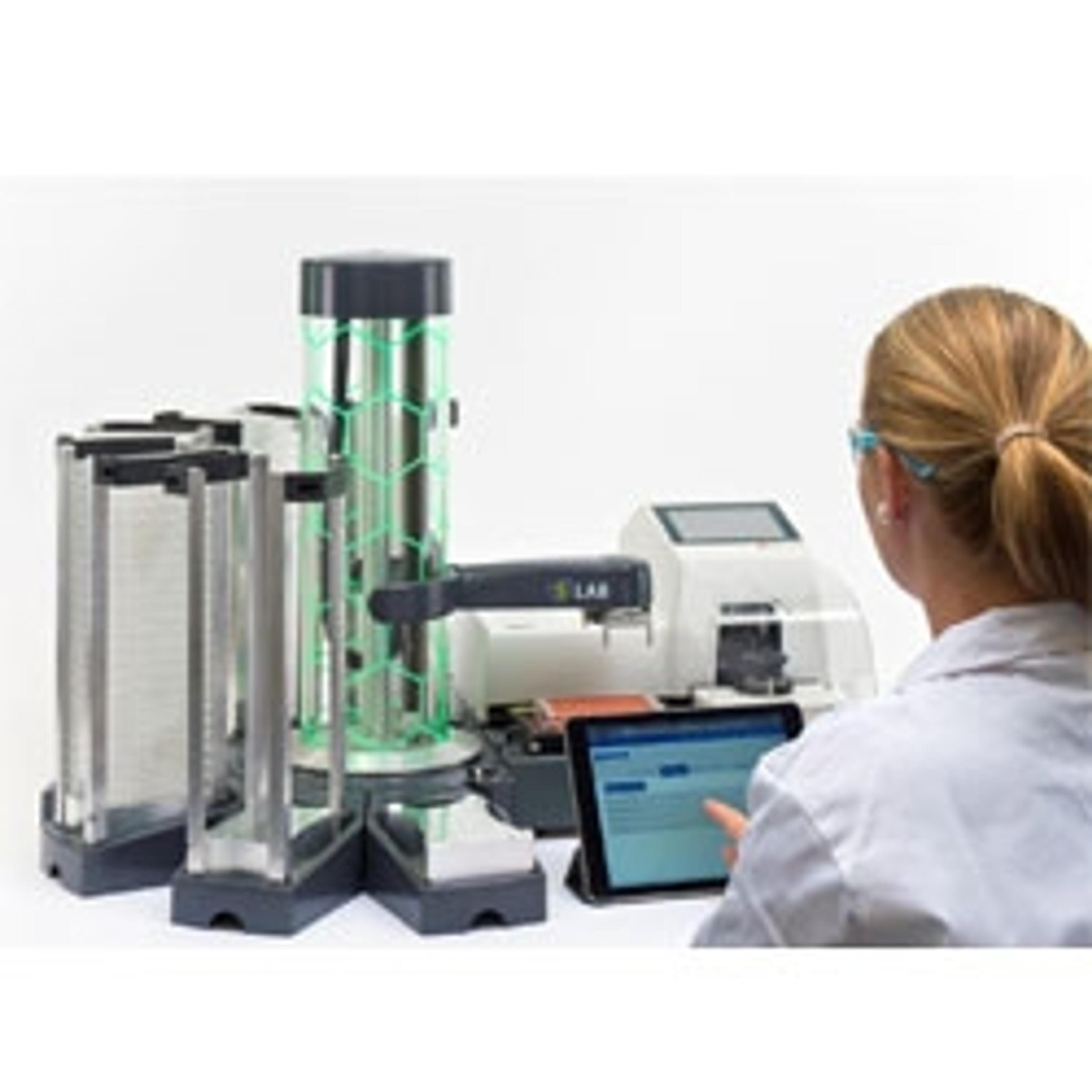
PAA plate handler enables automation of a wider range of applications

PAA releases a series of new application notes to demonstrate the versatility and flexibility of its benchtop S-LAB™ automated plate handler

14 Oct 2019

Cameron Smith-Craig
Cameron Smith-Craig
Pharma and Applied Sciences Editor

Product news

Peak Analysis & Automation (PAA), a global leader in laboratory automation, has released a series of new application notes demonstrating the versatility and flexibility of its benchtop S-LAB™ automated plate handler.

The S-LAB is PAA’s entry-level automation solution, designed to easily enable multiple applications for faster scientific breakthroughs. Compatible with hundreds of laboratory instruments, the latest application notes highlight specific instrument pairings for walk-away automation of flow cytometry, high-throughput flow cytometry, cell imaging/counting and qPCR.

Flow cytometry is a vital technique used in cellular analysis and biomolecule detection. Analytical instruments such as the Intellicyt iQue screeners or the Miltenyi MACSQuant systems are widely used for this purpose, however handing samples to these instruments can still produce a bottleneck. Similar sample handling bottlenecks occur with generating large-scale data from qPCR analyses on systems such as the Roche LightCycler® 480 and Applied Biosystems™ QuantStudio™ 7, as too with multiparameter cell imaging/counting with systems such as the Nexcelom Celigo Image Cytometer. The new series of app notes describe how the S-LAB automated plate handler seamlessly integrates with these and many other laboratory instruments, allowing scientists to carry out a wider range of sample analyses unattended and fully automated, reducing bottlenecks and increasing throughput. To read the application notes please visit the S-LAB™ product page.

PAA’s S-LAB™ automated plate handler features super-easy usability and a highly affordable price-point, redefining automation by providing the same reliability as an expensive robotic arm. Small enough to fit most lab benches and safety cabinets, this innovative system effectively handles lidded plates with barcode reading and optical plate sensing delivering reliable walk-away operation. Harmony Batch Manager™ and Overlord™ software provide more consistent control over processes, higher reliability and greater data connectivity.

Links

Tags

MicroplatesMicroplates are multi-well plates used to increase the throughput of biological investigations. The number of wells microplates contain can range from 6 to 3243 wells, with the 96-well format being the most commonly used. Microplates can come tailored for a range of applications including cell culture, PCR, filtration, storage, non-binding surface, protein crystallization, as well as pre-coated, deep well and normal Standard microplates. Additionally, options for microplate colors include clear , black, white or black with clear bottom and white with clear bottom for absorbance microplate reader applications. Find the best microplates for your lab in our peer-reviewed product directory: compare products, check customer reviews and receive pricing direct from manufacturers.Microplate Readers / DetectorsMicroplate readers are used to automate the detection and analysis of labeled or label-free components in microplates during assays or live-cell monitoring. Microplate readers are generally distinguished by their mode of detection. Types include absorbance, luminescence, fluorescence intensity, fluorescence polarization, TRF / FRET and multimode microplate readers. Microplate readers deliver a high throughput of samples by reading multiple wells simultaneously, with the 96-well format the most commonly used. As a result, microplate readers are often used in the drug discovery, bioassays, research and pharmaceutical industries for screening applications. Microplate loading can also be automated, with robotic microplate stackers to increase throughput. Find the best microplate readers in our peer-reviewed product directory: compare products, check customer reviews and receive pricing direct from manufacturers.Flow Cytometry / Cell CountingFlow cytometers are used to count, sort and examine multiple characteristics of cells. Other cell analysis equipment includes image cytometers, cell counters, fluorescence-activated cell sorters (FACS), magnetic-activated cell sorters (MACS), and a range of flow cytometry assay kits. Flow cytometers can reveal information on cell viability, cell proliferation, apoptosis and cell cycle progression, as well as identify cell populations and intracellular or cell-surface molecules. Additionally, some flow cytometers, known as FACS, have an additional sorting function after analysis. Cell counters and image cytometers count live and dead cell populations and can also conduct cell proliferation assays. Find the best flow cytometers, cell counters and cell sorters in our peer-reviewed product directory: compare products, check customer reviews and receive pricing direct from manufacturers.Plate ProcessingAutomated plate processing is used in microplate technologies for high-throughput, speed and efficiency. Plate processing systems include microplate handlers for moving plates, heat sealers, stackers and carousels for storage, retrieval and delivery, microplate washers and piercers. Useful features of plate processors include walk-away automation, compatibility and easy integration with microplate systems.qPCRQuantitative PCR (qPCR) is a molecular biology technique used to amplify and measure the amount of a specific DNA or RNA target. It plays a crucial role in gene expression analysis, pathogen detection, and quantifying DNA or RNA in various applications. Real-time PCR provides precise, quantitative results and is widely used in research, diagnostics, and clinical studies. Browse our peer-reviewed product directory to find the best qPCR solutions; compare products, check reviews, and get pricing directly from manufacturers.AutomationAutomation in laboratories and manufacturing processes enhances efficiency, precision, and scalability by reducing the need for manual intervention. It plays a critical role in improving productivity, minimizing human error, and accelerating workflows in fields like diagnostics, drug development, and industrial testing. Automation technologies include robotic systems, automated liquid handlers, and process control systems that streamline complex tasks and ensure consistent, reproducible results. Explore our peer-reviewed product directory to discover the best automation solutions, compare options, read user reviews, and get prices directly from manufacturers.Cell ImagingCell imaging can be achieved using a number of techniques including confocal microscopy, transmission electron microscopy, atomic force microscopy, and light sheet microscopy.High ThroughputHigh throughput experiments allow the simultaneous processing of several samples. This parallelization reduces the cost per experiment and increases reproducibility and output volume of data.Flow Cytometry
PAA plate handler enables automation of a wider range of applications