
Optimized clinical diagnostics: Making the leap from immunoassays to LC-MS
Dr. Emma Walker reveals how transitioning from immunoassays to LC-MS/MS has helped deliver better diagnostic services in her lab
12 Jul 2020
Editorial article

Immunoassay-based techniques have historically been the technology of choice for detection and quantification of biomolecules. Despite their common usage, however, they are susceptible to interferences and cross-reactivity, especially for biological compounds that exhibit similar chemical structures. Today, the availability of alternative technologies means an increasing number of clinical labs have begun to consider their adoption to alleviate the pitfalls of immunoassay methods. One such solution is LC-MS/MS, which offer advantages such as increased specificity, sensitivity, and accuracy, as well as the detection of multiple analytes within a single assay.
In this exclusive SelectScience interview, we talk with Dr. Emma Walker, Consultant Clinical Scientist at Imperial College Healthcare, who outlines her experiences in the journey from immunoassays to mass spectrometry adoption. Emma also reveals how the Xevo TQ-XS IVD system, alongside the support from the Waters team, has enabled them to develop new methodologies.
SS: Tell us about your job role and place of work
EW: I am a consultant clinical scientist in clinical biochemistry, and I work at Imperial College Healthcare in London. Imperial College Healthcare is an NHS Trust in Northwest London composed of five hospitals. We have a catchment area with a population of two million, and we have about one million patient episodes through the doors of our hospitals per annum.
I am based in Northwest London pathology, which is a pathology service for northwest London hosted by Imperial. I head up the diagnostic endocrine service in Northwest London pathology—it’s a long-established, supra-regional assay service. We provide testing not only to the local hospitals and GPs in our area, but we receive samples from all over England for the specialist tests that we offer. When the supra-regional assay service began, it was largely based on radioimmunoassay technology. There was a lot of expertise within the service at that time in those techniques and a lot of in-house methods were used.
Imperial College Trust
Imperial College Healthcare is an NHS trust with a mission to drive health and healthcare innovation, delivering outstanding care, education, and research with local, national and worldwide impact. It runs five London hospitals: Charing Cross Hospital, Queen Charlotte’s & Chelsea Hospital, Hammersmith Hospital, St Mary’s Hospital and Western Eye Hospital.
SS: What technologies are you currently using?
EW: We acquired our initial mass spectrometry instruments from Waters in 2008 when we purchased two Acquity TQDs, and we launched a vitamin D assay service on those platforms. We wanted to move more of our assays off the immunoassay technology and onto LC-MS, so we decided that we needed to purchase a more sensitive system. The latest piece of equipment that we have acquired from Waters is the Xevo TQ-XS instrument. The increased sensitivity that this instrument offers has allowed us to launch new methods where we need to achieve even greater sensitivity and measure hormones at even lower levels than we have previously. This has allowed us to launch assays for DHT and estradiol.
SS: Could you tell us more about your longstanding connection with the Waters portfolio of LC-MS/MS IVD medical devices and how that has been beneficial for your service?
EW: Waters has been with us throughout our LC-MS journey here in our laboratory. Their guidance and support have been invaluable in helping us to establish our service, and in helping us to develop it over time.
SS: What is your vision for the service in the future?
EW: Having launched the DHT service, this will mean that we have finally moved all our assays in the laboratory away from radioimmunoassay technology and into the LC-MS lab. With the suite of instruments that we have available to us in the laboratory, it will now enable us to consolidate our testing. Going forward, we are looking at implementing several multiplexed panels.
Additional resources:
• Application Note: ACQUITY UPLC I-Class with Xevo TQ-XS IVD System: Analytical performance for estrogens
• Application Note: Waters Clinical LC-MS/MS Systems: Analytical Capabilities
• Application Note: Implementing accurate-mass mass spectrometry for biotherapeutic development
• Article: Streamlined Clinical Mass Spectrometry Workflow at Imperial College Healthcare
• Article: ‘How Mass Spectrometry Transformed Our Clinical Pathology Lab into a Global Leader’
• Video: Waters LC-MS Clinical Laboratory Data Workflow Tour
Find out more about Waters family of LC-MS/MS in vitro diagnostic medical devices>>
Related products
Request Quote for All Products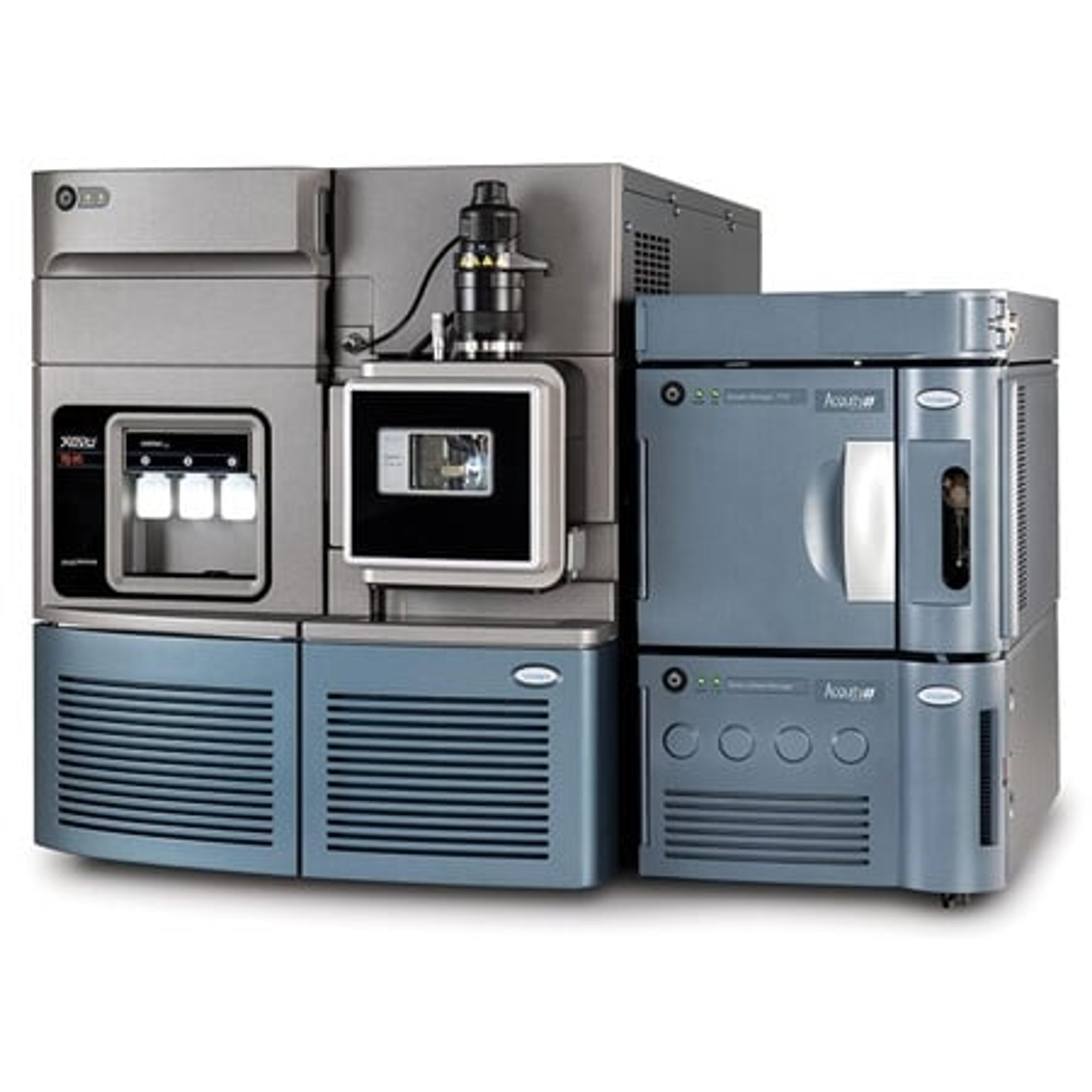
ACQUITY UPLC I-Class / Xevo TQ-XS IVD System
WatersWith patented StepWave technology, our highest performance IVD instrument provides ultimate sensitivity, to accurately quantify trace analytes in the most complex of clinical matrices encountered
ACQUITY UPLC I-Class / Xevo TQD IVD System
WatersThe rugged, robust and reliable Xevo TQD – a solid performer for clinical analyses