
Optibrium to Unveil StarDrop 5 and Revolutionary Nova Module at ACS Spring 2011
7 Mar 2011Product news
Optibrium™, a provider of software solutions for drug discovery, will be officially launching the next generation of StarDrop™ featuring the ground-breaking Nova™ module on booth #1121 at the American Chemical Society (ACS) National Exposition, 27-31 March, 2011, Anaheim, CA. This intuitive platform helps to guide scientists’ decisions to quickly identify compounds with a high chance of success for their drug discovery project. Nova is a completely new module within StarDrop 5, helping pharmaceutical and biotech companies to search for high quality drugs by generating new chemistry ideas, prioritised against specific property profile requirements when making critical decisions in drug discovery.
Fast identification of high quality compounds with the best balance of multiple property requirements is a major challenge in making effective drug discovery decisions. Complex, often conflicting requirements, combined with uncertain data, make it difficult to decide with confidence which lines of enquiry to pursue and which compounds to prioritise. So, it’s no surprise that most research in drug discovery results in expensive failure.
The revolutionary Nova module stimulates the search for high quality compounds by generating new chemistry ideas, prioritised against defined property profile requirements. It facilitates the search for prospective drug candidates by expanding the chemistry around an initial compound based on medicinal chemistry transformation rules, ensuring that they are chemically feasible. Independent tests proved that more than 94 per cent of generated compound structures were acceptable to medicinal chemists. In addition to an initial library of more than 200 transformations derived from literature and provided with Nova, chemistry knowledge can be transferred between medicinal chemists by defining their own transformation rules, flagging favourites and grouping rules tailored to specific goals. Nova provides the user with complete control of which transformations they wish to apply and enables a rigorous exploration of possibilities while searching for compounds with improved properties.
Nova ensures a broad exploration for new chemical ideas and, combined with StarDrop’s existing probabilistic scoring, chemical space visualisation, Glowing Molecule™ and predictive modelling capabilities, helps to quickly focus on high quality chemistry and speed up hit-to-lead and lead optimisation. Example applications include rigorously exploring the chemistry around new hits to identify those most likely to provide access to good drug-like properties; searching for new chemical strategies to overcoming issues in lead optimisation, including lead hopping; and identifying opportunities for patent busting.
The new Nova module is an addition to the existing suite of plug-in modules for the StarDrop platform, including a suite of predictive ADME QSAR models, quantum mechanics-based models to predict the regioselectivity and vulnerability to P450 metabolism and the Auto-Modeller that automatically generates and validates high quality QSAR models tailored to a project’s chemistry and data.
Furthermore, StarDrop 5 provides a comprehensive range of upgrades and significant new features, including enhanced data visualisation and new functionality to perform mathematical calculations within StarDrop, helping users to explore data and produce graphs, histograms and chemical spaces that can be easily included in reports. These build on StarDrop’s unique capabilities such as: Glowing Molecule™, which visualizes the influence of different regions of potential drugs to interactively guide the design of improved molecules and; Probabilistic scoring, which allows the user to objectively compare compounds against a weighted profile of required properties to discover the compounds most likely to yield successful results.
“We are very excited about the official launch of StarDrop 5 at ACS Spring 2011”, commented Dr. Matthew Segall, CEO of Optibrium. “The revolutionary Nova module and the major improvements to the core of StarDrop are the culmination of a major R&D effort and offer a step change in the ability of StarDrop to help our users to rapidly target high quality chemistry and improve the efficiency and productivity of drug discovery.”
The official launch of StarDrop 5 will be on booth #1121 at the American Chemical Society (ACS) National Exposition in Anaheim, CA, 27-31 March, 2011. Matt Segall will also be giving a talk on Nova at the ACS meeting in the DCOMP session at 11:15am on March 27th in room 213B of the Anaheim Convention Centre. For more information about Nova and StarDrop 5 please visit the company article page.
Related products
Request Quote for All Products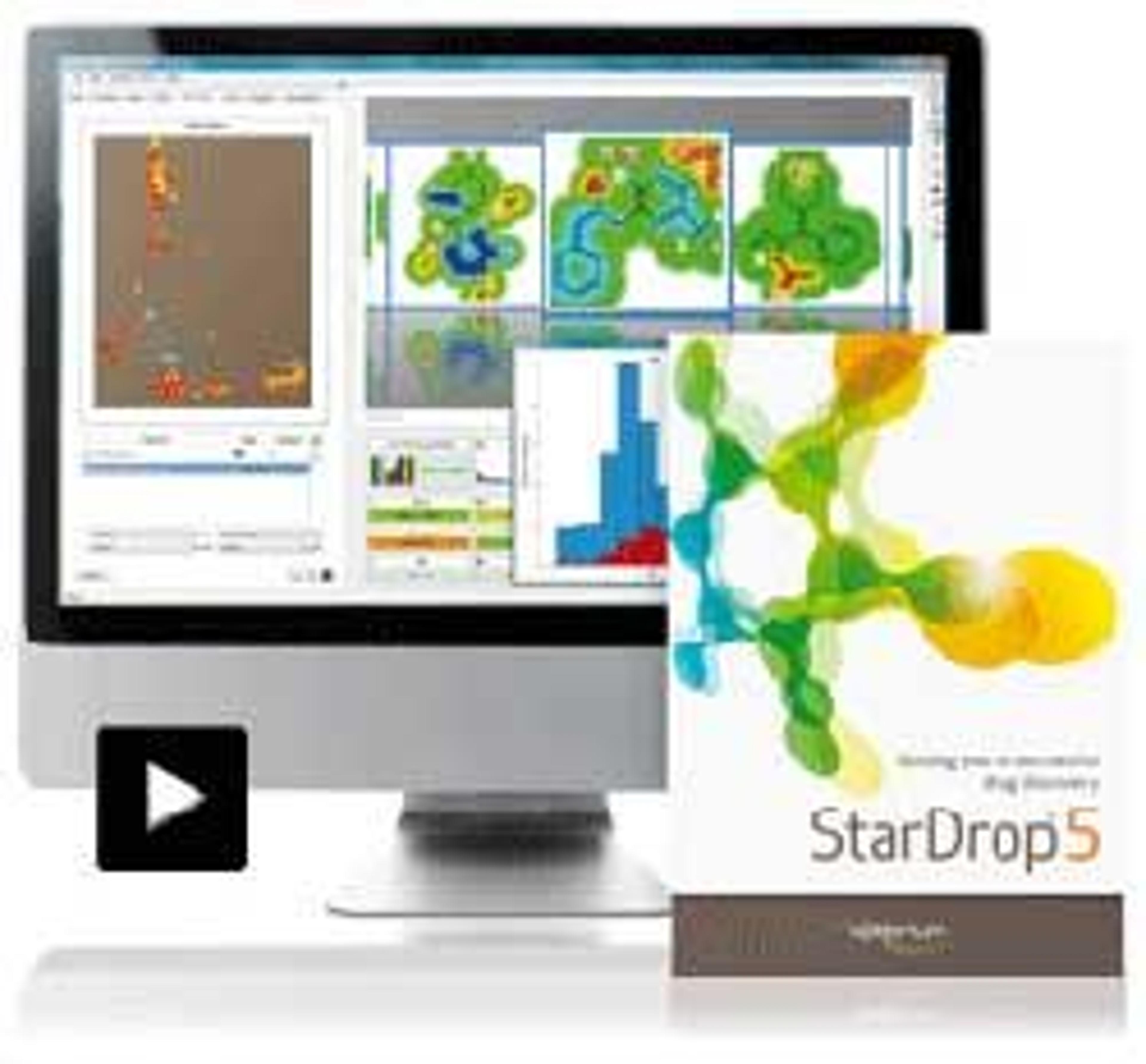
StarDrop 5 - Drug Discovery Software
OptibriumStarDrop is a suite of software that helps you to deliver optimally balanced, effective drugs - fast StarDrop works by evaluating complex data, which is often uncertain because of experimental variability or predictive error. In scoring this data, it brings confidence and intuitive simplicity to decision-making: guiding and validating the direction you take and which compounds you prioritise. Its instantly interactive tools then enable you to efficiently explore ways to further improve your chosen chemistries.Highly visual and easy-to-use, StarDrop also works with your existing IT systems to integrate a multiplicity of data sources. The latest release, version 5.5, comes with extensive data visualisation tools, which now include interactive 3D scatter and chemical space plots.StarDrop's modules include predictive ADME models, P450 metabolism prediction, automatic model building, application of 3D SAR based on Cresset's Field technology, knowledge based toxicity prediction through Derek Nexus while the Nova module can be used for automatically generating new compound ideas in parrallel with the BIOSTER database.StarDrop 5 - Drug Discovery Software Features: Probabilistic Scoring Chemical space Glowing Molecule Data visualisation R-group analysis StarDrop 5 Optional Modules: ADME QSAR Auto-Modeller Nova BIOSTER P450 torch3D Derek Nexus MPO Explorer