
Optibrium Announces a New Release of StarDrop Introducing MPO Explorer
14 Jan 2014
Product news
Optibrium™, a developer of software for drug discovery, today announced the release of a new version of its StarDrop™ software platform. The latest release introduces MPO Explorer™, which provides innovative new methods to guide ‘strategic’ decisions in research programmes, by helping to identify the key properties and selection criteria with which to select compounds with a high chance of success. The new module, alongside data visualisation enhancements, further extends StarDrop’s capabilities to reduce the time and cost to deliver high quality drug candidates.
MPO Explorer introduces unique (patent pending) methods that guide the development and validation of multi-parameter scoring profiles, tailored to a discovery project’s specific objectives. The resulting scoring profiles can be applied with StarDrop’s Probabilistic Scoring approach for multi-parameter optimisation (MPO), to effectively target novel compounds with a high chance of success. The most important property criteria are also highlighted, focussing experimental resources to generate the key data with which to identify successful compounds. To promote objective decision making, the new module also tests if a specific property criteria in a scoring profile may be artificially distorting the selection of compounds to pursue. If a small change in a criterion would lead to a different decision, this can highlight new avenues for exploration and avoid missed opportunities.
These new capabilities are supported by further enhancements to the core StarDrop application, including new data visualisation features such as 3D scatter and chemical space plots. In addition, StarDrop’s R-group analysis tool has been extended to perform matched pair analysis, providing insight into the key substitutions in a chemical series that have a significant impact on a compound’s properties.
Dr Matthew Segall, Optibrium’s CEO, commented: “StarDrop now offers our users a comprehensive desktop environment to guide strategic decisions in their drug discovery projects, optimise the use of resources and intuitively target compounds with an improved chance of success. The latest release delivers new technologies that represent the culmination of years of leading edge research and further our goals to improve the efficiency and productivity of our customers’ discovery projects.”
For further information on Optibrium and StarDrop 5.5, please visit www.optibrium.com, contact info@optibrium.com or call +44 1223 815900.
Related products
Request Quote for All Products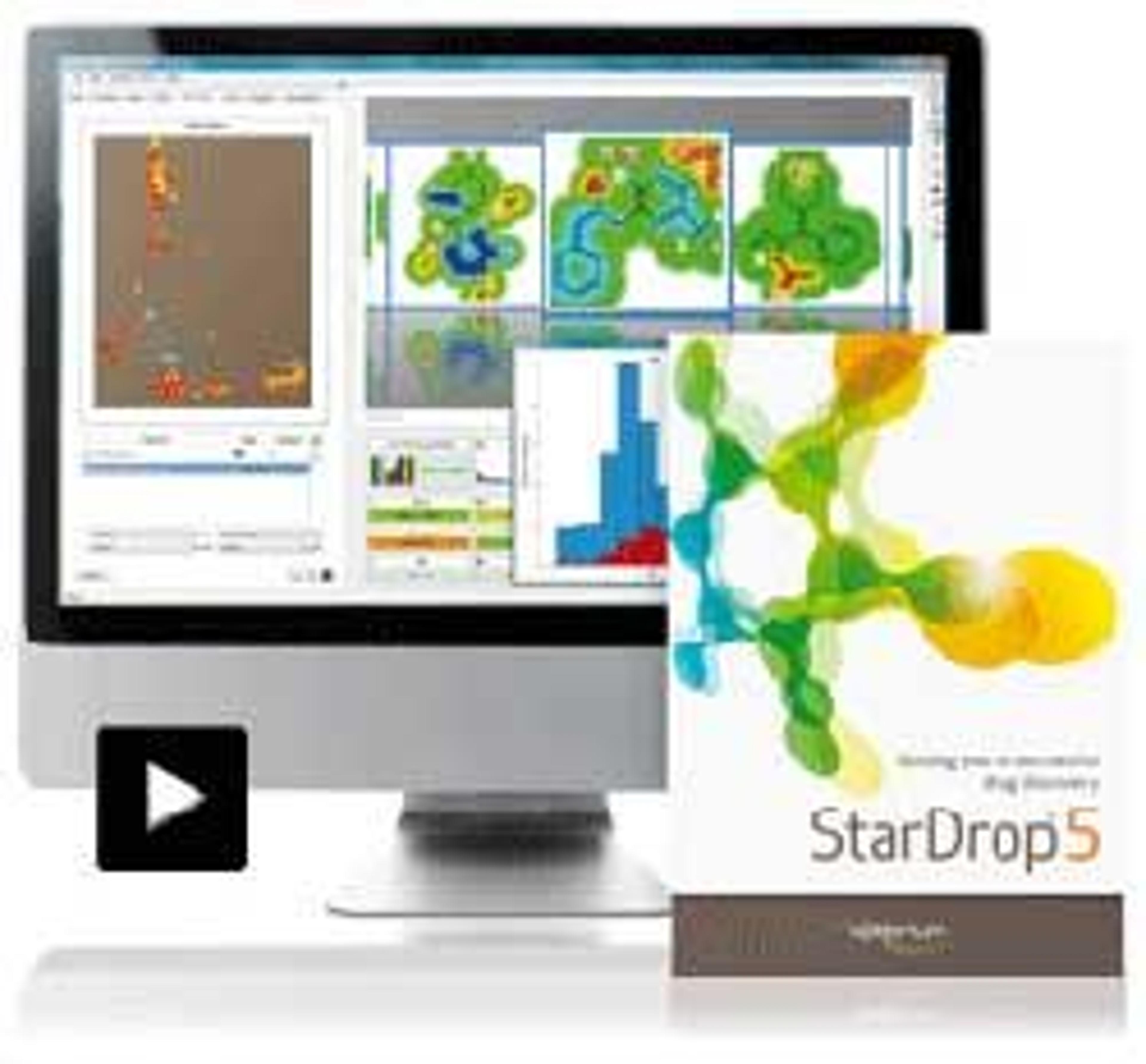
StarDrop 5 - Drug Discovery Software
OptibriumStarDrop is a suite of software that helps you to deliver optimally balanced, effective drugs - fast StarDrop works by evaluating complex data, which is often uncertain because of experimental variability or predictive error. In scoring this data, it brings confidence and intuitive simplicity to decision-making: guiding and validating the direction you take and which compounds you prioritise. Its instantly interactive tools then enable you to efficiently explore ways to further improve your chosen chemistries.Highly visual and easy-to-use, StarDrop also works with your existing IT systems to integrate a multiplicity of data sources. The latest release, version 5.5, comes with extensive data visualisation tools, which now include interactive 3D scatter and chemical space plots.StarDrop's modules include predictive ADME models, P450 metabolism prediction, automatic model building, application of 3D SAR based on Cresset's Field technology, knowledge based toxicity prediction through Derek Nexus while the Nova module can be used for automatically generating new compound ideas in parrallel with the BIOSTER database.StarDrop 5 - Drug Discovery Software Features: Probabilistic Scoring Chemical space Glowing Molecule Data visualisation R-group analysis StarDrop 5 Optional Modules: ADME QSAR Auto-Modeller Nova BIOSTER P450 torch3D Derek Nexus MPO Explorer