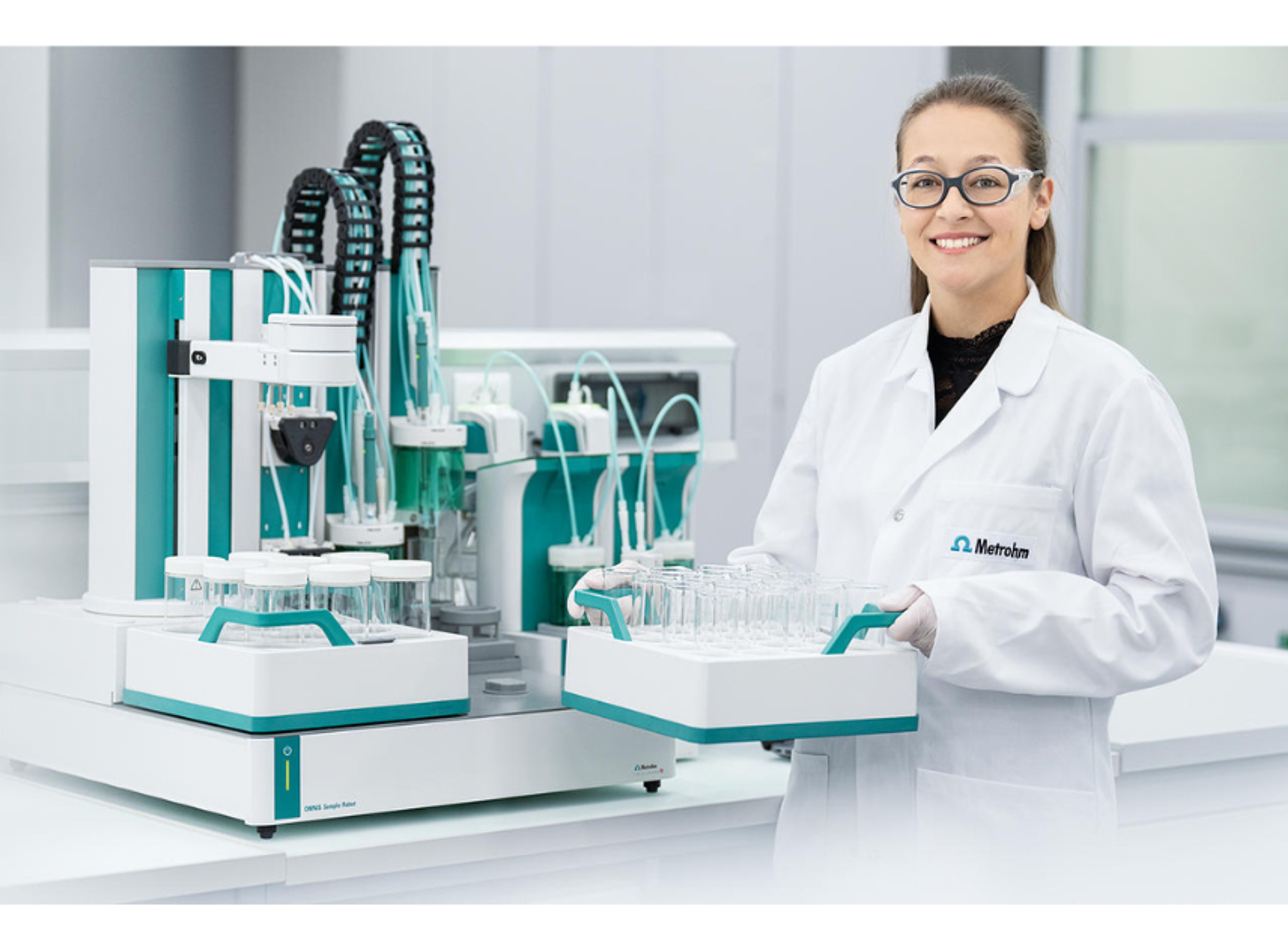
OMNIS – Reinventing Titration

New, modular titration platform enables higher sample throughput

30 Aug 2016
Weylan Kiam-Laine
Microbiologist

Product news

OMNIS addresses the needs of small and large laboratories alike: The new titration platform is modular and can be scaled up module by module from a simple stand-alone titrator to a powerful robotic system performing 4 analyses simultaneously processing up to 175 samples completely unattended.

Safer working and full traceability of results

OMNIS features a new, patented Liquid Adapter preventing exposure to hazardous liquids when exchanging reagents. An RFID chip in the cap of the reagent bottle enables the new titration platform to identify and check the content of the bottle against the specifications of the method to be performed. OMNIS warns the user if the system is connected to the “wrong” reagent.

Results for each sample at a single glance

OMNIS features new, smart software: No matter how many different parameters the user needs to determine his samples and by which methods, the new titration platform collects the results for each sample and shows them in a single report.

  • FASTER – Analyze 175 samples on four workstations completely unattended
  • SAFER – Exchange reagents without exposure to chemicals
  • EASIER – Configure work systems intuitively by drag and drop
  • MORE EFFICIENT – Whichever parameters you determine and by whichever methods, get the results in a single report

OMNIS

Metrohm AG

OMNIS is the universal platform for wet chemical analysis - and beyond. It is modular by design and can be scaled to control potentiometric titrations, volumetric and coulometric Karl Fischer titrations, thermometric titrations, pH and conductivity measurements and – with the OMNIS NIR analyzer – also measurements by near-infrared spectroscopy.

(110)

Links

Tags

Robotic InstrumentsRobotic instruments can be used for high-throughput automation of many lab processes. Such processes use instruments for assays like cell based assays and ELISA, for sample preparation like shakers, centrifuges and incubators, and for analysis such as sequencing and western blot analyzers. Useful features of robotic instruments include speed, reproducibility, barcode readers, software and automation.Robotic WorkstationsRobotic workstations are automated platforms enabling the user to perform high-throughput, multi-application processes, from sample preparation tasks such as PCR set-up, DNA purification and NGS library preparation, to integrated sample prep and analysis workstations. Automation makes processes consistent, fast, precise and fully walk-away. Find the best robotic workstations in our peer-reviewed product directory: compare products, check customer reviews and receive pricing direct from manufacturers.Software PlatformsSoftware platforms are useful for various stages of laboratory experiments from data collection to data storage and processing. For instance lab software is available for system control, data management, data analysis and qualification / validation.TitrationTitration is an analytical technique for determining substance concentration in a solution. For titration consider a manual or automated system, volumetric or coulometric reagent addition and indication by a potentiometer, spectrometer, turbidometer or by the Karl Fischer method. Other features of titration to consider include burettes, reagents, concentration range, reaction time and autosamplers.Quantitative AnalysesQuantitative analyses involve measuring the amount or concentration of a substance in a sample using analytical techniques. These analyses are essential in fields like chemistry, biology, and environmental science. Explore quantitative analysis tools in our peer-reviewed product directory; compare products, check reviews, and get pricing directly from manufacturers.AutomationAutomation in laboratories and manufacturing processes enhances efficiency, precision, and scalability by reducing the need for manual intervention. It plays a critical role in improving productivity, minimizing human error, and accelerating workflows in fields like diagnostics, drug development, and industrial testing. Automation technologies include robotic systems, automated liquid handlers, and process control systems that streamline complex tasks and ensure consistent, reproducible results. Explore our peer-reviewed product directory to discover the best automation solutions, compare options, read user reviews, and get prices directly from manufacturers.Chemical Process AnalysisHigh ThroughputHigh throughput experiments allow the simultaneous processing of several samples. This parallelization reduces the cost per experiment and increases reproducibility and output volume of data.