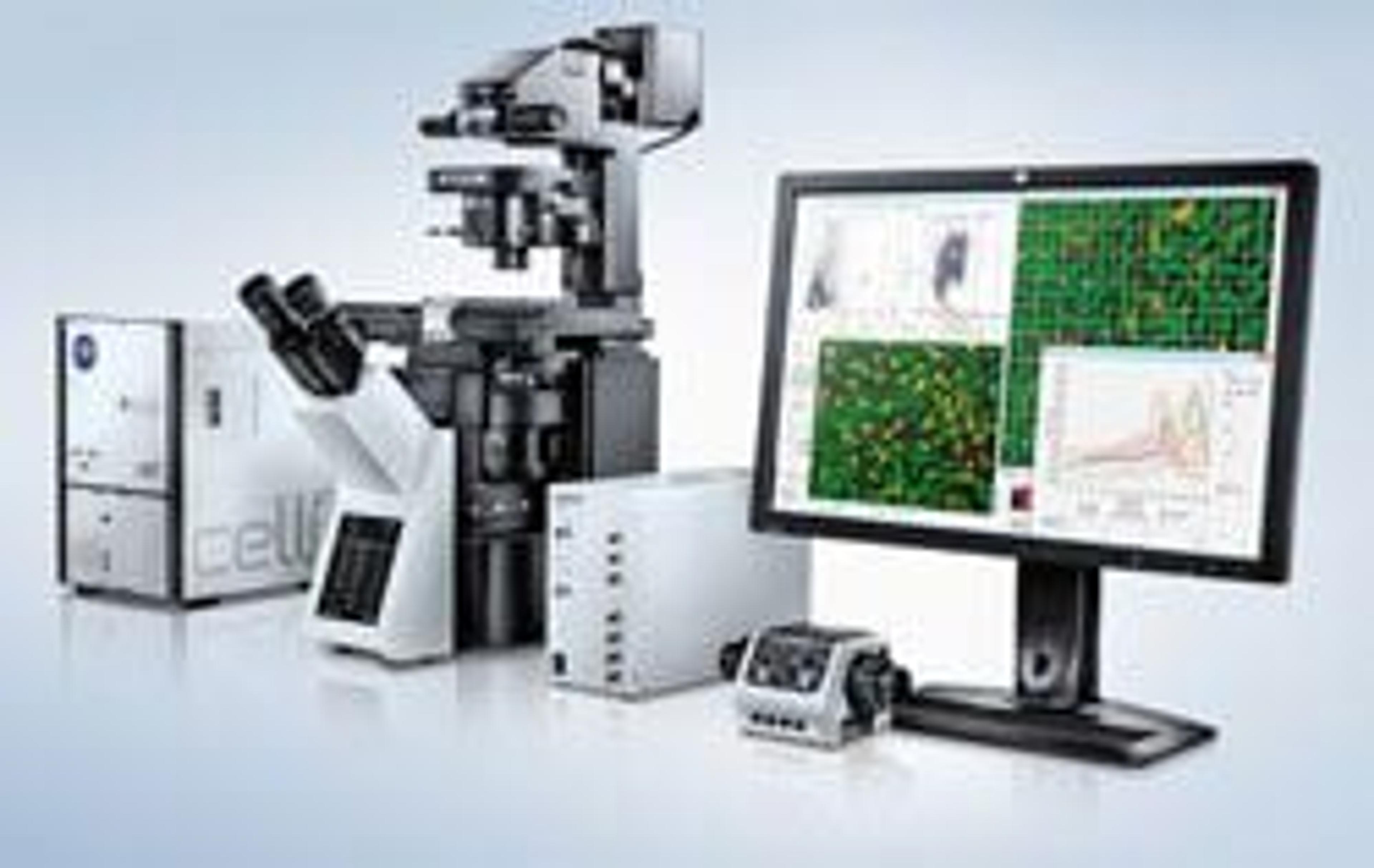
Olympus scanR 3.1 – AI Meets Live Cell Imaging

The software is designed to offer accuracy, robustness and ease of use for improved data quality and cell viability

8 Jul 2019
Georgina Wynne Hughes
Editorial Assistant

Product news

Olympus’ newly launched scanR 3.1 high-content screening (HCS) station fully embraces the capabilities of artificial intelligence (AI) to enable cutting-edge life science research. It combines the modularity and flexibility of a microscope-based setup with the automation, speed, throughput and reproducibility of HCS applications. Using the ‘self-learning microscopy’ concept, scanR 3.1 makes it easy to gather data quickly from large live cell populations for reliable, well-supported experimental results.

To minimize setup time, the self-learning approach makes use of a short, one-time training phase in which the software uses a quickly acquired set of images to generate ‘ground truth’ data without requiring human annotations. It then uses convolutional neural networks to autonomously create robust algorithms that can rapidly analyze large sets of images.

One application that clearly shows the power of AI in HCS is label-free quantification of live cells. Olympus’ scanR HCS software can reliably derive nuclei positions in micro wells solely from brightfield transmission images – with an accuracy that rivals fluorescence. Quantifying live cells from brightfield images instead of fluorescence shortens exposure times, avoids using genetic modifications or nucleus markers, and saves fluorescence channels for other markers. These benefits reduce phototoxicity and lead to simpler, faster image acquisition and better cell viability.

Reliable low light analysis has also become possible thanks to scanR’s AI-based imaging software. Olympus has shown that its software accurately detects DAPI-labeled cells at only 0.2% of the optimal light intensity. It can even distinguish different stages of the cell cycle, based on the intensity of the signal, providing better insights and improving reproducibility.

Dr. Manoel Veiga, application specialist at Olympus Soft Imaging Solutions, commented on the launch, saying: “This exciting new scanR system is good news for a whole range of life science applications. Low light and label-free analysis are only examples of how automated detection using an AI-based approach can improve the accuracy and reproducibility of HCS. Olympus’ self-learning microscopy approach for scanR 3.1 combines these benefits with a user-friendly workflow that requires little human interaction during the training stage. This makes it easy for life science researchers to harness the power of HCS data while benefitting from a fast, simple setup.”

For more science news, straight to your inbox, join SelectScience today.

Links

Tags

Flow Cytometry / Cell CountingFlow cytometers are used to count, sort and examine multiple characteristics of cells. Other cell analysis equipment includes image cytometers, cell counters, fluorescence-activated cell sorters (FACS), magnetic-activated cell sorters (MACS), and a range of flow cytometry assay kits. Flow cytometers can reveal information on cell viability, cell proliferation, apoptosis and cell cycle progression, as well as identify cell populations and intracellular or cell-surface molecules. Additionally, some flow cytometers, known as FACS, have an additional sorting function after analysis. Cell counters and image cytometers count live and dead cell populations and can also conduct cell proliferation assays. Find the best flow cytometers, cell counters and cell sorters in our peer-reviewed product directory: compare products, check customer reviews and receive pricing direct from manufacturers.High-Content ScreeningHigh-content screening (HCS), also known as high-content analysis (HCA), is a high-throughput technique used in drug discovery to identify substances that alter the phenotype of cells. HCS uses fluorescent microscopic imaging and automated image analysis to investigate cellular events such as apoptosis, cell viability, GPCR activation, oxide production, neurite outgrowth, and cell signaling. Find the best fluorescent labeling reagents, cellular assays, and high-content imaging systems in our peer-reviewed product directory: compare products, check customer reviews and receive pricing direct from manufacturers.In Vivo Imaging Systems<i>In vivo</i> imaging systems, including pre-clinical imaging systems and medical imaging systems are used to non-invasively visualize and capture images of live animals and plants. Monitor the natural processes or diseases of your subjects using small-animal pre-clinical imaging systems, including single photon positron emission tomography (SPECT), positron emission tomography (PET), computed tomography (micro-CT), magnetic resonance imaging (MRI), X-ray radiography, ultrasound, fluorescence and bioluminescence imagers. Multimodal systems and software solutions are also available for correlative analysis of organ, tissue, cell, or molecular-level processes. Find the best in vivo imaging products in our peer-reviewed product directory: compare products, check customer reviews and receive pricing direct from manufacturers.Light MicroscopyLight microscopes or optical microscopes are used to visualize microscale objects under magnification, including cells, clinical specimens and materials. Lab equipment for light microscopy includes confocal microscopes, fluorescence microscopes, zoom and stereo microscopes. Microscope slides and imaging reagents are available for visualizing samples, as well as various microscope stages and incubators for large or temperature-sensitive samples. Find the best light microscopes in our peer-reviewed product directory: compare products, check customer reviews and receive pricing direct from manufacturers.Software PlatformsSoftware platforms are useful for various stages of laboratory experiments from data collection to data storage and processing. For instance lab software is available for system control, data management, data analysis and qualification / validation.Cell ViabilityCell viability assays assess the health of cells and their ability to proliferate. These tests are crucial in drug development, toxicity testing, and cell-based research. Common methods for assessing viability include MTT, live/dead assays, and flow cytometry. Browse our peer-reviewed product directory to find the best tools for cell viability assays, compare products, check reviews, and get pricing directly from manufacturers.AutomationAutomation in laboratories and manufacturing processes enhances efficiency, precision, and scalability by reducing the need for manual intervention. It plays a critical role in improving productivity, minimizing human error, and accelerating workflows in fields like diagnostics, drug development, and industrial testing. Automation technologies include robotic systems, automated liquid handlers, and process control systems that streamline complex tasks and ensure consistent, reproducible results. Explore our peer-reviewed product directory to discover the best automation solutions, compare options, read user reviews, and get prices directly from manufacturers.Cell ImagingCell imaging can be achieved using a number of techniques including confocal microscopy, transmission electron microscopy, atomic force microscopy, and light sheet microscopy.Cell AnalysisThe analysis of cells allows researchers to understand the factors which contribute to cell health and function. These influencing processes can then be predicted and altered, leading to the development of medication and disease treatments.Image AnalysisImage analysis involves the extraction of meaningful information from images, often using software to quantify and interpret visual data. It is widely used in cell biology, material science, and diagnostics. Increasingly, AI is being used to streamline image analysis. Explore image analysis tools in our peer-reviewed product directory; compare products, check reviews, and get pricing directly from manufacturers.Data AnalysisThe analysis of data is the process of transforming, modeling and evaluating data to discover useful information from experimental results. Live Cell ImagingLive cell imaging is the study of living cells using microscopes and high-content imaging systems. This technique provides in-depth insight into fast and complex biological processes, by allowing dynamic imaging of living cells instead of acquiring an individual image at a single point in time.Cell Cycle AnalysisMicroscopyMicroscopy is a technique used to observe small objects in detail, from cells to materials, using light or electron microscopes. It enables researchers to examine structures with high resolution, aiding in fields such as biology, medicine, and materials science. With advanced microscopy techniques, scientists can gain insights into cellular processes, tissue structures, and material properties. Explore the best microscopy solutions in our peer-reviewed product directory, compare products, read customer reviews, and get pricing directly from manufacturers.Label-Free Analysis