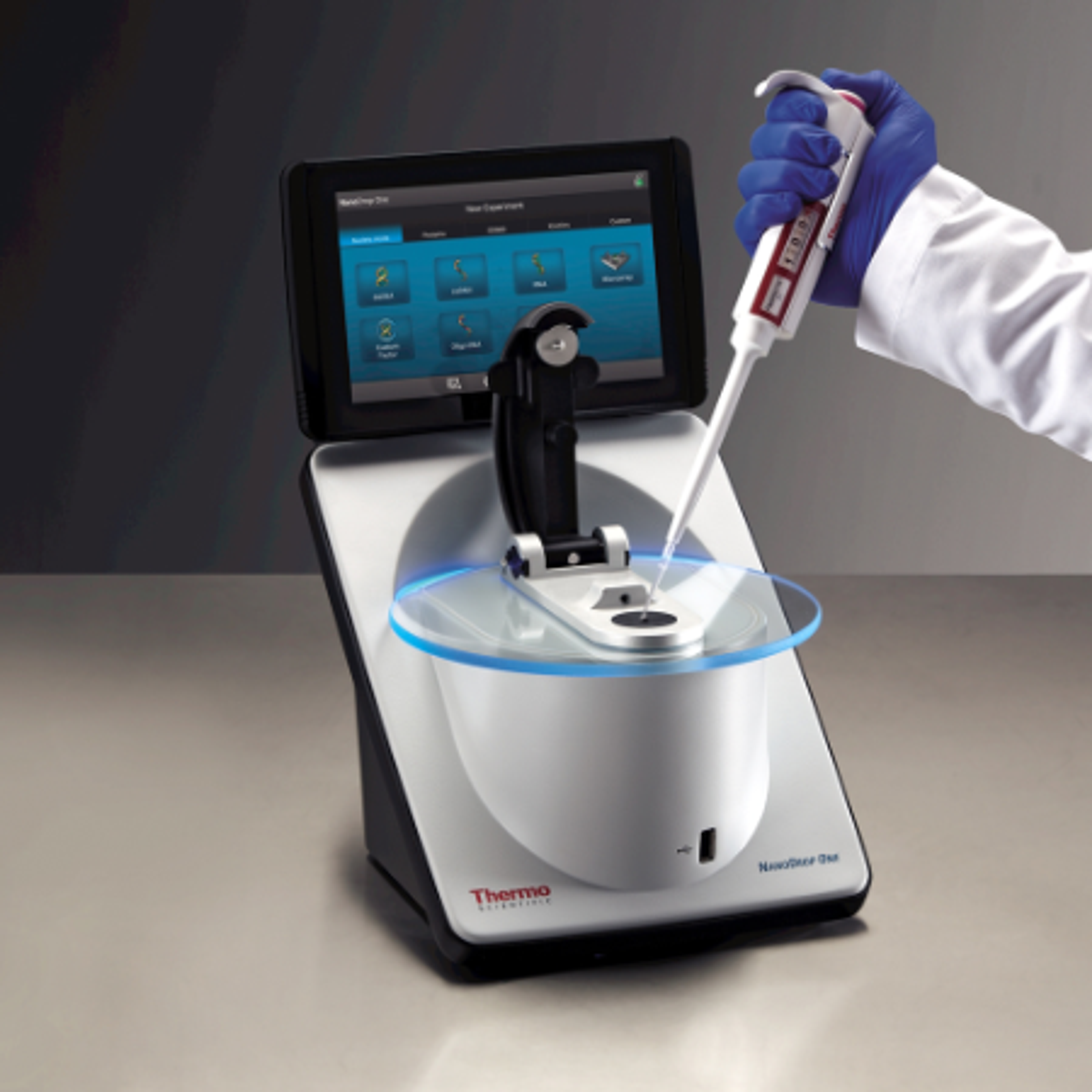
Nucleic acid contamination detection: Protect DNA and RNA samples to ensure downstream accuracy

How the NanoDrop One UV-Vis Spectrophotometer is bringing specificity to UV-Vis measurements

11 Nov 2020

Sarah Thomas
Associate Editor

Editorial article

Photo of Patrick Brown, Thermo Fisher Scientific
Patrick Brown, Product Manager, NanoDrop Microvolume UV-Vis, Thermo Fisher Scientific

A new solution from Thermo Fisher Scientific is now available to help scientists determine the purity of their DNA or RNA sample by detecting nucleic acid contamination using UV-Vis.

Nucleic acid contamination of your DNA or RNA samples can be detrimental to the accuracy of downstream experimental results, whether that be qPCR, RT PCR sequencing or any other assay. Here, SelectScience speaks with Patrick Brown, Product Manager, NanoDrop Microvolume UV-Vis, Thermo Fisher Scientific, to learn more about the new nucleic acid contamination detection software upgrade available for the Thermo Scientific™ NanoDrop™ One UV-Vis Spectrophotometer and how this can transform your research by providing confidence in your results.

Bringing specificity to UV-Vis

UV-Vis instruments enable scientists to quantify nucleic acid concentration following DNA or RNA extraction. However, during this quality control step, the UV-Vis instrument measures the entire absorbance of the sample. As a result, undetected nucleic acid contamination – RNA contamination in DNA or DNA contamination in RNA – can result in an overestimation of the concentration of the nucleic acid of interest. This contamination can consequently result in the incorrect amount of input DNA or RNA being used in downstream assays, which can lead to unreliable assays results.

If you are concerned about DNA or RNA contamination in your samples, traditional practices require the use of fluorescence assays to determine the specific concentration of each nucleic acid in your sample. While fluorescence assays may be the gold standard for measuring relative DNA and RNA concentrations in your sample, they require sample preparation, generation of a standard curve and incubation time. UV-Vis analysis in comparison requires just 1-2 µL of undiluted sample, but the ability to distinguish RNA from DNA using UV-Vis has been challenging as both nucleic acids are also absorbed at similar wavelengths. However, with the latest software update for the NanoDrop One UV-Vis spectrophotometer, users can now determine accurate DNA and RNA measurements from their sample at the same time using the same instrument.

NanoDrop users have eagerly awaited this new feature. “Everyone has been excited about the possibilities,” says Brown. The increase in specificity enables scientists to gain confidence in the purity of their samples as well as increase productivity. “The goal with this new ability to assess nucleic acid contaminants is to not only provide customers with an understanding of their sample concentration,” Brown explains, “but also some understanding of the purity of the sample.”

How does it work?

“We're taking the first step to providing nucleic acid specificity in a UV-Vis measurement by introducing mathematical models that can differentiate the absorbance spectrum of DNA from RNA,” says Brown. With the latest update of the NanoDrop software, its Thermo Scientific™ Acclaro™ Sample Intelligence technology algorithms are now able to identify RNA and DNA contamination, in addition to quantifying sample concentration. The technology, which works for samples of mammalian origin, provides information on the percentage makeup of a given sample – for example, if a sample contains 25% DNA and 75% RNA. This measurement is then used to produce a DNA or RNA concentration based on the uncorrected value.

“What we find is that our predictive software is able to provide a much more accurate concentration value than just the raw absorbance value,” says Brown. “So, we can get much better data, when we apply these algorithms.” After becoming aware of DNA or RNA contamination, users can then decide if they need to further process their sample or if the value is acceptable for downstream experiments.

DNA and RNA detected by the NanoDrop One instrument software
The latest update to NanoDrop One instrument software enables users to detect both DNA and RNA in a given sample to produce a corrected concentration for your nucleic acid of interest

Reduce troubleshooting – saving time & money

In addition to removing the need to perform fluoresce assays, a key advantage of the NanoDrop spectrophotomer’s new nucleic acid contamination detection feature is that it will eliminate troubleshooting in downstream assays. For example, if insufficient DNA or RNA is used in a reaction, detection early on will save users time, money, and enable them to get to important end results faster. “By providing a corrected concentration, users can be successful the first time and not have to spend hours redoing the experiment nor spend hundreds, maybe thousands of dollars in reagent costs to repeat that experiment,” Brown highlights.

How do I get the software update?

The software update is available as a free download for all Nanodrop One instrument owners. “Even if you purchased your instrument three years ago, you can go to the Thermo Fisher Scientific website and download this new feature for free,” Brown concludes.

Learn more about the latest updates to the NanoDrop in this SelectScience webinar>>

Links

Tags

UV-Visible SpectroscopyUltraviolet-visible (UV-Vis) spectrophotometers are used to measure the interaction of UV and visible light with a sample, including transmission, reflectance & absorbance. The two major instrument classes are single-beam or double-beam spectrophotometers. More specialized equipment includes colorimeters, spectroradiometers and refractometers. Portable and microvolume spectrophotometers are also available. For the modular spectroscopy lab, explore a range of light sources for combination with a spectrograph/spectrometer and optics. Find the best UV-Vis spectroscopy products in our peer-reviewed product directory: compare products, check customer reviews and receive pricing direct from manufacturers.PCR and Thermal CyclingPolymerase chain reaction (PCR) kits and thermal cyclers are used for the in vitro amplification of DNA permitting subsequent analysis and experimental procedures. Explore a range of high-quality polymerase, primers and nucleotides or simplify your workflow with a PCR mastermix. Find reverse transcription PCR (RT-PCR) and cDNA synthesis kits for RNA products and libraries. Quantitatively measure the amplification of DNA with real-time PCR (qPCR) and droplet digital PCR (ddPCR) kits and systems, and discover automated PCR setup solutions to increase throughput. Alternative DNA amplification methods also include recombinase polymerase amplification (RPA) kits. Find the best PCR kits and thermal cyclers and purification equipment in our peer-reviewed product directory: compare products, check customer reviews and receive pricing direct from manufacturers.DNA / RNA Extraction and PurificationPurified DNA and RNA are required for numerous downstream molecular biology applications. Consequently, the importance of high-quality DNA/RNA extraction and purification equipment cannot be underestimated. Many purification kits are available and are typically optimized for nucleic acid type and source, including plasmid DNA, genomic DNA, mRNA, RNA and viral nucleic acid purification kits. Automated extraction and purification of nucleic acids can be implemented with magnetic bead separator instruments or high-throughput purification workstations. Find the best DNA/RNA extraction and purification equipment in our peer-reviewed product directory: compare products, check customer reviews and receive pricing direct from manufacturers.DNA SequencingDNA sequencing, such as sanger sequencing, is a biological technique that determines the precise order of nucleotide bases in a fragment or template of DNA. DNA sequencers and genetic analyzers are based on capillary electrophoresis, where labeled DNA fragments are electrophoretically separated by size as they migrate through a polymer. Find the best DNA sequencing products, including DNA sequencing kits, genomic libraries and genetic identity kits in our peer-reviewed product directory: compare products, check customer reviews and receive pricing direct from manufacturers.DNA / RNA QuantificationDetection and quantification of nucleic acids is important in molecular biology, cloning, expression, forensics and clinical diagnostics. Nucleic acids can be detected by labeling with colorimetric, fluorescent or radio labels and using in situ hybridization kits to identify specific sequences. Multiple nucleic acids can be detected and quantified at once using RNA / DNA detection beads or RNA / DNA microarrays. Find the best DNA / RNA Quantification products in our peer-reviewed product directory: compare products, check customer reviews and receive pricing direct from manufacturers.Nucleic Acid ConcentrationqPCRQuantitative PCR (qPCR) is a molecular biology technique used to amplify and measure the amount of a specific DNA or RNA target. It plays a crucial role in gene expression analysis, pathogen detection, and quantifying DNA or RNA in various applications. Real-time PCR provides precise, quantitative results and is widely used in research, diagnostics, and clinical studies. Browse our peer-reviewed product directory to find the best qPCR solutions; compare products, check reviews, and get pricing directly from manufacturers.DNA QuantificationDNA quantification is the process of measuring the amount of DNA in a sample. It is vital in genomics, molecular biology, and biotechnology, helping to ensure accurate experiments and data analysis. Explore DNA quantification tools in our peer-reviewed product directory; compare products, check reviews, and get pricing directly from manufacturers.DNADeoxyribonucleic Acid (DNA) is the main component of chromosomes and the carrier of genetic information of living organisms. Find out here about PCR, NGS, ChIP-Seq, gel imaging, and many other techniques which can be used for the analysis of DNA.RNARNA is a nucleic acid that plays a key role in gene expression and protein synthesis. It serves as a messenger between DNA and ribosomes, carrying genetic instructions to produce proteins. Advances in RNA-based therapies, such as mRNA vaccines and gene editing, have revolutionized treatment strategies for genetic disorders and infectious diseases. Explore RNA research tools and therapies in our peer-reviewed product directory; compare products, check customer reviews, and get pricing directly from manufacturers.SequencingSequencing refers to determining the order of nucleotides in a DNA or RNA molecule. This process is essential in genomics, diagnostics, and evolutionary biology. Techniques like next-generation sequencing (NGS) and Sanger sequencing provide high-throughput and precise data for analyzing genomes and transcriptomes. Browse our peer-reviewed product directory to find the best sequencing tools and reagents, compare products, check reviews, and get pricing directly from manufacturers.PCRRT qPCRReal-time quantitative PCR (RT-qPCR) is a technique used to measure gene expression and quantify DNA or RNA in real-time. It is essential in genomics, diagnostics, and biotechnology research. Explore RT-qPCR systems in our peer-reviewed product directory; compare products, check reviews, and get pricing directly from manufacturers.Real-Time PCRReal-time PCR (RT-PCR) is a technique used to amplify and simultaneously quantify nucleic acids in real time. It is a key tool in gene expression analysis, pathogen detection, and diagnostics. RT-PCR allows for the detection of specific RNA or DNA sequences with high sensitivity and specificity. Browse our peer-reviewed product directory to find the best Real-Time PCR systems; compare products, check reviews, and get pricing directly from manufacturers.