
Novel research explores animal microbiome dynamics to improve livestock health
Why DNA extraction is key to characterizing the microbial communities that colonize the livestock gastrointestinal tract
19 Apr 2020
Editorial article

Just like the human gut microbiome, the gastrointestinal tracts of livestock animals are home to a complex and dynamic mix of microorganisms. While there is much research expanding our understanding of the human microbiome and its relationship with health and disease, study of the animal microbiome is still in its infancy. Analyzing the microbes that colonize the digestive tract of livestock and how these microbial communities shift will provide insight into digestion and animal health, and will help shape strategies for feeding, as well as antimicrobial treatment.
Dr. Amélia Camarinha-Silva is a junior professor at the Hohenheim University, where she is also Head of Livestock Microbial Ecology Group at the Institute of Animal Science. Here, she leads a team focused on expanding our knowledge of livestock microbiomes. In this interview, Camarinha-Silva shares how her team is approaching the phylogenetic and functional characterization of the microbial community present in livestock gastrointestinal tracts, from DNA extraction to high-throughput sequencing, and how she came to choose the best DNA extraction technology for this work.
What are the goals of the Livestock Microbial Ecology Group?
Our group is interested in the phylogenetic and functional characterization of the microbiome that colonizes the digestive tract of livestock. We want to understand the role of key organisms in the general functions of the digestion processes in livestock and to identify the shifts that can occur in the microbial communities. To do this, we have different studies with different partners to try to cover as much as possible about the effects of host nutrition, genetics, immunology and physiology on the microbiome of the animal.
This field is already very well developed in humans – there are a lot of studies in humans – but this is not the case for livestock; we still don't know everything that happens in their gastrointestinal tract, or what factors influence the microbiome. It is a new field with just a couple of years of research behind it, however, we use the same techniques as they use in human microbiome studies – it's pretty much the same, we’re just studying a different host.
In which fields do you perform phylogenetic characterization of animal microbiomes?
We study the gastrointestinal tract of all livestock animals – pigs, cows, and chickens. In the past few years, we have done a lot of research into diet effects on the gut microbiome of the animals, especially with calcium, phosphorus and phytase supplementation. We also study how the host genetics affect the microbiome.
We are currently working on a big research project, where several different expertise came together to study the effects of calcium and phosphorus supplementation and phosphorus utilization in laying hens at the individual level. This project covers the fields of nutrition, physiology, genetics, microbiome and immunology – it is a huge research group project.
What are the key techniques used in your research and how did you come to use the MP Biomedicals FastDNA Spin Soil extraction kit?
We mainly use target amplicon sequencing or shotgun metagenomics. We currently perform DNA extraction and use it to prepare all our high-throughput sequencing libraries. We know that the DNA extraction step has a huge effect on downstream analysis and in which microbial communities we're able to characterize, and so it's a very important step for us. It is also essential that this step is consistent to make our studies comparable and, for this, we need to always use the same DNA extraction methodology.
I've been using the MP Biomedicals soil extraction kit for several years – I started my Ph.D. by extracting nasal swabs with it. When I moved to Hohenheim we did a test of DNA extraction kits because there is not a standard operating procedure for microbiome studies in animals. We wanted to check which kit was the best to extract our samples – the best kit being the one that gave the optimum DNA concentration and purification and also the best output, by which I mean ability to extract all gram-positive and negative bacteria.
We compared around 15 kits and the MP Biomedicals kit was the one that worked the best. When we wrote the manuscript, we also advised our colleagues in the field that this was a very good kit to use.
So, our studies are all done with a DNA extraction using MP Biomedicals FastDNA Spin Kit. We’ve had a very good output and so we are quite happy with it. When we have some complicated samples, and the kit is not performing as expected we contact MP Biomedicals and they are always available to answer our calls and try to find solutions to improve the extraction.
What have the results of your studies suggested so far and what will you be working on next?
While the animal microbiome is still in its infancy, we have already shown that dietary treatments and host genetics can have a huge effect on the microbiome of livestock, regardless of the animal. We should look to these studies as a good bridge to improve animal health and performance and, consequently, we will have better products on the market.
We still face some challenges because it’s not a developed field – there is a lack of information on the microorganisms inhabiting the livestock gastrointestinal tract. There is still a long way to go to characterize those species because these samples contain a lot of not yet cultured microorganisms. The future will be focused more on data extraction to really try to create better databases on the microbial ecology of the livestock. At Hohenheim, we’re also about to start the construction of a new center for livestock microbiome research. The HOLMIR will be focused solely on livestock microbiome and will have great facilities that will allow us to deepen the knowledge on this research field.
Do you use the MP Biomedicals FastDNA Spin Soil extraction kit in your lab? Write a review today for your chance to win a $400 Amazon gift card>>
Related products
Request Quote for All Products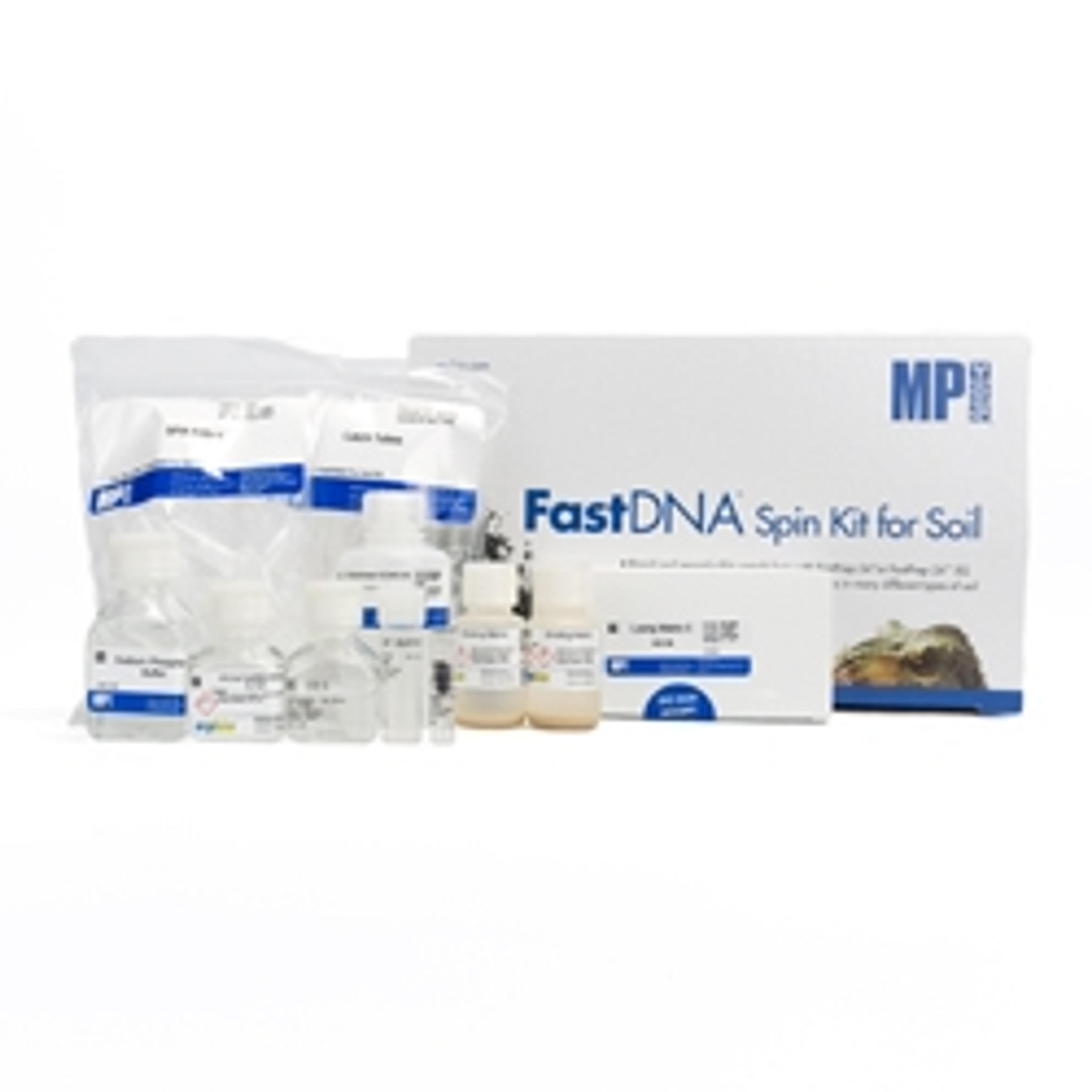
FastDNA SPIN Kit for Soil™
MP BiomedicalsIsolate Pure DNA from Cells Present in Soil or Other Environmental Samples! Thorough lysis in seconds of any microorganism present in environmental samples. Ready-to-use DNA for quantitative and qualitative characterization of microbial soil communities. Excellent reproducibility for an optimum assay-to-assay consistency. Total removal of humic acids and PCR inhibitors for a successful investigation of microbial diversity. The FastDNA™ SPIN Kit for Soil is designed to efficiently isolate bacterial, fungal, plant and animal genomic DNA from soil and environmental samples. Up to 500 mg soil are processed by the FastPrep®-24 5G or and any bead beating homogenizers with the Lysing Matrix E tubes designed to efficiently lyse all microorganisms including difficult sources such as eubacterial spores and endospores, gram positive bacteria and yeast. The released DNA is purified by a silica-based spin filter method and is suitable for PCR and other downstream applications.