
Nobel Prize Winner in Chemistry Talks Cryo-EM and its Impact on Drug Discovery: Video Exclusive
Dr. Richard Henderson shares insights into the importance of cryo-electron microscopy to pharma and his hopes for the future, in an interview with The Scientists’ Channel
2 Oct 2018
Editorial article
At the launch of eBIC, the new national electron bio-imaging centre at Diamond Light Source, UK, The Scientists’ Channel spoke with 2017 Nobel Prize winner in Chemistry, Dr. Richard Henderson, about the importance of cryo-electron microscopy and eBIC to science and the pharmaceutical industry.
Henderson was one of three scientists to share last year’s Nobel Prize in Chemistry, along with Jacques Dubochet and Joachim Frank, for their work “developing cryo-electron microscopy for the high-resolution structure determination of biomolecules in solution”, thereby enabling scientists to study biological structures that were previously inaccessible.
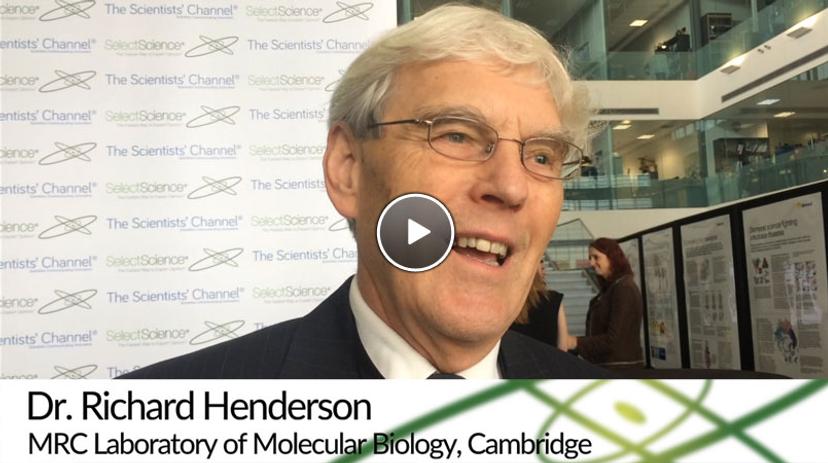
In an exclusive video interview one year on, Henderson explores the impact of the technique, how it can accelerate R&D for both industry and academic users and his hopes for what more can be achieved in terms of treating viruses and disease.
He tells The Scientists’ Channel: “In the last three or four years, pharmaceutical companies have realized that this methodology, cryo-EM, can be used to target previously inaccessible targets.”
Understanding the complex structure of biological macromolecules is highly important when designing drugs to block or activate biological activities (revealing in precise detail, the architecture of the drug targets). Over the past 50 years, X-ray crystallography and nuclear magnetic resonance have dominated the field of structural biology, but with the recent technological developments in Cryo-EM, it is proving to be an equally powerful and versatile technique reaching near atomic resolutions of 2.2 Å.
The technique itself does not require the high-level purity needed for X-ray, nor does it require crystals of the biological macromolecule. Samples are vitrified in amorphous ice by rapid freezing and visualized under a transmission electron microscope.
While larger pharma companies have been able to invest huge sums of money into the new technique, smaller companies may have to be a little more imaginative – and that’s where the new cryo-EM suite at eBIC comes into play.
Thanks to a partnership between Diamond Light Source and Thermo Fisher Scientific, eBIC, one of the largest cryo-EM sites in the world and well-integrated into the infrastructure of the Diamond Light source, now offers professional cryo-EM services designed exclusively for the pharmaceutical industry, alongside its current 4 cryo-EM’s for academia.
Watch the interview with Dr. Richard Henderson to find out more >