
NIS-Elements Version 4.0 for Improved Imaging
11 Nov 2011Product news
Nikon has introduced version 4.0 of its global microscope and camera software, NIS-Elements. Version 4.0 now offers the ability to control current existing and the latest Nikon systems, ensuring familiarity on all Nikon imaging platforms. It offers over 100 new functions for improved user experience, from simplifying multiple user accounts and easy-to-use image analysis functions, to powerful 3D and live cell image acquisition and reconstruction. New support for third party cameras and hardware is also included in this new version.
The interface enables easier switching between microscope applications. Improved user rights management enables the same account to be used for more than one user. Workflow for live cell imaging can be simplified with the option of a triggered start for image acquisition.
The slices viewer, rendering and thresholding and analysis windows have been redesigned for improved viewing. Tracking in 2D has also been added to the software expanding functionality.
A special experiment designer function, called recipe mode, can used with Nikon’s inverted research microscopes. The recipe mode utilises the Nikon hardware architecture to speed up communication time, in some multiple image capture experiments this allows the experiment to finish twice as fast as other comparable systems. Expanded stitching functions enable scanning of a large image and scanning of a large image with Z intensity correction.
NIS-Elements v4.0 is available with a Nikon Software Update Agreement (SUA) to allow access to software updates, as well as the ability to download the latest full retail releases of NIS- Elements at no additional charge during the first year, with further year options available.
Related products
Request Quote for All Products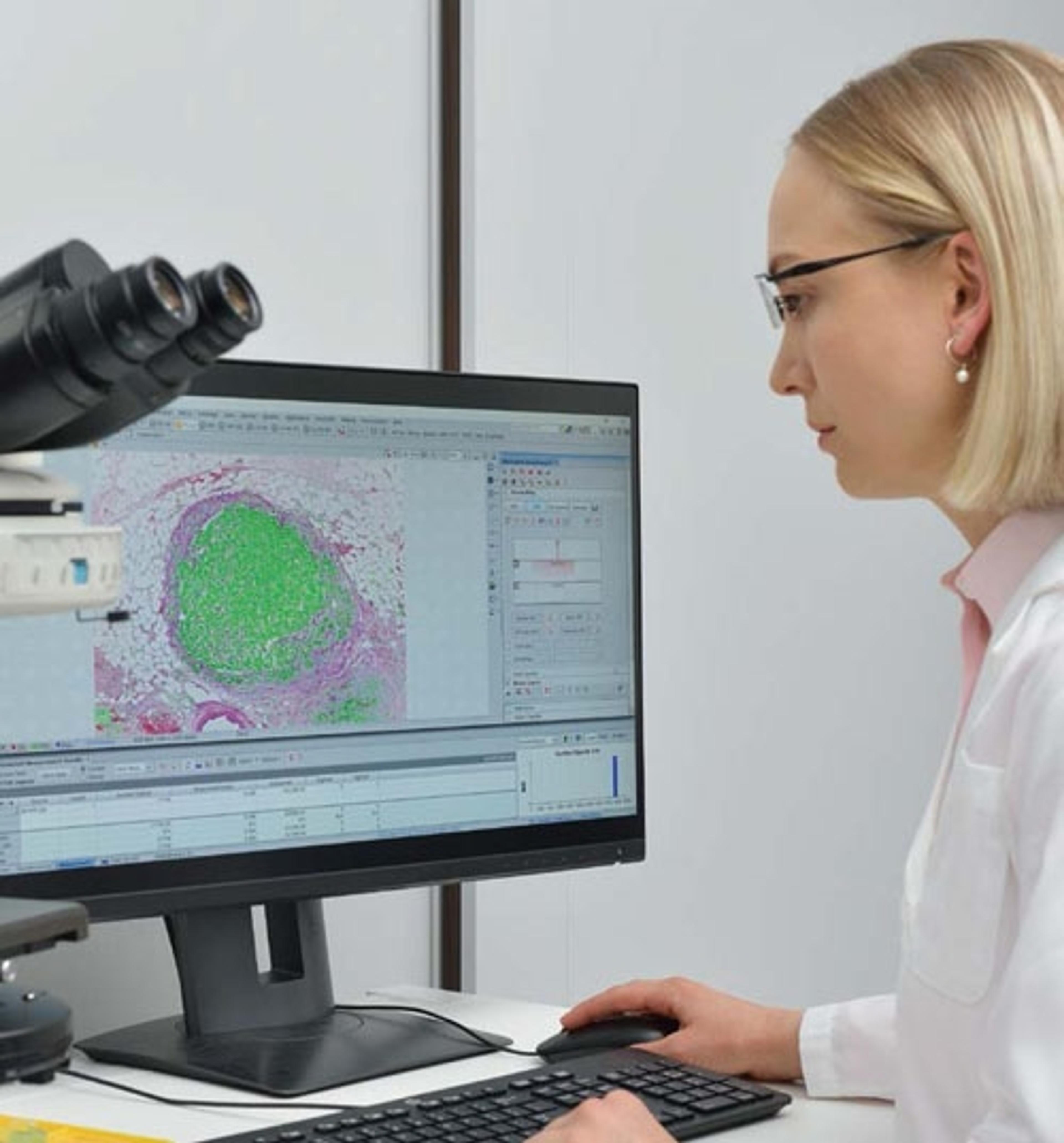
NIS-Elements Microscopy Software
Nikon Healthcare Business – Microscope SolutionsFlexible software platform for controlling Nikon microscopes and 3rd-party components, with powerful custom programming tools for image acquisition and analysis.