
Nikon Introduces World’s Largest Zoom Range, Highest-Resolution Stereomicroscopes
20 May 2013Product news
Nikon Instruments, Inc. has announced the introduction of two all new stereomicroscopes, its Nikon SMZ25 and SMZ18 systems. Ideal for all bioscience applications, these new microscopes meet the increasing need of scientists for imaging systems capable of spanning spatial scales from single cells to whole organisms.
New Features for World-Class Performance
The SMZ25 features a breakthrough in zoom technology, the innovative Nikon Perfect Zoom System, which enables the world’s largest zoom ratio of 25:1, superior resolution, and exceptional fluorescence transmission capability. The Perfect Zoom System enables this uncompromised zoom range and resolution all within a compact zoom body and objective lens design. Nikon’s new research stereomicroscope series offers both the automated zoom model, SMZ25, as well as the more economic, manual-intelligent zoom model, SMZ18. Both can be equipped with a variety of automated and intelligent accessories including z-focus, LED Dia light intensity control and epifluorescence filter cube selection.
The SMZ25 also features an Auto Link Zoom (ALZ) function, which automatically adjusts the zoom factor to maintain the same field of view when switching objective lenses, enabling seamless viewing at different scales. The incredible resolution at high zoom magnifications provides researchers with a powerful macro-to-micro, all-in-one imaging system.
The new systems are also the first stereomicroscopes to use a fly-eye lens on an epi-fluorescence attachment. This ensures bright and uniform illumination even at low magnifications, resulting in uncompromised uniformity in brightness across a large field of view.
Optical Design Improvements
Both the SMZ25 and SMZ18 also feature breakthroughs in optical design, resulting in significantly improved signal to noise ratio and crystal-clear fluorescent images.
Traditionally, researchers must switch to a higher magnification microscope to view microscopic details after using a stereomicroscope to view, or manipulate macroscopic structures. The SMZ25 and SMZ18 eliminate this need by providing both macroscopic and microscopic imaging capabilities. This, combined with Nikon’s newly-developed objective lens, the SHR Plan Apo series, offers a superior resolution never before seen on a stereomicroscope. The SHR Plan Apo 2x Objective, enables visualization of structures as small as a few microns, once considered to be impossible on a stereomicroscope. Apochromatic correction is maintained in both the objective lens and the optical zoom system, virtually eliminating color aberrations.
Even at low magnification, the SMZ25 series can capture an entire 35mm dish with equal brightness over the whole field of view, simultaneously delivering microscopic details. This feature is ideal for activities like live screening of developmental biology models such as C. elegans, drosophila, zebrafish or mice to identify and select mutants. Brilliant images can be captured even with low excitation light levels, minimizing photo-bleaching and photo-toxicity which is harmful to live cells and organisms.
Increased Usability, Easy Integration with Software
The SMZ25 remote control provides easy access to zoom and focus controls. Nikon’s cross-platform NIS-Elements imaging and analysis software can be used to capture multi-channel time-lapse images, z-stacks and EDF images easily from a PC.
A slimmer diascopic illumination base helps increase the efficiency and ergonomics of sample manipulation. The new base also features a built-in Oblique Coherent Contrast illuminator that produces high-contrast images of transparent samples such as ITO film and zebrafish.
A wide range of accessories and illuminators accommodate a wide variety of observation methods.
Related products
Request Quote for All Products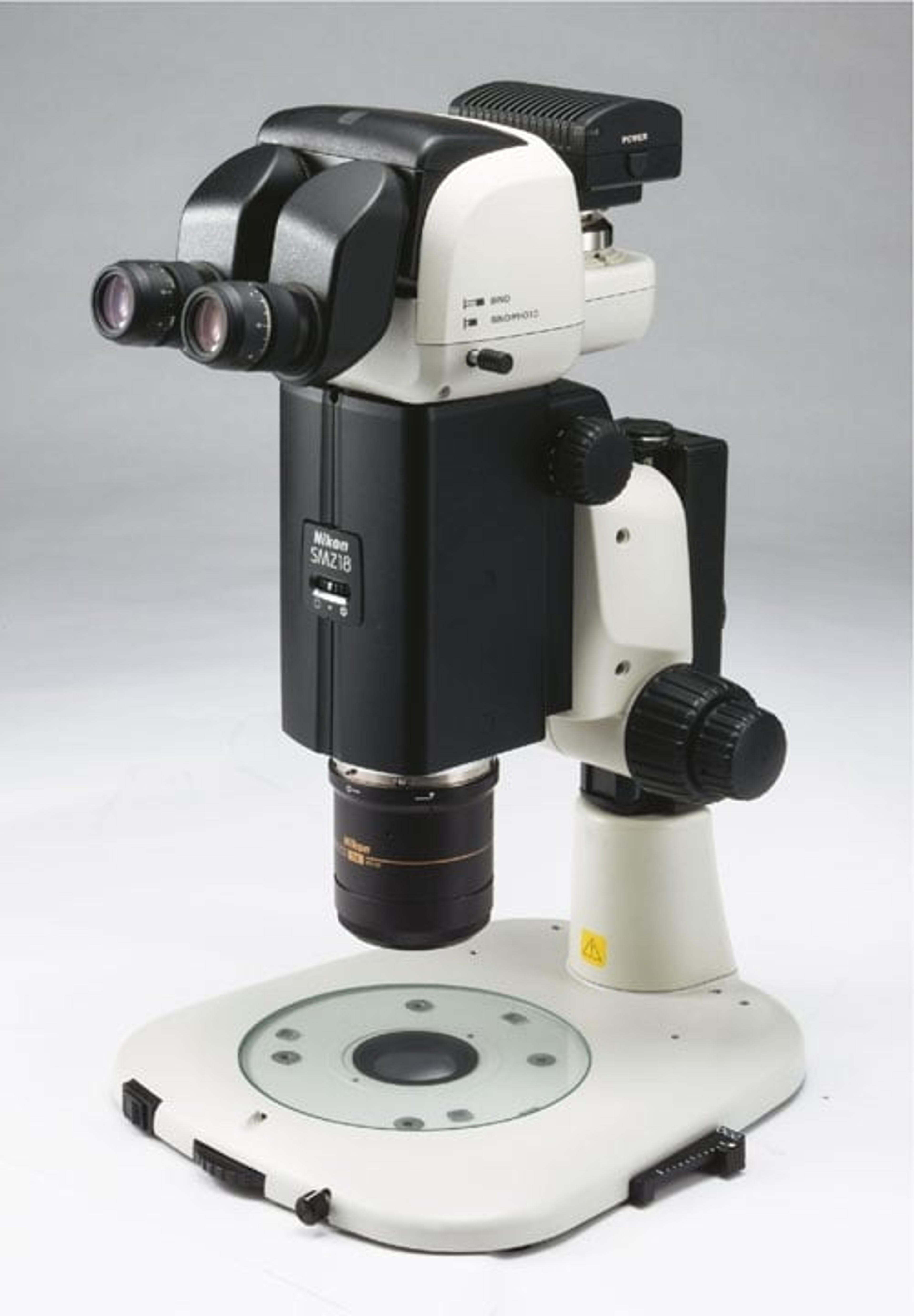
SMZ18 Research Stereomicroscope
Nikon Healthcare Business – Microscope SolutionsManual zoom stereo microscope providing advanced optical performance with 18:1 zoom ratio, and incredibly bright fluorescence at a economical cost
SMZ25 Research Stereomicroscope
Nikon Healthcare Business – Microscope SolutionsBreakthrough stereo microscope optics delivering the world's highest zoom ratio of 25:1, unprecedented resolution and bright, fluorescent images. Capture stunning images and time-lapse data with incredible detail and field of view.