
New Technology Enables Comprehensive Biopharmaceutical Characterization Workflow with a Single Platform
Thermo Scientific Q Exactive BioPharma enables three powerful new protein characterization workflows on one instrument Researchers performing biopharmaceutical characterization can now benefit from a single system
23 Jun 2016
Product news
Researchers performing biopharmaceutical characterization can now benefit from a single system from Thermo Fisher Scientific that enables three powerful workflows for the complete characterization of biotherapeutics.
The new Thermo Scientific Q Exactive BioPharma MS/MS Hybrid Quadropole-Orbitrap mass spectrometer takes full advantage of the high-resolution, accurate-mass (HRAM) capabilities of the Orbitrap mass analyzer to enable three key protein characterization workflows; denatured and native MS intact analysis, subunit and top/middle-down analysis, and peptide mapping. Combined with recommended sample preparation and analysis methods based on Thermo Scientific reagents, columns, UHPLC and data processing technologies, the Q Exactive BioPharma constitutes a complete solution for the rigorous structural characterization of biotherapeutic compounds.
“Researchers require multiple MS techniques to perform the experiments essential for biopharmaceutical structure characterization,” said Jonathan Josephs, director, pharma/biopharma marketing, life sciences mass spectrometry at Thermo Fisher. “We now offer a single instrument that encompasses all of our leading technologies into one system, which can be used to analyze antibody-based biologics at the intact, subunit, and peptide levels—ultimately providing an efficient route to high quality results.”
The Thermo Scientific Q Exactive BioPharma features a new High Mass Range (HMR) mode which adds the ability for exceptional intact monoclonal antibody and antibody-drug conjugate (ADC) analysis, under both native intact and denatured intact conditions, to the existing capabilities for subunit top/middle-down and peptide mapping analysis.
When combined with Thermo Scientific BioPharma Finder Software, the technology is a powerful solution for biotherapeutic characterization. The integrated workflow-driven interface enables automated processing of data from peptide, subunit, and intact protein analyses. BioPharma Finder uses two deconvolution algorithms to take full advantage of the ultra-high-quality, high-resolution accurate mass (HRAM) data produced by Orbitrap-based mass spectrometers to provide superb accuracy for intact mass measurements. This powerful software can also be used to accurately characterize disulfide bond linkages, detect low-level impurities and automate the relative quantitation and reporting of sequence variants and post-translational modifications.
To further complete the solution, the new Thermo Scientific Vanquish Flex Binary UHPLC system adds a binary solvent delivery option in the 1000 bar (15,000 psi) performance range, and will preview at this year’s ASMS. The system is built for high-speed, fast gradient applications and the Vanquish platform’s inherent outstanding retention time reproducibility. The Vanquish Flex Binary UHPLC system is the solution for pharmaceutical and biopharmaceutical laboratories performing qualitative and quantitative LC or LC-MS analysis. Ease-of-use and innovative technologies that are robust by design are making UHPLC widely accessible and enable easy and effective method transfer from established systems and applications.
Related products
Request Quote for All Products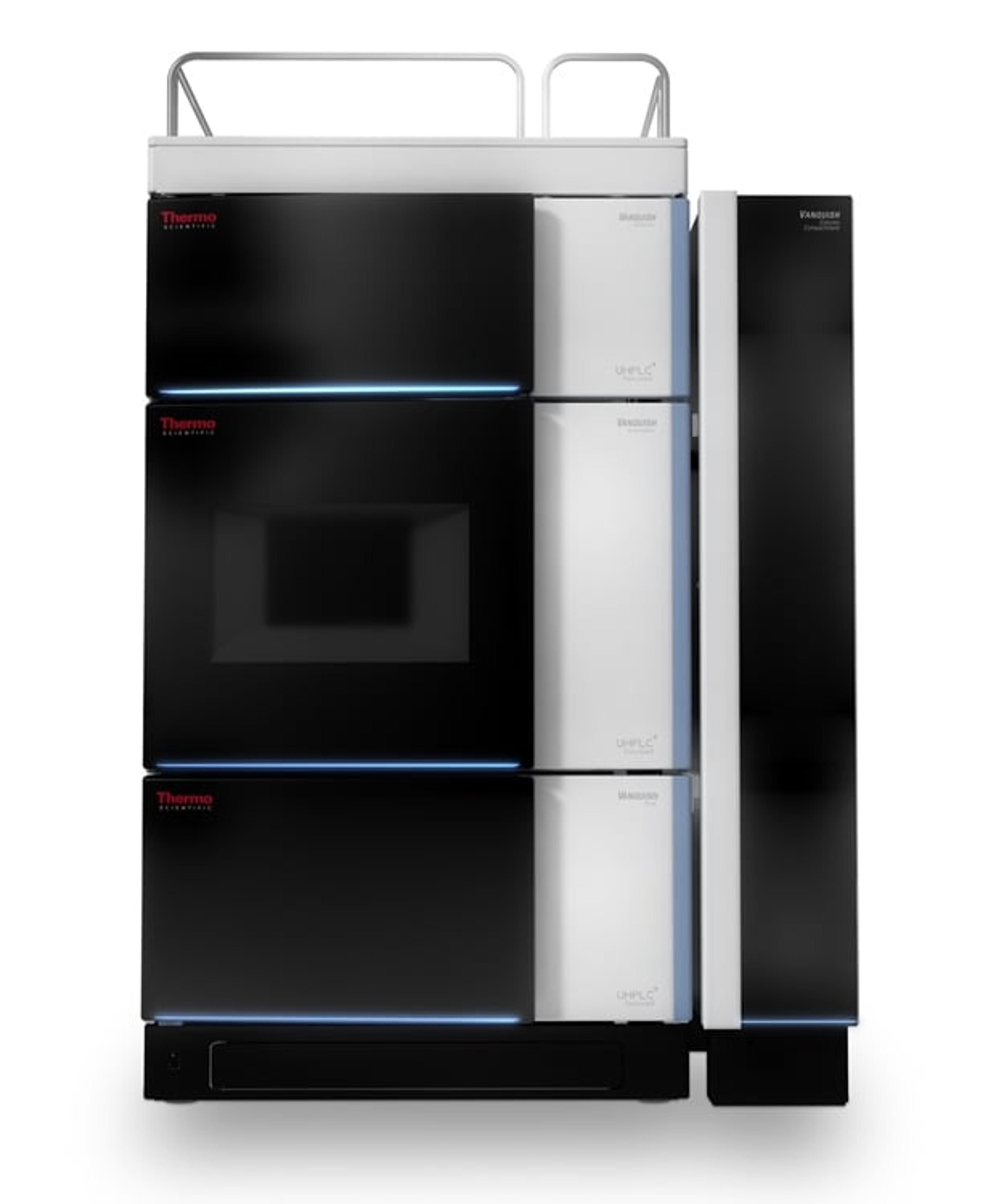
Thermo Scientific™ Vanquish™ Flex Quaternary UHPLC System
Thermo Fisher ScientificThe Thermo Scientific™ Vanquish™ Flex Binary UHPLC system is biocompatible with a state-of-the-art binary high-pressure pump and state-of-the-art binary solvent blending. This ultra high performance liquid chromatography system shares all Vanquish values, such as a design focused on uptime, robustness and reliability. Multiple detection options as well as Thermo Scientific™ Viper™ fingertight connections throughout the system will give you the performance you need with the ease of use you want. Our SmartFlow™ pumping technology with automatic compensation for changing eluent compressibility ensures excellent flow and gradient precision, independent of eluent composition and backpressures. This gives you unrivaled retention time precision and highest data confidence, even for ternary and quaternary gradients, and for more freedom in method development and application switching. Detection capabilities include high sensitivity and linearity Diode Array Detection with LightPipe technology, selective and sensitive Fluorescence Detection and near-universal detection capabilities with the Vanquish Charged Aerosol Detector. Key Features: Integrated modularity design concept to offer uncompromising UHPLC State-of-the-art quaternary solvent blending 1000 bar of pump pressure and flow rates up to 8 mL/min Industry-leading flow and gradient precision Multiple detection options including DAD, FLD and CAD Relevant Applications: Separations of Intact mAbs Analysis of labeled glycans Ternary gradient impurity profiling Efficient, reliable peptide mapping