New Refractive Index Detector with a Very Wide Dynamic Range from KNAUER

Hall A2, Stand 307

19 Apr 2016

Tamara Preuschoff
Marketing / Sales

Product news

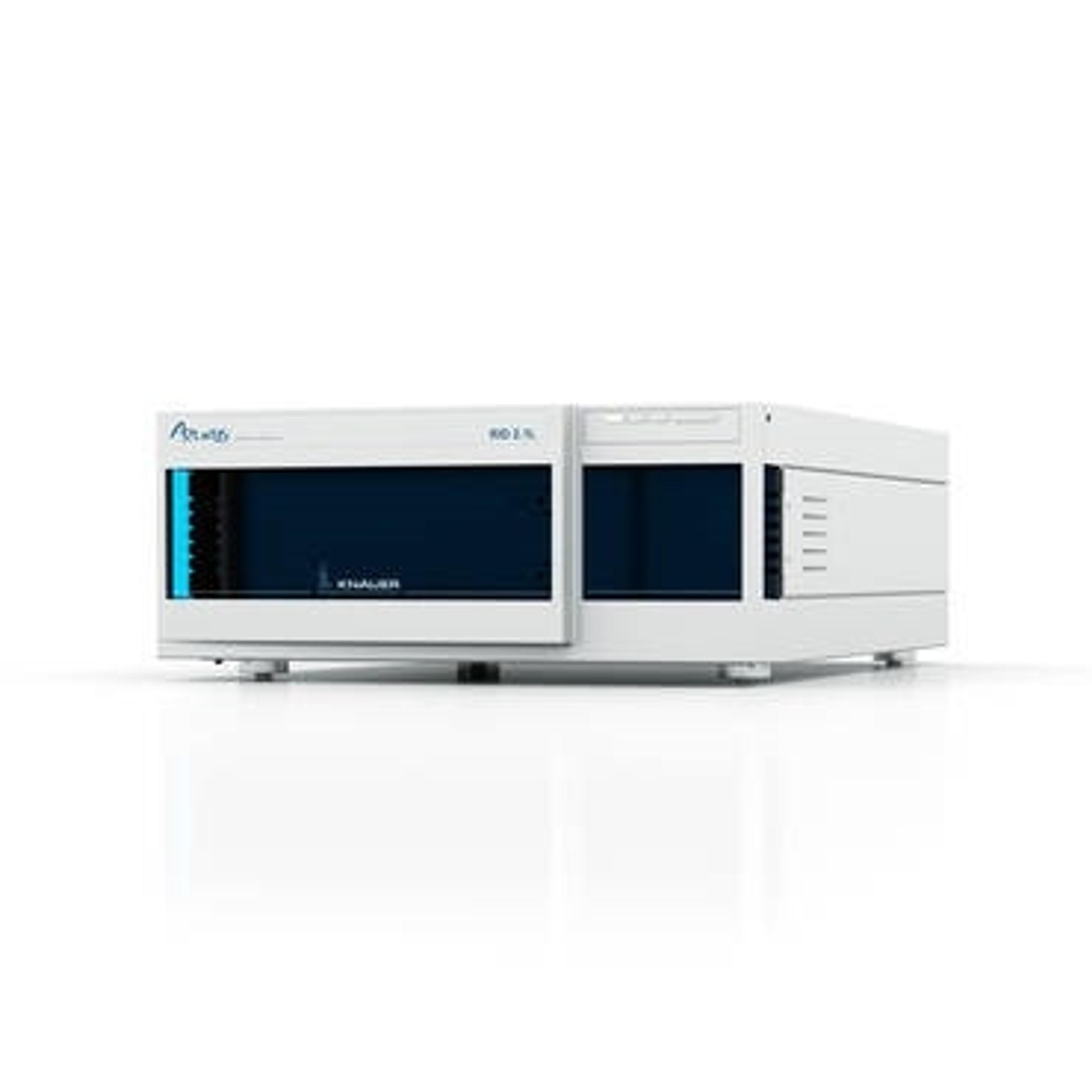
At Analytica 2016, the trade show for the laboratory field taking place in Munich from May 10th to 13th, KNAUER will be introducing a newly developed refractive index (RI) detector with most up-to-date features.

The AZURA RID 2.1L is a sensitive and competitively priced differential refractometer suitable for detecting compounds with little or no UV activity such as alcohols, sugars, lipids or polymers. This instrument is designed for use in analytical HPLC (high performance liquid chromatography) as well as for GPC (gel permeation chromatography) applications.

The intelligently designed optical unit with advanced temperature control ensures high sensitivity, fast baseline stabilization, and excellent reproducibility. Furthermore, the long-life LED, highly pressure resistant flow cell, improved safety features and enhanced diagnostics functions guarantee easy handling and minimal maintenance.

The wide linear dynamic range of up to 2000 µRIU and its maximum flow rate of 10 ml/min, make the AZURA RID 2.1L the perfect choice for most LC tasks.

This detector can be controlled with OpenLAB® EZChrom, ClarityChrom®, Chromeleon® and PurityChrom® Bio software, as well as from the AZURA Mobile Control app (stand-alone operation). Control is possible via LAN or through analog input/output, allowing this RI detector to be integrated into almost any LC system.
Links

Tags

UHPLC and HPLCHigh performance liquid chromatography (HPLC) and ultra high performance liquid chromatography (UHPLC), also known as UPLC, are analytical techniques used to separate, identify and quantitate components of complex mixtures including biological samples such as proteins and lipids as well as chemical mixtures of pesticides, drugs and oils. Both techniques are liquid chromatographic methods but differ by operating pressures (HPLC < 6000 psi < UHPLC ). Components of HPLC and UHPLC systems include columns, detectors, pumps, autosamplers and column heaters. Explore a range of UHPLC and HPLC columns for your specific sample needs including reverse phase, normal phase, ion exchange, HILIC, ion exclusion and size exclusion columns. For more specialized HPLC, explore FPLC, countercurrent LC and simulated moving bed systems. Find the best UHPLC and HPLC equipment in our peer reviewed product directory: compare products, check customer reviews and receive pricing direct from manufacturers.Sample PreparationSample preparation can improve the quality and speed of separation techniques. Products to assist sample preparation include filtration equipment, evaporators, membranes and sieves.UV-Visible SpectroscopyUltraviolet-visible (UV-Vis) spectrophotometers are used to measure the interaction of UV and visible light with a sample, including transmission, reflectance & absorbance. The two major instrument classes are single-beam or double-beam spectrophotometers. More specialized equipment includes colorimeters, spectroradiometers and refractometers. Portable and microvolume spectrophotometers are also available. For the modular spectroscopy lab, explore a range of light sources for combination with a spectrograph/spectrometer and optics. Find the best UV-Vis spectroscopy products in our peer-reviewed product directory: compare products, check customer reviews and receive pricing direct from manufacturers.Refractive IndexanalyticaAnalytica is a leading international trade fair for laboratory technology, analysis, and biotechnology, showcasing innovations and solutions in the scientific community. Stay updated with the latest trends and products in the industry. LipidsLipids are a diverse group of organic compounds that are insoluble in water, including fats, oils, and hormones. They are critical for cellular structure and energy storage. Explore lipid analysis tools in our peer-reviewed product directory; compare products, check reviews, and get pricing directly from manufacturers.PolymersPolymers are large molecules made up of many repeat units. Natural polymers such as DNA and proteins are essential to life, whereas synthetic polymers such as polystyrene and polyethylene are used widely due to their functionality. Typical techniques for analysis include GPC, SEC, DSC, FT-IR and NMR.Sugars in Biomass