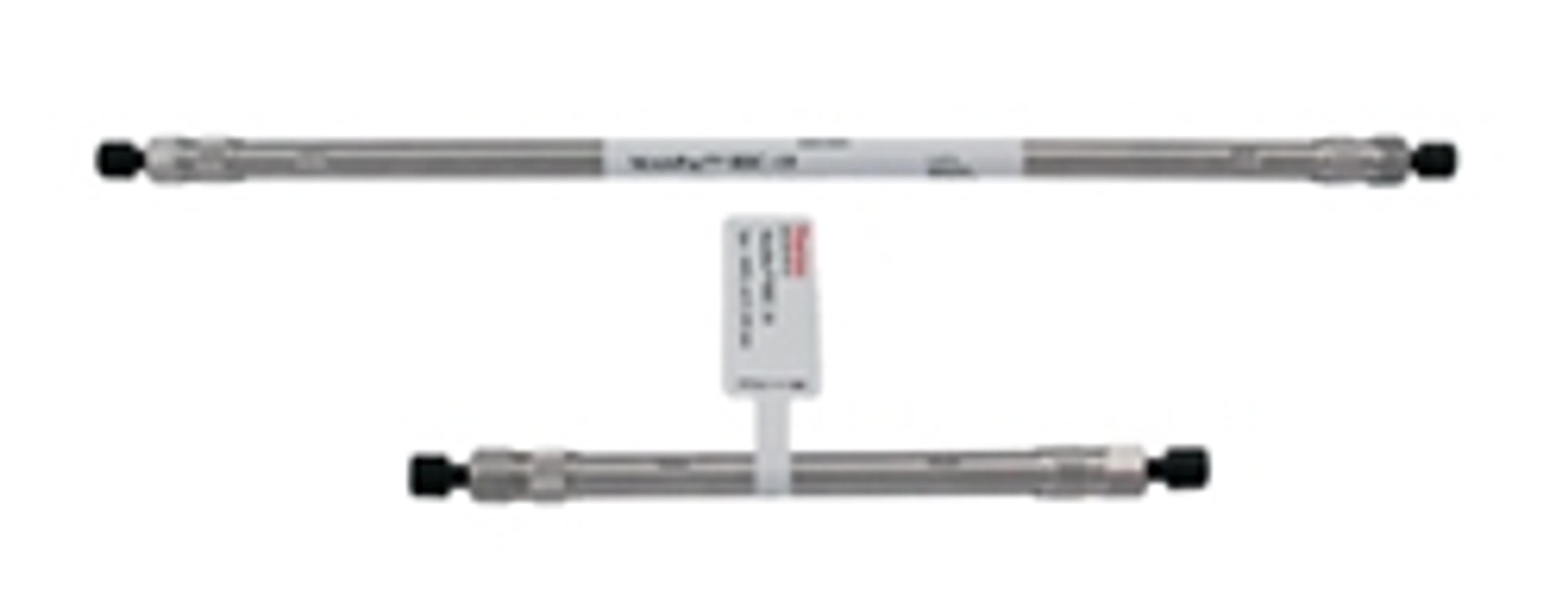
New Hydrophobic Interaction Column Offers

20 Aug 2014

Kerry Parker
CEO

Product news

Many laboratories analyzing monoclonal antibodies (mAb) regularly encounter situations where they need alternative hydrophobic interaction chromatography (HIC) selectivity. Thermo Fisher Scientific has developed new column chemistry that separates many more of these challenging mAbs, antibody-drug conjugates (ADCs) and proteins.

The Thermo Scientific MAbPac HIC-10 HPLC column has been demonstrated to provide selectivity that is different from other commercial HIC columns, including separating many native mAbs, fragments, aggregates, oxidation variants, PEGylated mAbs and ADC.

The column’s proprietary chemistry is designed to provide the new selectivity in a high-resolution column with excellent biocompatibility and high recovery. The column is compatible with organic solvent and aqueous mobile phase. It is designed for rugged stability and very low carry-over.

“MAbs are the most successful and prominent class of biotherapeutics,” said Ilze Birznieks, product line manager, biocolumns, Thermo Fisher Scientific. “HIC is a popular technique for separating these biomolecules, but researchers have been continually asking for alternative selectivity. This new column responds to these customer demands.”

For more information, please visit our website.

Thermo Scientific™ MAbPac™ HIC-10 Monoclonal Antibody Column

Thermo Fisher Scientific

Designed for separation of monoclonal antibodies (MAbs) and related biologics by hydrophobic interaction, the Thermo Scientific™ MAbPac™ HIC-10 LC column is a high resolution silica column. The MabPac HIC-10 column's unique chemistry provides high resolution, excellent biocompatibility, and selectivity that is different from other HIC columns on the market. The MAbPac HIC-10 column is based on high-purity, spherical, wide-pore (1,000Å), 5μm silica particles functionalized with proprietary alkyl amide groups. Its advanced surface bonding technology leads to excellent chemical stability, high efficiency, and unique selectivity optimized for MAbs and different from other HIC phases.Features: Excellent biocompatibility and extremely low carryover High resolution and high efficiency Compatible with both organic solvent and aqueous mobile phases Rugged column stability Column Details: Type: Hydrophobic Interaction, Alkyl amide Particle Size: 5 µm Pore Size: 1000 Å Length: 100, 250 mm ID: 4.6 mm

(1)

Links

Tags

UHPLC and HPLCHigh performance liquid chromatography (HPLC) and ultra high performance liquid chromatography (UHPLC), also known as UPLC, are analytical techniques used to separate, identify and quantitate components of complex mixtures including biological samples such as proteins and lipids as well as chemical mixtures of pesticides, drugs and oils. Both techniques are liquid chromatographic methods but differ by operating pressures (HPLC < 6000 psi < UHPLC ). Components of HPLC and UHPLC systems include columns, detectors, pumps, autosamplers and column heaters. Explore a range of UHPLC and HPLC columns for your specific sample needs including reverse phase, normal phase, ion exchange, HILIC, ion exclusion and size exclusion columns. For more specialized HPLC, explore FPLC, countercurrent LC and simulated moving bed systems. Find the best UHPLC and HPLC equipment in our peer reviewed product directory: compare products, check customer reviews and receive pricing direct from manufacturers.Protein PurificationProtein purification is a vital step in drug discovery, therapeutics, biotech and life science research. The purification process typically involves subcellular or membrane protein extraction with cell lysis kits, separation of proteins from cell debris by filtration or spin columns, and the isolation of proteins of interest from other proteins and impurities with affinity purification (including fusion protein tags and antibody binding proteins A, G and L), immunoprecipitation or chromatographic methods, such as ion exchange, size exclusion and immobilized metal affinity chromatography. All purification methods come in multiple formats for your laboratory needs, including agarose or magnetic beads, resins, columns and filter plates. Find the best protein purification equipment in our peer-reviewed product directory: compare products, check customer reviews and receive pricing direct from manufacturers.Scale-upScale-Up is generally defined as the process of transferring the results of the discovery phases of the drug discovery process, obtained on a laboratory scale, to the pilot plant and finally to production scale. Scale-Up uses reactors and pump systems as well as reagents, standards and buffers. Often Scale-Up is provided as a service by Contract Manufacturing Organizations (CMOs). Monoclonal AntibodiesMonoclonal antibodies (mAbs) are lab-made molecules that can bind to specific antigens on cells, making them highly effective in treating cancers, autoimmune diseases, and infections. These targeted therapies are transforming the treatment landscape for many conditions. Browse our peer-reviewed product directory to find monoclonal antibodies for research and clinical applications; compare products, check reviews, and get pricing directly from manufacturers.ChromatographyChromatography is a powerful technique used to separate and analyze components of mixtures based on their chemical properties. It is widely used in fields like biochemistry, pharmaceuticals, and environmental analysis. By exploiting differences in the interaction of substances with a stationary phase and a mobile phase, chromatography enables precise purification and quantification of compounds. Whether you're working with complex biological samples or industrial chemicals, chromatography is essential for obtaining high-quality results. Browse our peer-reviewed product directory to find the best chromatography systems, compare products, read customer reviews, and get pricing directly from manufacturers.BiotherapeuticsBiotherapeutics are proteins and other compounds (such as nucleic acids) produced by living organisms that have uses as therapeutics or in <i>in vivo</i> diagnostics. The most well-known example of a biotherapeutic product, and the first to be approved for therapeutic use, was recombinant human insulin.