
New High Throughput Screening (HTS) Assay to Aid Researchers in Their Search for Breakthrough Drugs Targeting Epigenetic Pathways
12 Oct 2017
Product news
The AptaFluor™ SAH Methyltransferase Assay is an enabling new high throughput screening (HTS) assay to aid researchers in their search for breakthrough drugs targeting epigenetic pathways.
Methyltransferases have become a major focus of drug discovery for cancer and other diseases driven by epigenetic factors. BellBrook Labs’ new, ultra-sensitive AptaFluor™ SAH Methyltransferase Assay eliminates cost and sensitivity barriers that are slowing the discovery of methyltransferase inhibitors.
Methyltransferases produce a variety of methylated products, but most use S-adenosylmethionine (SAM) as the methyl donor, leaving S-adenosylhomocysteine (SAH) as a common reaction product. BellBrook scientists engineered a naturally occurring SAH aptamer to produce a fluorescent signal on binding to SAH, resulting in a non-radioactive assay with unparalleled sensitivity.
By directly detecting SAH, the new AptaFluor assay is universal and can be used with virtually any methyltransferase enzyme. The assay utilizes a simple mix-and-read format with a far-red positive TR-FRET readout, ensuring its compatibility with automated dispensing equipment and plate readers commonly used for HTS.
Ultra-Sensitive
- LLD of 0.6 nM SAH - Perfect for low turnover methyltransferases
- Robust assay with Z' values greater than 0.7 under initial velocity conditions
- Use with SAM concentrations as low as 100 nM
- Reduces enzyme usage by 30X or more
- Assay at or below Km for SAM
Applications
- Monitor methyltransferase enzyme activity
- Characterize and validate potential hits
- Determine inhibitor potency
- Profile inhibitor selectivity
- Mechanism of action studies
Related products
Request Quote for All Products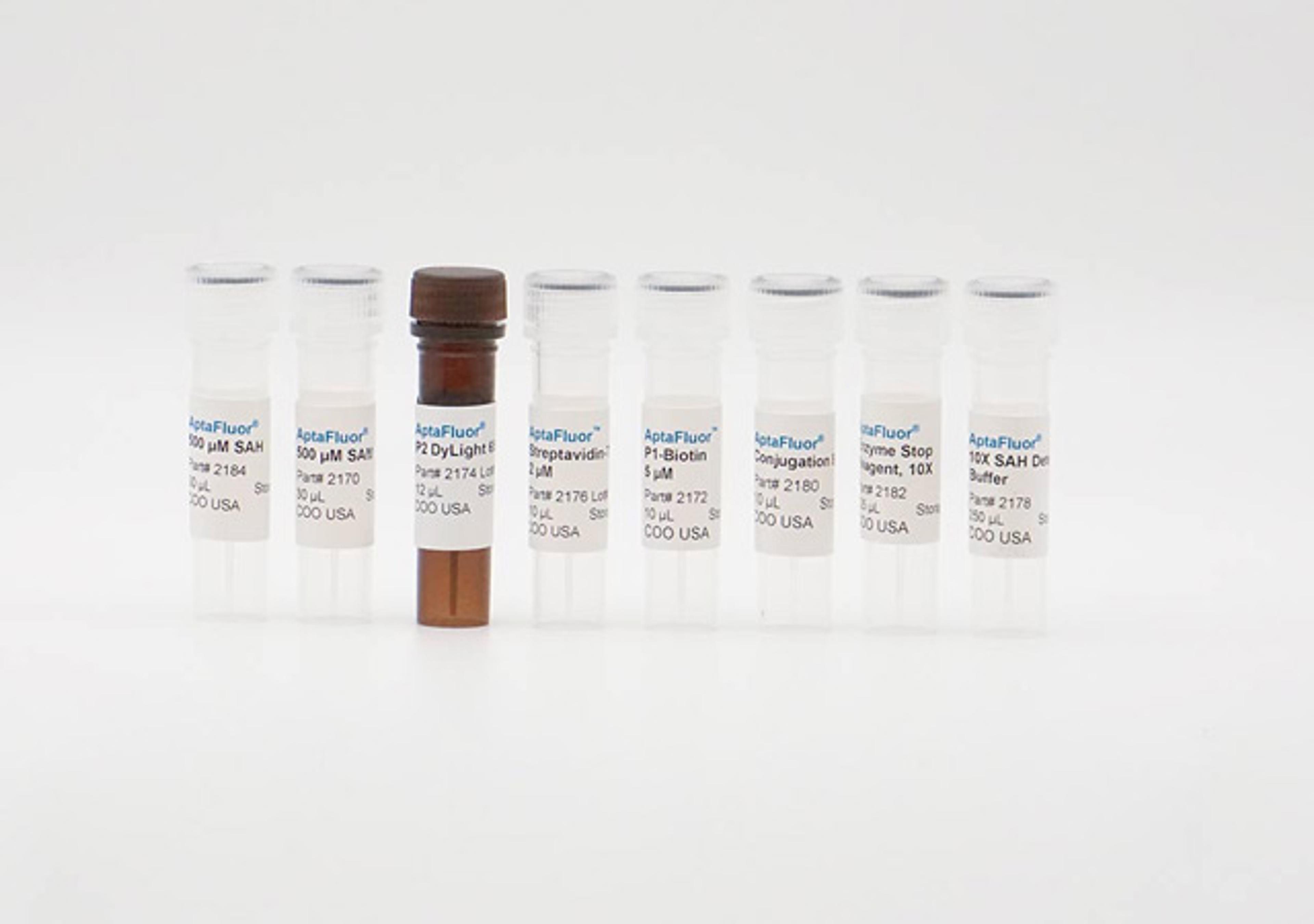
AptaFluor™ SAH Methyltransferase Assay
BellBrook LabsThe AptaFluor® SAH Methyltransferase Assay Kit enables ultra-sensitive, direct detection of SAH—the universal product of methyltransferase reactions—using a riboswitch-based TR-FRET format. With no coupling enzymes required, it delivers high signal-to-background, Z’ ≥ 0.7, and is fully HTS-compatible for drug discovery and inhibitor screening.