
New Conductive and Stackable Disposable Tips in the 384 Format at Biotechnica 2009
28 Sept 2009Product news
HAMILTON are to offer conductive tips for the CO-RE 384 probe head at Biotechnica 2009. In addition to the possibility to detect the liquid level these tips where also designed to be stackable, in order to save space on the system. Visit Hall 9, booth G24 to explore these exciting new features on the most innovative pipetting platform and get input for your automation projects.
Users requiring absolute precision when handling their valuable samples in the 96- or 384-well format can now benefit from a number of new products from the innovation leader in automation. . The CO-RE 384 probe head can also be “converted” to a 96-probe head on the fly by using HAMILTON’s “Rocket-Tips” – adapters that combine 4 probes into one offer pipetting in the 96-well format. The CO-RE 384 probe head itself has been redesigned to offer not only column- and row-wise tip pickup, but also any user required pattern, i.e. quadrants or even single tips.
The new CO-RE 96 probe TADM head brings HAMILTON’s unique “Monitored Air Displacement” to the multiwell format. Each of the 96 probes has an individual pressure sensor that allows for complete aspiration and dispense monitoring. All benefits the individual channels of the Microlab® STAR line are famous for since the STAR’s introduction in 2001 are now available on a 96-probe head: Clot detection, detection of short samples and any devation from the expected pipetting curve. Together with HAMILTON’s CO-RE tips, this head now offers the highest possible process safety in the 96-well format available today.
Related products
Request Quote for All Products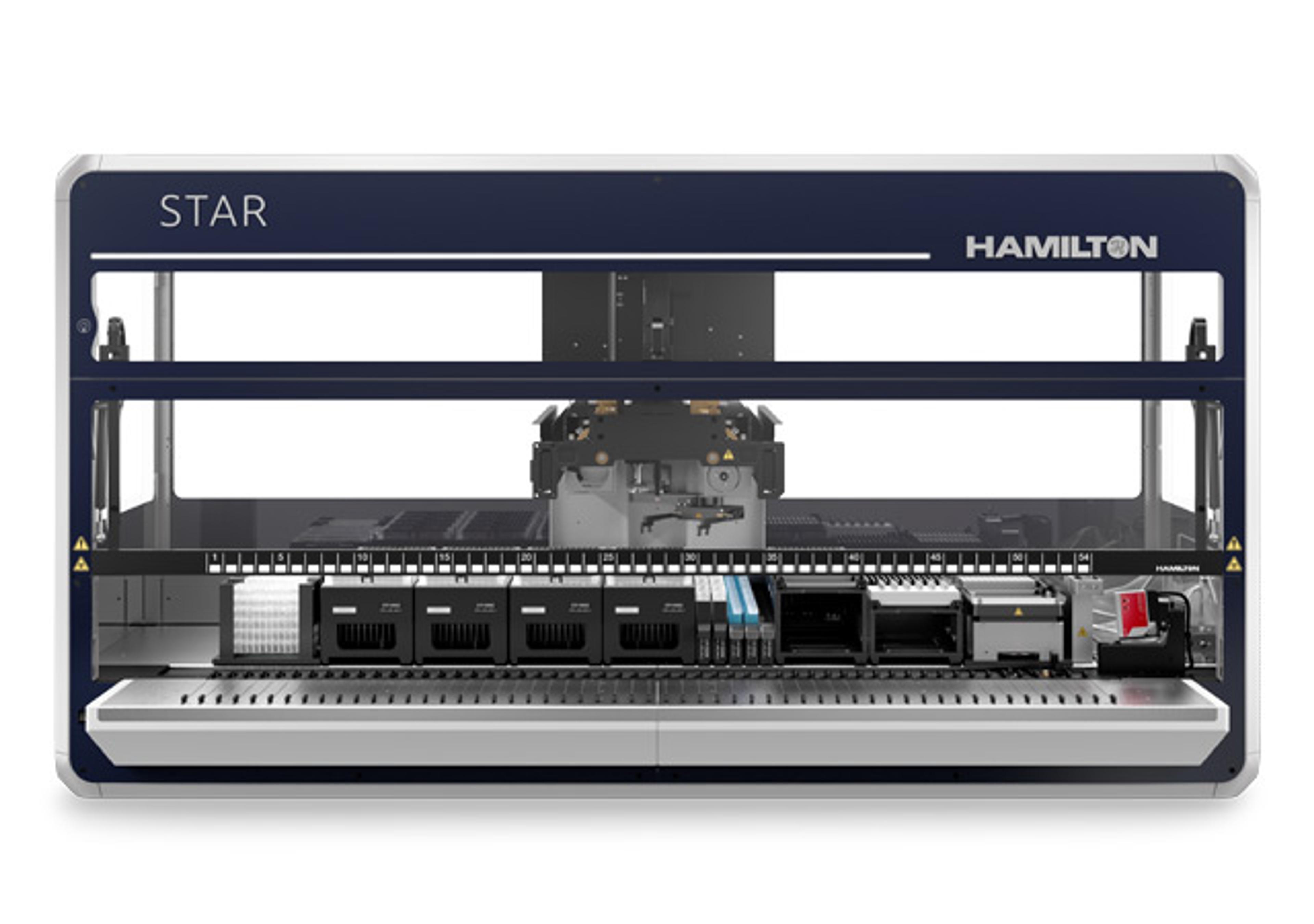
Microlab STAR
HamiltonExperience Automation Your Way. The Microlab STAR Line automates liquid handling tasks from simple to complex with exceptional precision and flexibility so that you can increase throughput, reduce errors, and gain confidence in results.