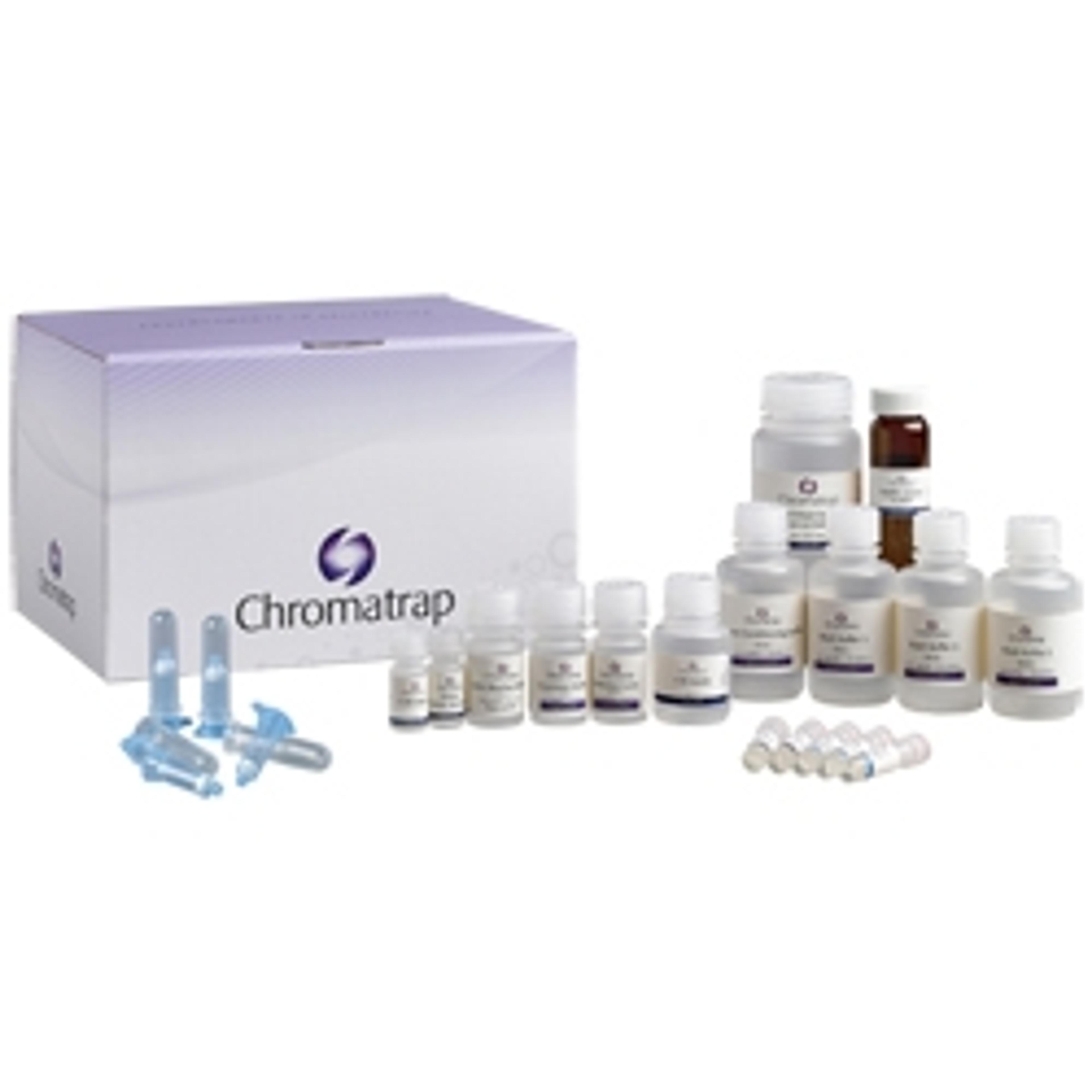
New and Improved ChIP Assay Kit Released

1 May 2017

Emily Adam
Publishing / Media

Product news

Chromatrap® has introduced a new and improved version of it’s popular solid phase chromatin immunoprecipitation (ChIP) assay kit for chromatin extracted from Formalin Fixed Paraffin Embedded (FFPE) tissue.

Ideal for tissue samples, biopsies and difficult to lyse samples, the Chromatrap® FFPE ChIP-seq kit has overcome the issues often associated with FFPE ChIP, by offering a streamlined protocol which provides the user with excellent quality isolated chromatin.

The new updated Chromatrap® FFPE ChIP-seq kit protocol is shorter, offers increased chromatin yield / accessible epitopes and provides greater flexibility in chromatin sample loading for ChIP.

The sensitivity of the unique Chromatrap® solid state platform ensures that small samples can be used with efficient enrichment of both high and low abundant targets. Chromatrap® FFPE ChIP-​seq kits provide a quicker, easier and more efficient way of performing ChIP assays from a range of FFPE samples. Using the unique, patented Chromatrap® technology maximises the capture efficiency of the target chromatin/antibody complex. By avoiding the use of magnetic or agarose beads, non-specific background is eliminated together with reduced manual handling errors and subsequent sample loss.

This kit is compatible with both qPCR and sequencing as a downstream process and has a wide dynamic range, ensuring that adequate DNA is enriched for library preparation for sequencing. The wide dynamic range of the Chromatrap® FFPE ChIP-seq kit enables better results from small sample sizes and provides greater flexibility. Prior to sequencing, DNA purification is required and Chromatrap® purification columns are supplied for ease of use.

Each Chromatrap® FFPE ChIP-seq kit contains sufficient Protein A or Protein G based spin-columns, buffers and reagents to perform 24 chromatin immunoprecipitation assays and up to 10 chromatin preparations.

Chromatrap® FFPE ChIP Kit

Chromatrap

Epigenetic identification and targeting in clinical FFPE tissues is a crucial step for potential epigenetic therapeutics and personalized medicine therapies. FFPE is a standard method to archive and preserve medical tissue biopsy samples. These archives, kept in many hospitals world-wide, are a huge, rich and untapped sample resource for genetic research. Due to the cross-linking of proteins by formaldehyde, FFPE tissues present a particular challenge for ChIP analysis. In addition, the small size and delicate nature of the tissue, and the difficulty in extracting samples from paraffin, used to provide tissue support after preservation, can damage complex cellular complexes such as chromatin. ChIP assays from these samples have therefore proved time consuming and difficult.  Chromatrap® FFPE ChIP kit overcomes these issues and provides the following benefits: Provides greater flexibility and more IPs per sample Works across a range of FFPE samples, human and animal Available in 96-well plate or spin column format Works equally well with high and low abundant marks Provides sufficient DNA to perform library preps for ChIP-seq assays

(0)

Links

Tags

Genome AnalysisGenomics, the study of genomes, includes functional genomics, evolutionary genomics and comparative genomics. There are many genomic technologies such as DNA sequencing of whole genomes, computational biology and bioinformatics. DNA and nucleic acids must be isolated and concentrated from cells for analysis with kits, automated analyzers and software. Other useful technologies for studying genomics include PCR, microarrays and electrophoresis.ProteomicsProteomics is the systemic bioinformatics study of proteins and amino acids, including their structure, size, function and identification. Tools used in proteomics include chromatography, blotting and gels, protein arrays, mass spectrometry and ELISA and associated analysis software. Analyzers and proteomic systems should be sensitive, high resolution, fast and may be automated for high-throughput.DNA SequencingDNA sequencing, such as sanger sequencing, is a biological technique that determines the precise order of nucleotide bases in a fragment or template of DNA. DNA sequencers and genetic analyzers are based on capillary electrophoresis, where labeled DNA fragments are electrophoretically separated by size as they migrate through a polymer. Find the best DNA sequencing products, including DNA sequencing kits, genomic libraries and genetic identity kits in our peer-reviewed product directory: compare products, check customer reviews and receive pricing direct from manufacturers.Gene Expression and Molecular CloningMolecular cloning is a set of techniques that utilizes vectors to transfer recombinant DNA into host cells and is an essential tool for investigating the expression of genes and proteins in bacterial or mammalian cells. A variety of vectors optimized for gene cloning and expression in a range of host organisms are available, alongside competent cells for genetic replication. Here, you can explore a range of molecular tools, high-quality genomic and cDNA libraries, premade clones, transformation and transfection reagents and mutagenesis or gene expression detection assays and expression arrays. Find the best gene expression and molecular cloning products in our peer-reviewed product directory: compare products, check customer reviews and receive pricing direct from manufacturers.Next Generation SequencingNext-generation sequencing (NGS), also known as whole-genome sequencing, high-throughput sequencing and massive parallel sequencing, produces and analyses thousands to millions of nucleotide sequences at once. Sequencing systems operate via varying technologies depending on the manufacturer, including sequencing by synthesis, ligation, pyrosequencing, ion semiconductor and single-molecule real-time sequencing. For NGS, library preparation is paramount to successful sequencing. In this section, explore a range of library preparation kits, from targeted, amplicon-based or hybridization-based kits including epigenomic, transcriptomic and genomic workflows to fragmentation kits. Find the best next-generation sequencing products in our peer-reviewed product directory: compare products, check customer reviews and receive pricing direct from manufacturers.ChIP-SequencingClinical NGSNext Generation Sequencing (NGS) refers to the use of massive parallel sequencing of multiple small fragments of DNA. This high-throughput genomic analysis yields enormous amounts of sequence data, which if appropriately analyzed could have huge potential for clinical laboratories. For this to happen there are technique and bioinformatic hurdles to be overcome.ChromatinSequencingSequencing refers to determining the order of nucleotides in a DNA or RNA molecule. This process is essential in genomics, diagnostics, and evolutionary biology. Techniques like next-generation sequencing (NGS) and Sanger sequencing provide high-throughput and precise data for analyzing genomes and transcriptomes. Browse our peer-reviewed product directory to find the best sequencing tools and reagents, compare products, check reviews, and get pricing directly from manufacturers.Genome SequencingGenome sequencing involves determining the complete DNA sequence of an organism's genome. It provides crucial information about genetic variations, mutations, and diseases. Advances in sequencing technologies, such as next-generation sequencing (NGS), have accelerated research in genomics, diagnostics, and personalized medicine. Explore genome sequencing tools in our peer-reviewed product directory; compare products, check reviews, and get pricing directly from manufacturers.