
Modern Sample Preparation Solutions Bring Mass Spec to the Clinical Research Lab
State-of-the-art PaperSpray technology simplifies mass spectrometry integration and improves efficiency
27 Jun 2016
Editorial article

Nicholas Manicke, Professor of Chemistry, IUPUI, U.S. Prosolia Velox 360™ PaperSpray™ System The Prosolia Velox 360™ PaperSpray™ System is a direct ionization technique for qualitative and quantitative analysis of small molecules from complex matrices such as blood and urine without time-consuming sample preparation and liquid chromatography.
Nicholas Manicke is a mass spectrometry expert and Professor of Chemistry at the Indiana University-Purdue University Indianapolis (IUPUI), U.S. In this interview with SelectScience’s Associate Clinical Editor, Sonia Nicholas, Nicholas discusses the very latest, state-of-the-art technology available for mass spectrometry sample preparation.
SN: Could you tell us about the type of work that you do and how you are using Mass Spectrometry (MS)?
NM: I am a professor at the IUPUI University, which is located in downtown Indianapolis. I started working here about 3 years ago and amongst other duties, I lead an analytical chemistry research group focused on MS and sample preparation approaches. Prior to joining IUPUI, I started doing some spin out work on PaperSpray® technology. I continue to be involved in developing new technologies and techniques using PaperSpray, working with both Prosolia and Thermo Fisher Scientific.
Current Challenges
SN: What are the problems traditionally associated with mass spectrometry in clinical research?
NM: With the exception of some large, commercial laboratories, the vast majority of clinical labs, located in clinics or hospitals, are not fully automated with numerous multiplexed systems. It is currently quite rare for moderately sized, laboratories like this to carry out MS analysis. It is more likely that these tests would be sent out to a specialist lab.
One of the reasons why these labs don’t use MS, is because the barrier for entry is so high. Not just to invest and install a system, but also when you consider the cost of the labor and expertise required.
Analysis time is also important; fast turnaround times are vital for clinical laboratories because clinicians often can’t wait for a send-away test to be analyzed and for a result to be returned. MS is not generally considered to be a rapid test method. Proper sample preparation is critical to the MS workflow, but this step can be time consuming and can introduce an element of variability that can have a serious impact on result quality.
If we can simplify MS workflows, this should make it easier for labs to carry out MS analysis.
A sample preparation solution
SN: How can the PaperSpray system help to simplify the MS workflow?
NM: Let’s say that we want to investigate how we might analyze the concentration of a drug in someone’s system. In our research experimental set up, we would take the plasma sample, and have to carry out some sort of extraction – meaning that we remove a significant amount of the drug from the biological components surrounding it. This extract is injected into a liquid chromatography system, before being injected into the MS.
These pre-analytical procedures are time consuming and labor intensive, but with PaperSpray, it may be possible to replace both the extraction and chromatography steps. PaperSpray uses a thick absorbent paper that is loaded into a disposable cartridge. Blood is spotted onto this paper matrix and the cartridge is loaded directly into the PaperSpray system.
The instrument adds a solvent to the paper, and this solvent wicks through the blood spot by capillary action. As this happens, the soluble organic component (in our example, the drug being tested) is extracted into the liquid phase. A high voltage is applied to the wet paper, which produces an electrospray plume which gets transferred into the mass spectrometer.
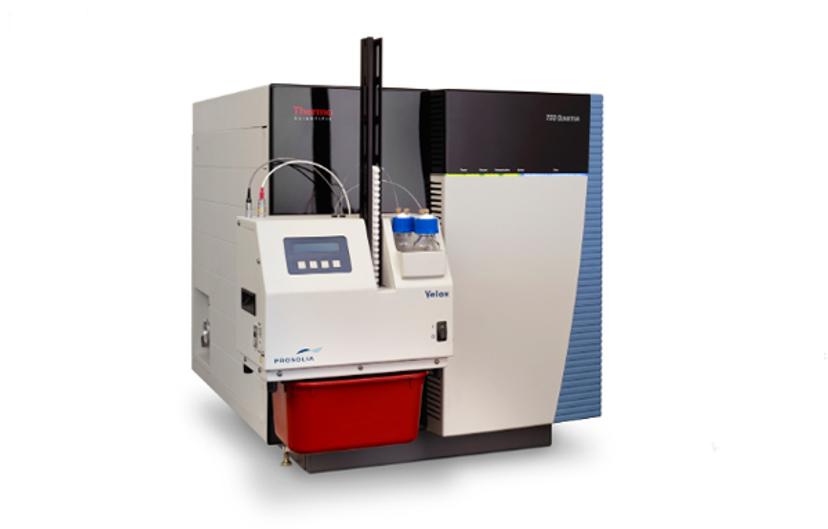
Prosolia Velox 360™ PaperSpray™ System
SN: What benefits does PaperSpray offer to the laboratory?
NM: For the applications we’ve researched, PaperSpray eliminates the sample preparation steps necessary for MS analysis. A major advantage of the technology is that it can be used with dried bloodspots, a sample collection method that is becomingly increasingly routine in clinical laboratories. This system uses much smaller solvent volumes and produces much less solvent waste. If we can eliminate the need for liquid-liquid extraction, we also eliminate the need for additional processing steps, such as centrifugation and manual preparation.
A further headache associated with HPLC systems is carryover. This is when high concentration samples are carried over from one sample to the next. PaperSpray shows promise in eliminating this problem, as the system uses a fresh disposable cartridge for each new sample.
An additional advantage shown by our research is that the PaperSpray ion source is significantly simpler than HPLC. HPLC can be quite troublesome and prone to problems such as leaks in the fittings and plumbing, and deteriorations in the LC column. PaperSpray removes the liquid chromatography step so there are no columns or high pressure solvents to replace. Not only is this less technical, it also removes the expense associated with disposing solvents.
An emerging technology
SN: What are the current limitations of PaperSpray?
NM: PaperSpray shows great promise in our research so far, however there are a number of limitations that laboratories should be aware of. The PaperSpray system does not carry out front-end sample separation, as such it relies on exact mass and/or MS/MS alone for selectivity. The detection limits with PaperSpray are also not as good as with LCMS; single digit ng/mL LLOQ are typical.
SN: Is the installation of PaperSpray easy?
NM: The first time the ion source is added there is a bit of work to do such as putting it all together, installing the software etc. However, once it’s up and running it is easy to swap back and forth between MS and commercial LC-MS. There is a flange that is instrument specific which latches onto the front of the MS. The PaperSpray ion source is held by the flange, the operator then only needs to exchange the existing electrospray ion source with the PaperSpray source.
SN: Do you have any further advice for any lab considering installing this technology?
NM: There are two things that you need to think about if you are considering using PaperSpray technology – analyte sensitivity (the lowest quantity of a substance to be tested) and analyte selectivity (the ability to distinguish a particular substance from others with similar interferences). You do need to know a bit about your required detection levels, and you need to know if there are any other chemicals that could give a similar signal to the analyte. These are the two things I would always look at during any clinical research method development.
For research use only. Not for use in diagnostic procedures.