
MicroPro in the Lab: Avidien announces winner of microPro giveaway contest
For their prize, Dr. Lieberman and her team have chosen to receive the upcoming low volume model, the microPro 25
11 Oct 2020
Industry news
MIT researcher, Dr. Tami Lieberman, is the winner of Avidien’s microPro giveaway contest! In 2019, participants submitted entries in hopes of winning a free microPro for their lab. The Lieberman lab already owns a microPro 300 that is heavily used in their human microbiome research. They eagerly submitted entries in hopes of bringing a second instrument to their bench! We interviewed Dr. Lieberman about her research and how the microPro supports her lab’s work.
A person’s microbiome is the unique composition of bacteria that have formed an ecosystem in and on their body, often interacting with a person’s own cells in important ways. The microbiome plays a major role in health, impacting everything from the immune system, to digestion, to brain function. Dr. Lieberman’s research aims to illuminate why some strains of bacteria easily take up long term residence in a person’s microbiome while others fail to form stable colonies, and why this process can look very different from person to person.
Bacteria taken to alter the microbiome, probiotics, hold great promise for improving human health. However, doctors must first understand which microbes hold real influence and which just pass through the body with no impact. Lieberman’s work provides a critical foundation for more targeted and effective probiotic therapies in the future. They study microbial evolution in the body through a combination of experimental, theoretical, and computational approaches, often utilizing genomic tools.
A typical project in the Lieberman lab involves culturing a participants' microbiome and performing whole genome sequencing on thousands of bacterial isolates to determine both the species present and their unique genetic variants. The graduate students in the lab are regularly setting up culture plates and high-throughput metabolic assays, and performing DNA extractions, library preparations, and magnetic bead cleanups prior to sequencing. The microPro 300 has become an essential part of the lab’s workflows thanks to its ability to streamline protocols in ways that save time and deliver clean results.
The lab loves their microPro 300 for many reasons. It’s small size and remote operation allow for use in and out of anerobic chambers. The single-cartridge tip refills eliminate issues with unreliable individual 96 tip refills, making the micoPro a pleasure to work with across protocols. In particular, the microPro has proven effective at fast bead cleanups during prep for high-throughput and Sanger sequencing. Dr. Lieberman notes, “We love how easy it is to avoid disturbing the pellet during wash steps.” These features and more make the microPro a powerful tool for high volume research.
For their prize, Dr. Lieberman and her team have chosen to receive the upcoming low volume model, the microPro 25, when it ships near the end of 2020.
“We are very excited to try out the smaller volume model (the microPro 25)! We have multiple protocols for which we have wanted to use the microPro 300, but the volume limits didn’t allow us to,” says Dr. Tami Lieberman
The original microPro 300 offers high precision liquid handling between 15-300ul, while the new microPro 25 will provide accuracy at 1-25ul. With both microPro’s on hand, the Lieberman lab will be able to streamline even more protocols for efficient and accurate 96-well experiments at any volume.
Do you use Avidien products in your lab? Write a review today for your chance to win a $400 Amazon Gift Card>>
Related products
Request Quote for All Products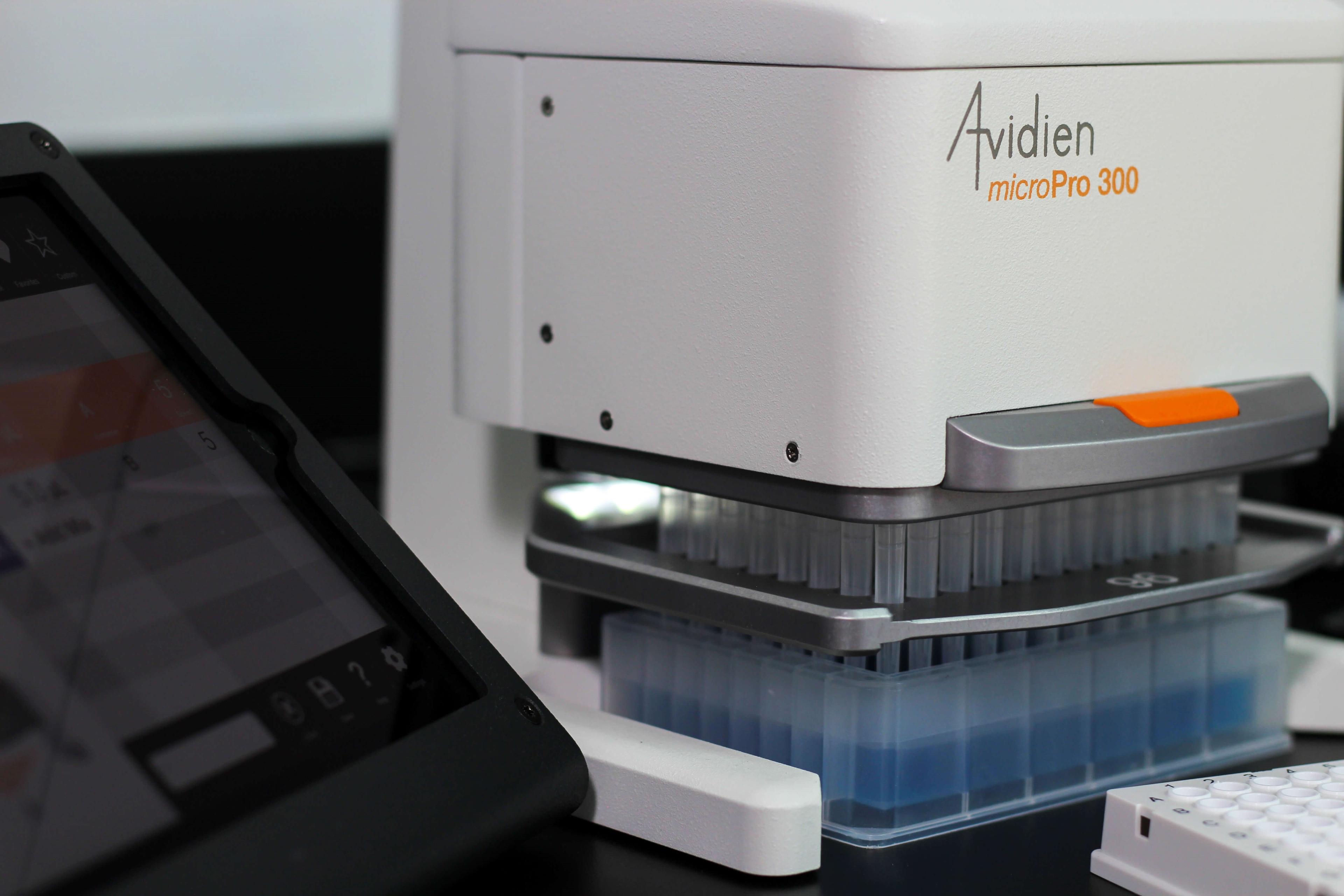
microPro 300
Avidien TechnologiesThe world's smallest 96/384 channel semi-automated benchtop pipettor. This innovative compact instrument packs an enormous feature set that offers unprecedented capability and value. It is accurate, affordable, efficient, reliable and easy to use.