
Metrohm and Industry Leaders Develop ASTM Acid Number Method for Petroleum Products
18 Aug 2016Product news
Metrohm is proud to announce that a method developed using the 859 Titrotherm titrator has been released by the ASTM for the determination of Acid Number (AN) in crude oil and petroleum products. Method D8045 demonstrates the superiority of thermometric titration for complex petroleum samples as it is significantly faster, requires less maintenance and consumes less reagent.
Thermometric titration uses a highly sensitive, fast responding electrode that detects enthalpy change at the endpoint. This method requires no sensor maintenance aside from a solvent rinse, needs no hydration and requires no calibration. New chemistries used in ASTM D8045 significantly lower the costs per analysis by consuming less reagents that require costly disposal.
Acid Number (AN) is a critical quality control parameter for crude oil and petroleum products. The accuracy of the AN influences the commercial value of crude oil and the profitability of a refinery. Acidic compounds lead to corrosion in petroleum refining and transportation infrastructure, therefore accurate AN measurements are necessary for safe operation. The commercial and corrosion impact of the AN make it central to quality control laboratories throughout the industry.
Related products
Request Quote for All Products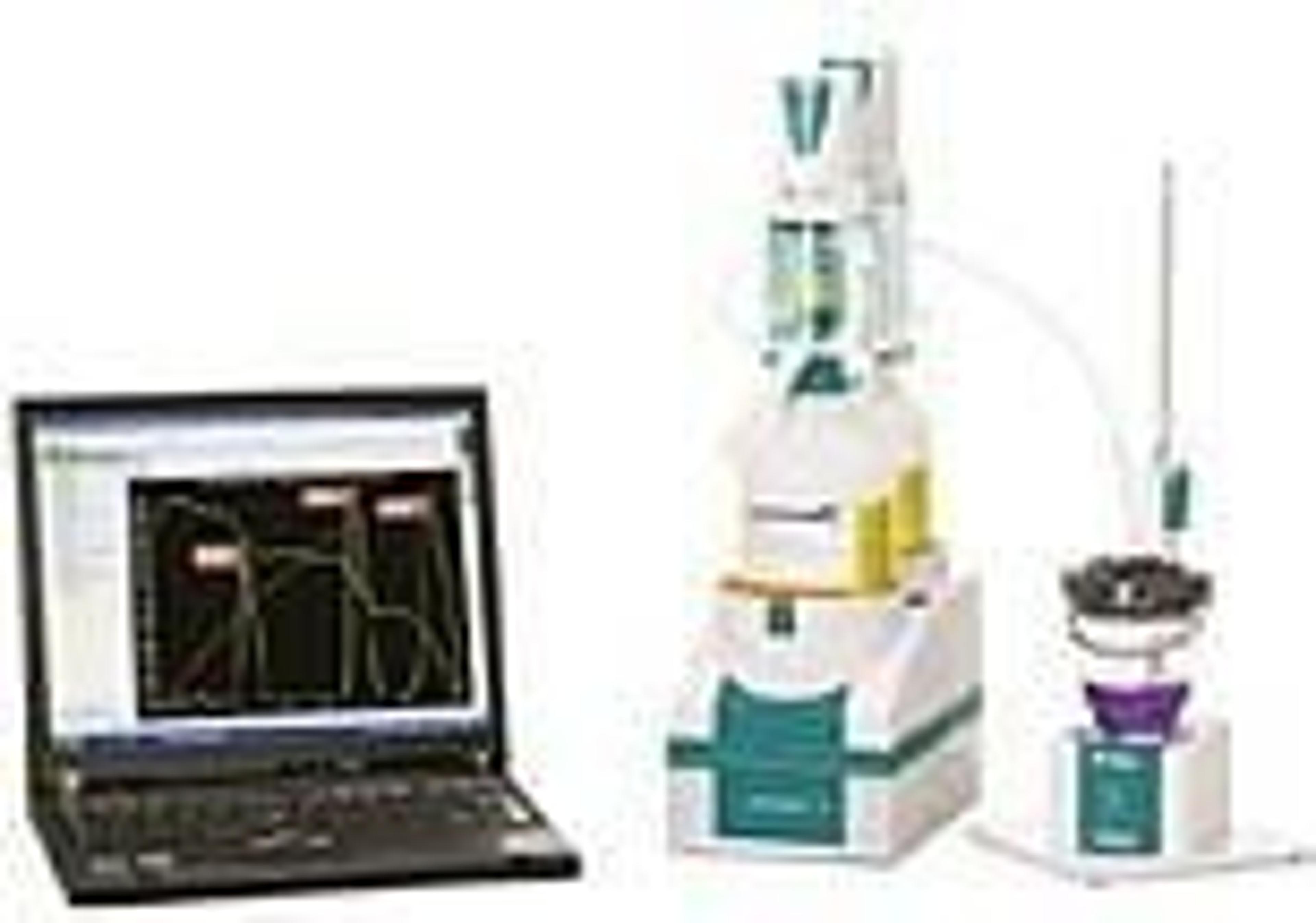
859 Titrotherm
Metrohm AGThermometric titration is a very versatile determination method and an ideal complement to potentiometric titration. In principle it is suitable for any reaction that produces a sufficiently large temperature change in the sample solution. It is particularly suitable for applications for which no suitable potentiometric sensor is available, for which no suitable reference electrode is available, in which the sample affects the indicator electrode or destroys it, for which no solvent is available that is suitable for potentiometry. The 859 Titrotherm combines innovative sensor technology with Metrohm's titration know-how. The temperature sensor based on semiconductor technology (thermistor), has a short response time of 0.3 s and a high resolution of 10-5 K. This makes the Thermoprobe the ideal sensor for thermometric titration, as it can follow any change in temperature quickly and accurately. Metrohm's Dosino technology has defined a new standard for volumetric titration. The Dosing Unit with its drive motor is mounted on the reagent bottle and thus guarantees maximum precision with minimum space requirements. The clearly laid out Titrotherm software allows adaptation of the screen view to the particular method parameters and thus provides rapid access to important commands or parameters. The endpoints are determined by calculating the first and second derivatives of the titration curve; by means of additional optimization parameters, the reproducibility can be improved even further.