Methods for the analysis of SVOCs in water samples

Explore cutting-edge approaches for advancing semi-volatile organic compounds (SVOCs) analysis in water samples

18 Mar 2024

Lawrence Howes
Editorial Assistant

Editorial article

The detection of semi-volatile organic compounds (SVOCs) in drinking water represents crucial elements of environmental surveillance and safeguarding public health. Given the increasing apprehensions regarding water quality and pollution, the establishment of dependable analytical techniques is paramount. SVOCs, distinguished by their ability to distribute between aqueous and solid phases, pose distinct hurdles in detection and measurement. Moreover, their varied molecular compositions and associated health risks emphasize the indispensability of meticulous analytical methodologies.

For the latest insights into the analysis of SVOCs in water samples, delve into this series of application notes from Thermo Fisher Scientific.

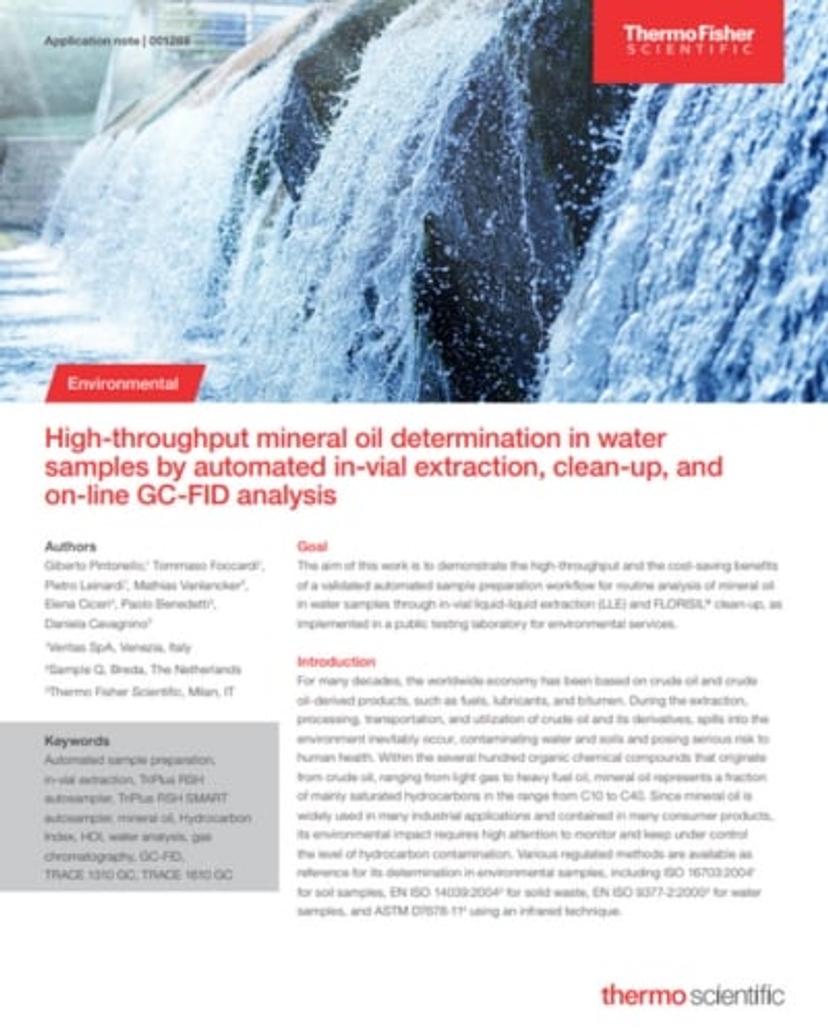
1. High-throughput mineral oil determination in water samples by automated in-vial extraction, clean-up, and on-line GC-FID analysis
Tecan logo

Discover Thermo Fisher Scientific's innovative approach to automating the high-throughput determination of mineral oil in water samples. Through in-vial extraction, clean-up using FLORISIL, and on-line GC-FID analysis, this method streamlines the process. Automation improves efficiency by reducing labor and costs and ensures repeatability and robustness while maintaining acceptable levels of linearity and recovery.


Download resource


2. Automated sample preparation followed by sensitive analysis by GC-MS/MS for environmental contaminants in surface waters

Tecan logo

Explore a study that addresses environmental contaminant concerns in surface waters, and the need for efficient sample analysis in laboratories. Emphasizing cost and time savings, it showcases the Thermo Scientific TSQ™ 9000 triple quadrupole mass spectrometer's advanced features. This automated solution, utilizing the Triplus™ RSH autosampler and GC-MS analysis, detects contaminants in surface water samples, demonstrating excellent linearity, sensitivity, and repeatability.


Download resource


3. Analysis of multiple matrices with a single calibration curve for polycyclic aromatic hydrocarbons (PAHs) with the ISQ 7610 GC-MS system following EPA Method 8270E

Tecan logo

Learn about the Thermo Scientific™ ISQ™ 7610 single quadrupole mass spectrometer, equipped with the XLXR™ detector, for analyzing 19 polycyclic aromatic hydrocarbons (PAHs) in soil and water per EPA Method 8270E. Addressing challenges in analytical labs, including chromatographic resolution and maintenance, this note emphasizes the importance of monitoring pervasive environmental contaminants like PAHs, known for their toxic effects.


Download resource


4. Determination of polycyclic aromatic hydrocarbons in drinking water at ppt levels by Solid Phase Micro Extraction Arrow coupled with GC-MS

Tecan logo

Gain insight into a method for extracting and quantifying low levels of polycyclic aromatic hydrocarbons (PAHs) from drinking water using Thermo Scientific™ SPME Arrow technology. PAHs, toxic environmental contaminants, are regulated in water due to their origins. Traditional extraction methods are prone to errors and time-consuming, the SPME Arrow technology, a solvent-free technique, promises to offer a more efficient and automated approach.


Download resource


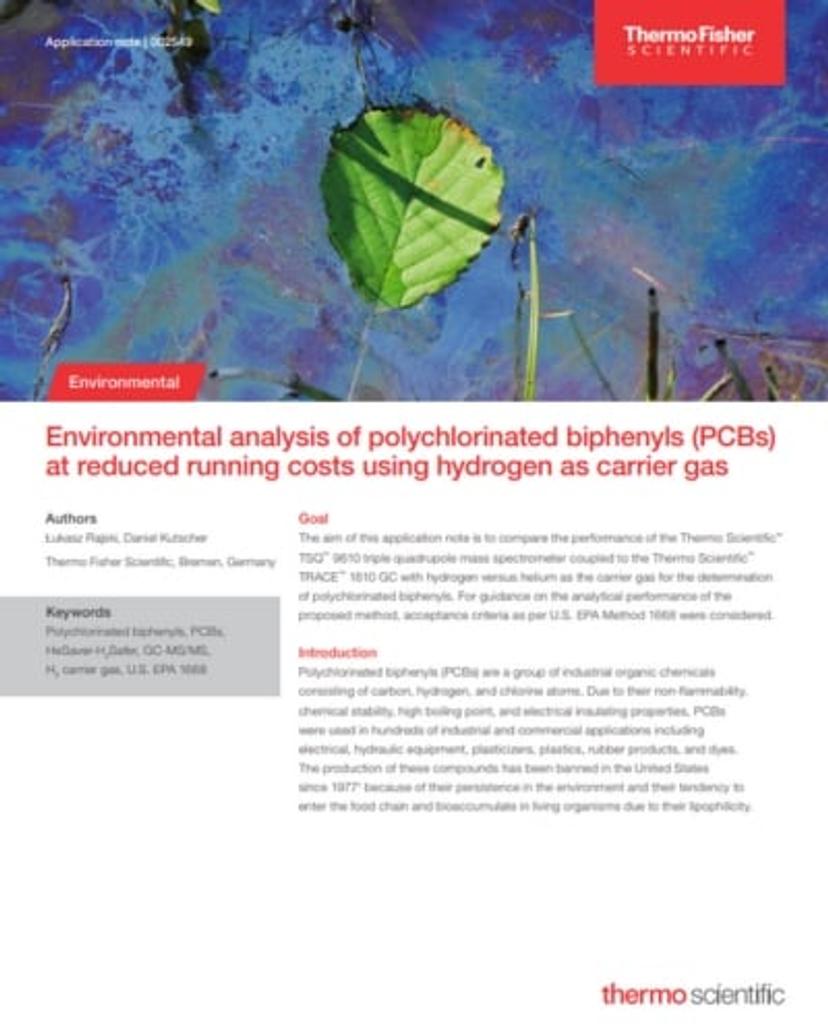
5. Environmental analysis of PCBs at reduced running costs using hydrogen as carrier gas
Tecan logo

Explore a comparison of the performance of a triple quadrupole mass spectrometer coupled to a gas chromatograph (GC) using hydrogen versus helium as the carrier gas for analyzing polychlorinated biphenyls (PCBs). PCBs are industrial chemicals banned since 1977 due to environmental concerns. The study aims to meet acceptance criteria outlined in US EPA Method 1668 and discusses the structure and toxicity of PCBs, the regulations surrounding them, and the application of GC-MS/MS for analysis.


Download resource


Links

Tags

Gas ChromatographyGas chromatography (GC) is an analytical technique used to separate and quantitate mixtures of small and volatile compounds. Gas chromatographs or GC systems include components such as GC columns, detectors, pumps and autosamplers. Choose from packed or capillary GC columns, flame ionization (FID), photoionization (PID) electron capture detectors and selective or non-selective detectors. Find the best gas chromatographs in our peer-reviewed product directory: compare products, check customer reviews and receive pricing direct from manufacturers.Mass SpectrometryMass spectrometry (MS) is a powerful analytical technique used to identify and quantify molecules based on the mass-to-charge ratio of gas-phase ions. It provides detailed information about the structure, composition, and properties of compounds and is widely used across fields such as environmental monitoring, materials science, drug discovery and development, food and beverage testing, and wider chemical research. Key MS techniques include tandem mass spectrometry (MS/MS), liquid chromatography–mass spectrometry (LS-MS) and inductively coupled plasma (ICP-MS). Choosing from these wide range of techniques and technologies can be a daunting task, so keep up to date with scientific applications, performance expectations, and customer reviews here all in one place. Visit our product directory to receive quotes direct from the manufacturer. Environmental Monitoring and TestingEnvironmental monitoring and testing uses handheld portable analyzers, kits, spectrometers or chromatography systems for air, water, soil, food and other sample testing. Useful features of analyzers such as BOD and COD include portability, easy calibration, automation and sensitivity.  Environmental test kits for pH, water, moisture, etc, should be accurate, sensitive, reliable, fast and easy to use.GC-MS GC-MS (gas chromatography-mass spectrometry) instruments and equipment are used to separate, quantify and identify mixtures of small and volatile compounds, such as polycyclic aromatics, fatty acids and alcohols. Often used in drug detection, forensic investigation and environmental analysis for pesticides and contaminants, GC-MS is a powerful addition to your lab’s analytical capabilities. GC-MS/MS instruments equipped with a qTOF or triple quadrupole analyzers can give greater sensitivity and resolution to your analysis. Find the best GC-MS instruments and equipment in our peer-reviewed product directory: compare products, check customer reviews and receive pricing direct from manufacturers.Water PurificationThere are a number of water purification methods available to remove contamination from laboratory water. These systems include demineralization, reverse osmosis, filtration and ultrafiltration. A combination of methods is sometimes necessary to achieve purified water suitable for use in experiments.Water AnalysisAnalytical methods used to test the purity of drinking water include determining the level of contaminants abides to the level set by the Environmental Protection Agency (EPA).Water Content AnalysisWater content analysis is crucial for determining the moisture levels in food, pharmaceuticals, chemicals, and other materials. Accurate measurement ensures product quality and shelf-life. Explore water content analysis tools in our peer-reviewed product directory; compare products, check reviews, and get pricing directly from manufacturers.Semi Volatile Organic CompoundsSemi volatiles organic compounds (SVOCs) are a groups of compounds that have a low boiling point and evaporate above room temperature. SVOCs include phenols and polynuclear aromatic hydrocarbons (PAH).Drinking Water AnalysisAnalytical methods used to test the purity of drinking water include determining the level of contaminants abides to the level set by the Environmental Protection Agency (EPA).