
Memmert Hot Air Sterilizers S Meet Requirements of DIN EN ISO 20857: 2013
11 Dec 2013
Product news
In August 2013, the German edition of DIN EN ISO 20857: 2013 on the development, validation and control of the sterilization of medical products with dry heat was published. The Memmert hot air sterilizers S meet the requirements of the internationally applicable standard without any restrictions.
Justifiably, requirements for the conditioning of medical products such as instruments, glassware and miscellaneous metal equipment are most stringent. The level of safety for medical products according to DIN EN 556-1 has to be at 10-6. This means that the germ reduction rate has to be better than 1:1,000,000. Hot air sterilization is not only suitable for the elimination of germs but also for denaturation of pyrogens and endotoxins.
Process Steps of Dry Air Sterilization
The revised standard DIN EN ISO 20857: 2013 in detail describes the steps mandatory for sterilization with dry air such as calibration, maintenance, product and process definitions as well as acceptance, functional and performance assessment. In the attachment, the admissible means for compliance with the requirements are explained. Furthermore, the new DIN EN ISO 20857: 2013 describes the requirements to the process for depyrogenation of heat-resistant glassware, metal equipment and instruments as well as heat-resistant chemicals, waxes and oils with dry heat at the corresponding denaturing effect.
Hot Air Sterilizers S Comply With the Requirements of DIN EN ISO 20857:2013
Memmert hot air sterilizers S comply with the requirements to appliances and installations without restrictions, such as safety in compliance with IEC 61010-1 and IEC 61010-2-040, control and documentation of temperature and sterilization time, alarm on limit violation, detection of a measuring sensor failure, tamper-proof setpoint definitions, control and monitoring of temperature changes, accuracy of 0.5 °C or better, control stability of 1 % or better, time control ±1 or better.
Related products
Request Quote for All Products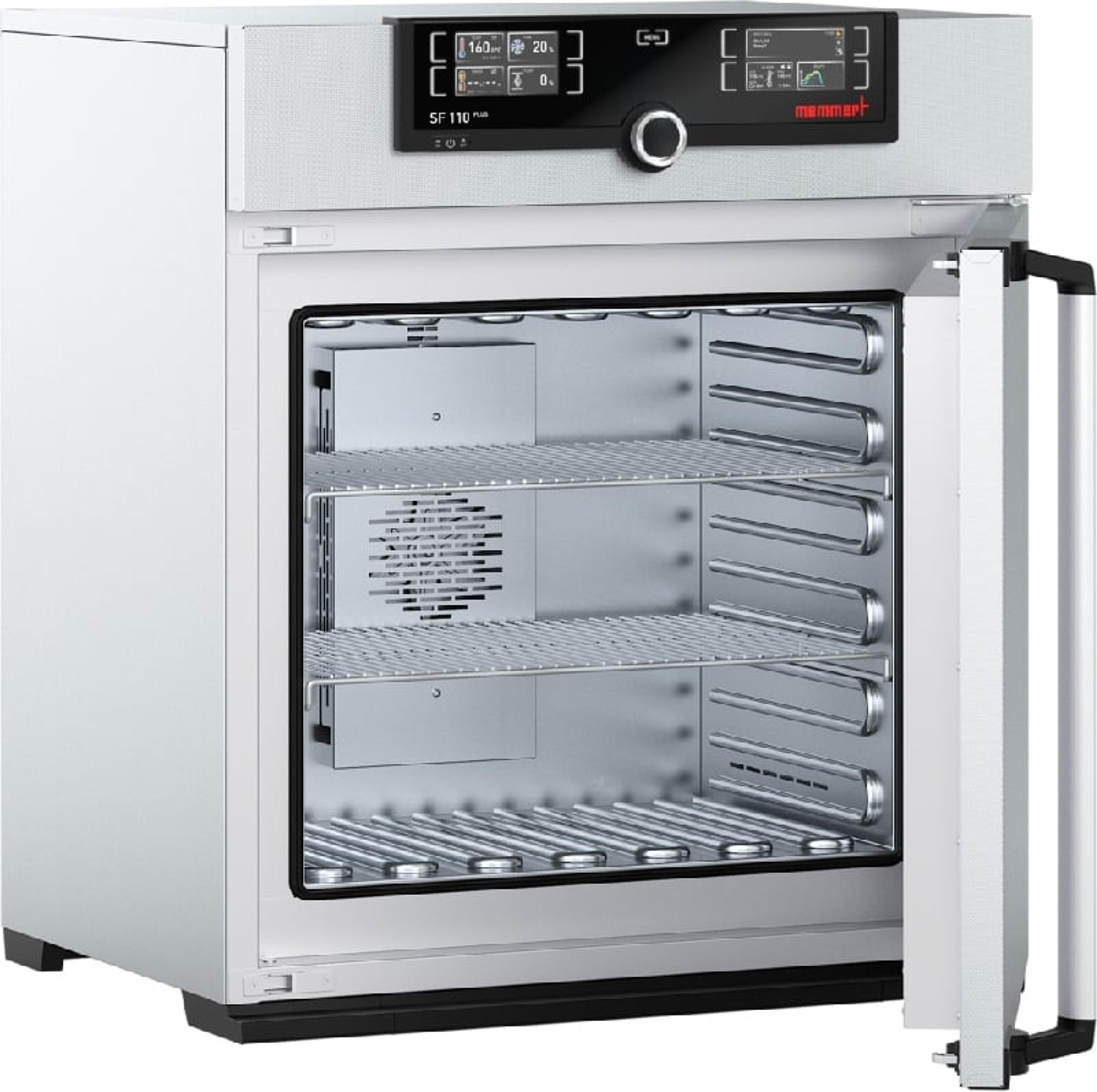
Sterilisers SN/SF/SNplus/SFplus
Memmert GmbH + Co. KGComplies with all relevant standards: hot air steriliser S