Master media exchange for long-term spheroid assays: Solutions & troubleshooting top tips

Protect long-term 3D cell-based assays for toxicology, oncology, disease modeling and more

14 Nov 2021

Sarah Thomas
Associate Editor

Editorial article

Even the most careful pipetting can result in evacuation of spheroids from microplate wells

The use of 3D cell models provides a more physiologically relevant setting for experiments compared to cells grown on flat 2D surfaces and is proving to be key in both life sciences research and preclinical studies. Overcoming some of the limitations associated with 2D cell cultures for predictive modeling of clinical outcomes, 3D cell cultures, such as spheroids and tumoroids, provide more in vivo-like environment that aids cell viability over longer periods of time. With an uptake in long-term spheroidal 3D live cell assays, it is essential that media exchange and dosing steps are performed with minimal disruption to unattached 3D cultures. Here, we look at a new solution for media exchange for your long-term microplate assays that will help to protect your cells and experimental results.

Moving on from manual methods

Using a single or multichannel pipette can be tedious and time-consuming, especially when working in high-throughput 96-384 well microplate formats. Uttermost care must be taken to remove and add liquid as slowly as possible so that the spheroids are not disturbed or removed. Even with care, one wrong move and spheroids suspended in cell culture media can be aspirated from the well, damaged, or simply pushed out of the field of view.

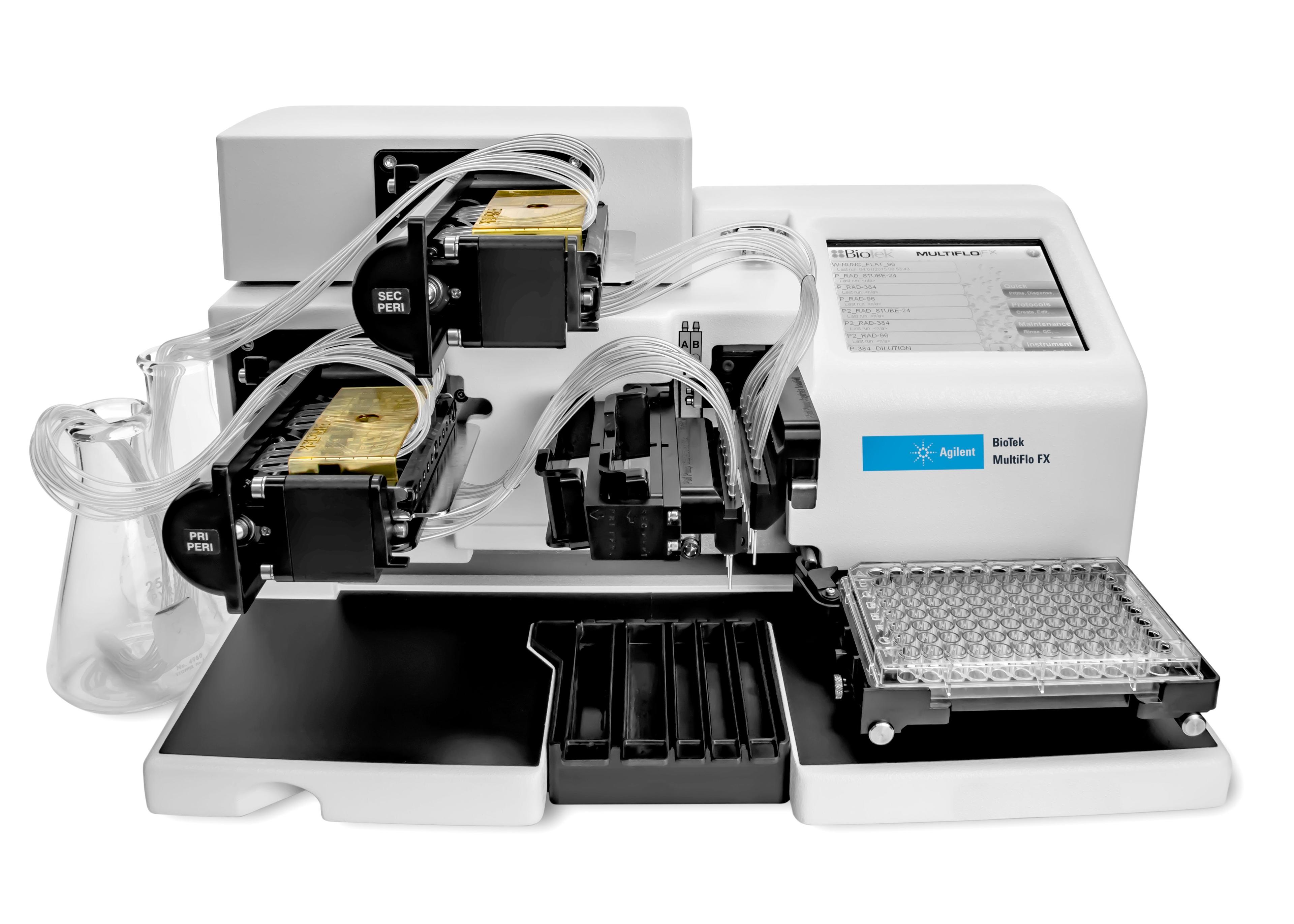
To eliminate consequences of human error and enable the scale-up of experiments to a high throughput format, automated liquid handling is ideal for long-term assays, which can last a week. While some larger liquid handling systems require large containment systems to avoid contamination of experiments, a new contender to the market takes the form of a module for the compact MultiFlo FX Multi-Mode Dispenser from BioTek Instruments, Inc. The new patent-pending AMX™ Automated Media Exchange modules are designed to facilitate gentle media exchange for microplate-based spheroid applications, with liquid transferred in a slow and controlled manner, making 3D assay procedures easy to perform.


BioTek’s Trouble Shooting Top Tips for Spheroid Assays

Long-term assays: When performing long-term assays using 3D cell models, media exchanges should be automated to ensure that are always in fresh media so that experiment results aren't compromised.

Aspiration: If an automated media exchange method, such as the use of the AMX module, is incorporated, aspiration rates should be optimized to ensure that spheroids are not removed from test wells. Smaller spheroids created from fewer cells, having a smaller mass, will require a slower rate of aspiration compared to larger spheroids having a greater mass. 

Final volume: Placement of the tubes in the z-axis for aspiration and dispense will vary depending on the desired final volume in the well. Moving the tubes further into the well by using a smaller z-axis offset is necessary for an 85% liquid removal, whereas the tubes can remain higher in the wells for a 50% liquid removal. 

Incubation: When using a fluorescent probe, or performing immunofluorescence with 3D spheroid-based cell models, increased incubations are commonly required, as the reagent or probe needs a longer time to penetrate into the interior portions of the 3D cell model. 

Imaging: To ensure unattached spheroids are included in an imaging field of view, it is recommended to capture a montage of images in the x- and y-axes due to the propensity of the spheroid to move slightly away from the well center during processing. When this procedure is combined with z-stacking to image the 3D structure in multiple z-planes, an accurate assessment of the cells within the spheroid can be attained. 


The perfect set-up to protect your spheroids

The AMX™ Automated Media Exchange module is set up to avoid contact with cell structures

Designed for media exchange and washing of unattached 3D Cell Structures, the AMX™ can be optimized for your experiments to eliminate the risk of accidental spheroid removal. The module consists of two peristaltic pumps and two autoclavable cassette heads, one set for aspiration, the other for dispensing liquids. Dispensing and aspiration can be optimized to accommodate your microplate design and spheroid types to avoid contact with cell structures, control the volume of liquid removed and manage liquid flow rate — all to ensure spheroids are protected while media exchange or dosing steps take place.

Combine with the BioSpa™ 8 Automated Incubator for long-term live cell assays

Combined in a set-up with the BioStack Microplate Stacker or BioSpa™ 8 Automated Incubator, along with the Cytation 5 Cell Imaging Multi-Mode Reader, you can create the perfect high-throughput environment for automation of endpoint processes and live cell assays, all within a laminar flow hood.

Read about the benefits of the AMX™ module compared to manual pipetting for media exchanges using unattached 3D spheroid models in this technical note.

Learn more about the MultiFlo FX and AMX™ module and how they can be used to automate media exchange for spheroid cultures.

Agilent BioTek BioStack Microplate Stacker

Agilent Technologies

The Agilent BioTek BioStack microplate stacker is a compact and versatile microplate stacker, compatible with Agilent BioTek washers, dispensers, plate readers, and imaging systems. The rapid plate exchange speeds deliver increased throughput and enhanced efficiency and greater productivity.

(29)

Links

Tags

Microplate Readers / DetectorsMicroplate readers are used to automate the detection and analysis of labeled or label-free components in microplates during assays or live-cell monitoring. Microplate readers are generally distinguished by their mode of detection. Types include absorbance, luminescence, fluorescence intensity, fluorescence polarization, TRF / FRET and multimode microplate readers. Microplate readers deliver a high throughput of samples by reading multiple wells simultaneously, with the 96-well format the most commonly used. As a result, microplate readers are often used in the drug discovery, bioassays, research and pharmaceutical industries for screening applications. Microplate loading can also be automated, with robotic microplate stackers to increase throughput. Find the best microplate readers in our peer-reviewed product directory: compare products, check customer reviews and receive pricing direct from manufacturers.Cell-Based AssaysCell-based assays are used to monitor the presence, quantity and activities of a desired cellular analyte including drug molecules or biomarkers. This can reveal information on cell health (apoptosis, cytotoxicity, viability and proliferation assays), cell metabolism, cell migration and cell signaling mechanisms. Find the best cell-based assay products, kits and equipment with our peer reviewed product directory: compare products, check customer reviews and receiving pricing direct from manufacturers.Automated Liquid HandlingAutomated liquid handling equipment is used to mix, dilute and dispense allotted volumes of liquid into microplates and other vessels automatically. The robotic, liquid handling arms can dispense from single channel to 3456 multichannel as well as operate nanoliter dispensing, enabling high throughput of samples. Find the best automated liquid handlers in our peer-reviewed product directory: compare products, check customer reviews and receive pricing direct from manufacturers.Cell / Tissue CultureCell culture or tissue culture is used to study the biology of cells or tissues and to isolate cellular products in an environment which can be manipulated and well defined. Accurately control your culture environment with bioreactors or culture incubators, bind your cells to a surface or together with an extracellular matrix. Distinguish cell types with differential media or proliferate cells with certain characteristics using selective media. Enrich your media with supplements such as growth factors, sera and vitamins. Find the best cell and tissue culture products, kits and equipment in our peer-reviewed product directory: compare products, check customer reviews and receive pricing direct from manufacturers.CytotoxicityCytotoxicity assays measure the toxic effects of substances on cells, often used in drug testing and environmental studies. These tests are crucial in determining the safety of chemicals and pharmaceutical compounds. Explore cytotoxicity testing tools in our peer-reviewed product directory; compare products, check reviews, and get pricing directly from manufacturers.Cell ImagingCell imaging can be achieved using a number of techniques including confocal microscopy, transmission electron microscopy, atomic force microscopy, and light sheet microscopy.Cell AnalysisThe analysis of cells allows researchers to understand the factors which contribute to cell health and function. These influencing processes can then be predicted and altered, leading to the development of medication and disease treatments.Live Cell ImagingLive cell imaging is the study of living cells using microscopes and high-content imaging systems. This technique provides in-depth insight into fast and complex biological processes, by allowing dynamic imaging of living cells instead of acquiring an individual image at a single point in time.Cell WashingDrug DiscoveryDrug discovery is the process of identifying potential new medications, involving stages such as target identification, compound screening, and preclinical development. It relies on cutting-edge technologies like high-throughput screening, artificial intelligence, and molecular modeling to accelerate the identification of drug candidates. Drug discovery plays a pivotal role in developing new therapies for diseases ranging from cancer to rare genetic disorders. Browse our peer-reviewed product directory to find the latest drug discovery technologies, compare options, check customer feedback, and get pricing directly from manufacturers.Cell BiologyCell biology studies the structure, function, and behavior of cells. Understanding cellular processes is essential for research in areas such as cancer biology, stem cell research, and neurobiology. Techniques like flow cytometry, microscopy, and cell culture enable researchers to explore cellular mechanisms in detail. Browse our peer-reviewed product directory to find the best cell biology tools and equipment, compare products, check customer reviews, and get pricing directly from manufacturers.SpheroidsSpheroids are clusters of cells that have been grown in 3D culture to be used as <i>in vitro</i> model systems. These 3D microtissues can be used for toxicology testing, DMPK studies and many other applications involving cell analysis.Cell Based AssaysCell-based assays use living cells to measure biological responses to various treatments or stimuli. They are essential for drug discovery, toxicology testing, and understanding cellular mechanisms. These assays are used to assess cell viability, proliferation, gene expression, and other cellular activities. Browse our peer-reviewed product directory to find the best cell-based assay tools and reagents, compare products, read customer reviews, and get pricing directly from manufacturers.TumorsTumor research focuses on understanding abnormal cell growth that leads to cancer. Identifying biomarkers, studying tumor microenvironments, and developing targeted therapies are critical for advancing cancer treatment. Early detection and personalized treatment options are key to improving outcomes for patients. Browse our peer-reviewed product directory to explore tools for tumor research, diagnostics, and cancer therapies; compare products, read customer reviews, and get pricing directly from manufacturers.