
Learn How BioTek Solutions Can Transform Your Research at SLAS 2015
20 Jan 2015
Product news
Join BioTek Instruments as they demonstrate the latest microplate innovations at the SLAS 2015 Conference and Exhibition to be held February 7-11 in Washington DC. Learn how you can transform your research with state-of-the-art microplate-based imaging, detection, liquid handling and automation solutions. As a Platinum Sponsor of SLAS 2015, the company will showcase their newest innovations at booth #305.
Featured will be BioTek’s award-winning, second generation Cytation™ 5 Cell Imaging Multi-Mode Microplate Reader. Cytation 5 is a configurable system that combines automated digital widefield microscopy with conventional multi-mode microplate reading to provide phenotypic cellular information and well-based quantitative data. This single instrument platform can process workflows that would traditionally require multiple instruments and software interfaces, and is simple to setup and operate. With up to 60x magnification, the microscopy module provides high-quality cellular and sub-cellular imaging in fluorescence, brightfield and phase contrast. The multi-mode microplate reader features BioTek’s patented Hybrid Technology™, which incorporates variable bandwidth monochromator optics and high sensitivity filter-based detection optics for unmatched versatility and performance. Stop by booth #305 to see live cell 3D spheroid cellular analysis on this exciting new instrument!
In addition, BioTek’s full line of microplate instrumentation will be on display. This includes the new MultiFlo FX Multi-Mode Dispenser, the EL406 Combination Washer Dispenser and the popular 405 Touch Microplate Washer.
BioTek will also present 13 application posters, an exhibitor tutorial, “Automated Digital Microscopy for Cellular Analysis” and participate in the interactive forum, Late Night with LRIG with “Cytation™ 5 Cell Imaging Multi-Mode Microplate Reader: An Overview”.
Related products
Request Quote for All Products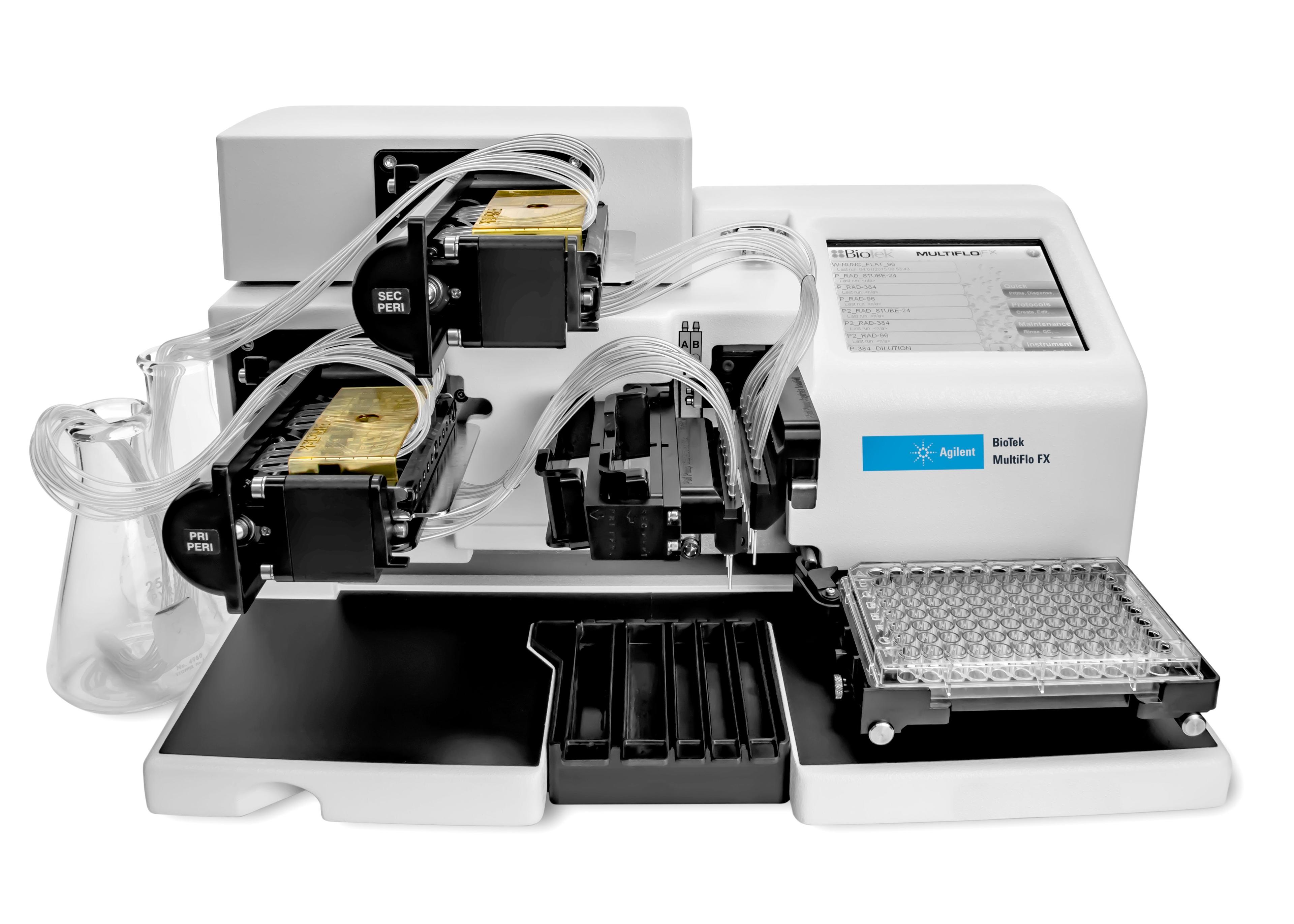
Agilent BioTek MultiFlo FX Multimode Dispenser
Agilent TechnologiesMultiFlo FX can dispense up to 4 independent reagents into 6- to 1536-well microplates.

Agilent BioTek 405 TS Washer
Agilent TechnologiesAgilent BioTek 405 TS Washer offers fast, reliable 96- and 384-well plate washing.