
Labcyte Inc. Launches Two New Systems to Expand Acoustic Droplet Ejection Technology for a Wider Range of Uses
7 Jan 2008Product news
Labcyte, world leader in acoustic ultra-low volume dispensing, introduces the Echo® 520 liquid handler. This affordable system uses sound to transfer fluids with high accuracy and precision. Multiple types of common solutions are transferred without cross-contamination. We also introduce the POD™ 810 plate assembler, which unites any Echo system with additional hardware components to prepare assay-ready plates. See both of these exciting new systems at booth 356.
Move liquids with sound! Acoustic droplet ejection (ADE) is a highly precise technology that uses sound energy to transfer ultra-low volumes of fluids. Nothing ever touches your compounds or reagents. This eliminates the risk of cross-contamination. ADE uses no tips or nozzles so there is no clogging, even with crystallizing reagents or proteins.
The Echo 520 liquid handler expands the range of applications available to the user. This affordable system can transfer 2.5 nL to microliters of fluid including common aqueous buffers used in protein and nucleic acid assays, as well as DMSO for drug compound management and screening.
The POD plate assembler enhances the performance of any Echo liquid handler by incorporating a robotic plate handler, bulk filler, plate stackers, scheduling software and other components into a single integrated system. The POD uses Echo Dose-Response and Cherry Pick software to prepare hundreds of plates per day, relieving you of the onerous task of plate set-up while facilitating miniaturization for reduced assay costs. ADE eliminates pipette tips and wash-waste stream, thereby further reducing running costs by as much as hundreds of thousands of dollars per year. Truly non-contact liquid transfer minimizes false results due to cross-contamination, accumulated error or sample precipitation while it eliminates the cost of pipette tips and wash procedures.
Visit these posters showing Labcyte technologies while you are at LabAutomation2008:
- MP06 Label-Free Characterization of Proteins Using Acoustic Droplet Ejection Deposition and Advanced X-Ray Technology Measurement
- MP13 Best Practices for Assessing Nanoliter Transfer Performance for Labcyte Echo Liquid Handlers Using the Artel MVS
- MP34 Assay Optimization and Kinase Profiling in uHTS Format
- MP36 Development of an Automated AlphaScreen for Detection of MEK Phosphorylation in a Transiently Transfected Cellular Model
- MP73 Sample Library Management and Replication - An Integrated Software Solution
- TP22 Hydration-Free, Automation-Friendly Alternative for Compound Library Storage
- TP53 Kinase Assay Development using Acoustic Droplet Ejection Technology
- TP05 High Throughput Kinase Selectivity Profiling for Drug Discovery Applications
- TP47 Assay Development and Miniaturization of the ADP Hunter™ HS Assay for Kinase Screening in 1536 Well Plate Format
Related products
Request Quote for All Products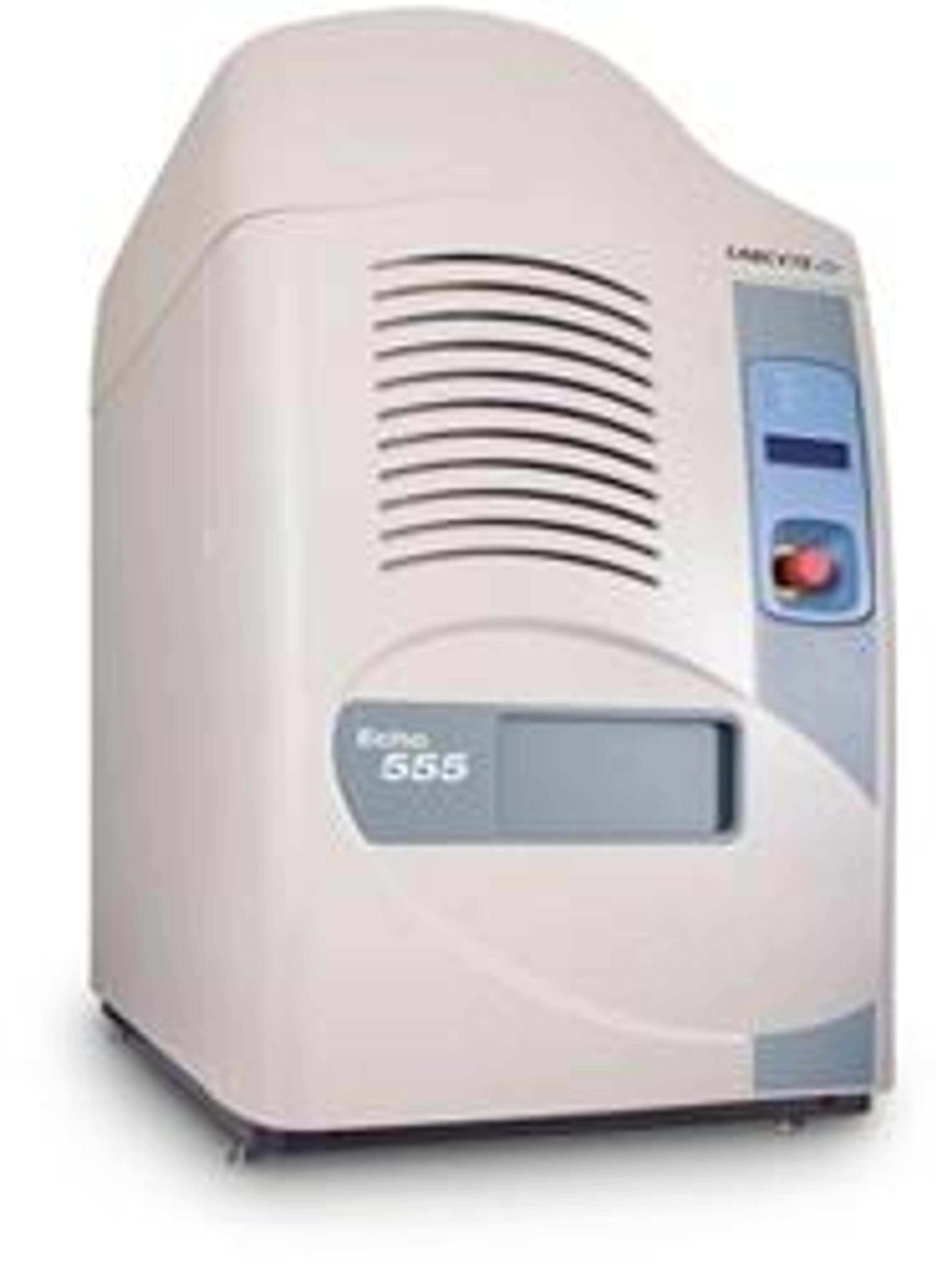
Echo® 555 Liquid Handler
Beckman Coulter Life SciencesEcho® 555 liquid handler - the world's fastest acoustic dispensing platform for life science applications. The Echo® 555 liquid handler is the world’s fastest acoustic liquid handling platform for life science applications. Laboratories that demand very high throughput rely upon the Echo 555 liquid handler for round-the-clock trouble-free operation to enable the fastest discovery.The Echo 555 doubles the throughput of the Echo 550 and provides transfers from as many as 660,000 wells per day. Like the Echo 520 and Echo 550 liquid handlers, the Echo 555 uses "touchless" ADE transfer technology. ADE uses sound energy to transfer 2.5 nL droplets from Echo-qualified 384- and 1536-well source plates into 96-, 384-, 1536- and 3456-well destination plates.This unique touchless technology eliminates consumable tip costs, washing, and cross-contamination. Unsurpassed volumetric precision (≤ 8% CV) and accuracy (≤ 10% CV) ensure superior results. Independent studies have shown that Echo liquid handlers eliminate false negatives due to sample loss on tip surfaces in low-concentration transfers. Like the Echo 550 liquid handler, the Echo 555 liquid handler reports both fluid volume and DMSO hydration.Echo® 555 Liquid Handler Features: Tipless transfer, resulting in dramatic cost savings Accurate, precise movement of nanoliter-scale quantities, enabling assay miniaturization and further reducing costs Elimination of cross-contamination, carryover or leachates Better results through direct dilution of compounds, an improvement over serial dilution methods Improved information about sample integrity and improved transfer quality through measurement of DMSO hydration level Applications: Compound management Compound screening siRNA screening Biochemical assays Cell-based assays PCR Genotyping Gene expression

MicroClime® Environmental Lid
The MicroClime® environmental lid incorporates a novel, fluid-absorbing matrix that minimizes edge effects and preserves the concentrations of solutions in microplate wells. The absorbed fluid creates a vapor barrier that protects the sample from the exterior environment and from evaporation, greatly reducing edge effects. The MicroClime lids also eliminate edge effects which might occur due to long-term cell incubation, such as overnight cell culture (e.g. Molecular Devices CellKey® 96 and 384 protocol). MicroClime environmental lids protect the contents of a wide variety of SBS standard microplates. Features of the MicroClime: Eliminate microplate edge effects Increase microplate efficiency by up to 20% Seamless integration Compatible with a wide range of solvents Can be filled manually or with automated bulk fillers