
Investigating Stress: Efficient Analysis of Hormone-Receptor Interactions
How microplate reader technology is optimizing endocrinology research
22 Mar 2016
Editorial article

Professor Robert Dores discusses stress response hormone-receptor interactions in this SelectScience® interview
SelectScience® spoke to Professor Robert Dores, of the Department of Biological Sciences, University of Denver, Colorado, USA, about his research into hormone-receptor interactions and the technologies that are optimizing his experiments.
Professor Robert Dores Robert Dores is a full Professor in the Department of Biolological Sciences at the University of Denver. He is also Editor-in-Chief of the journal of General and Comparative Endocrinology and President of the North American Society for Comparative Endocrinology (NASCE).
Professor Dores is particularly interested in the melanocortin-2 receptor, one of five receptors in the melanocortin family of G-protein coupled receptors, “this particular receptor is found in humans on the cells of the adrenal cortex. When the pituitary gland releases the hormone ACTH it binds to the melanocortin-2 receptor, resulting in the cell producing the steroid, cortisol. Cortisol in turn tells most cells in our body to function properly – it’s there to keep things in balance.” Professor Dores explained. “The receptor interaction with this hormone is pretty important because this is the system that deals with chronic stress.”
“All organisms have to deal with acute and chronic stress – if the melanocortin-2 receptor doesn’t operate properly, then at least for bony fish and tetrapods, this is going to put them in a position where their fitness is challenged.”
Implications of melanocortin-2 receptor loss of function
In humans, the melanocortin-2 receptor requires an accessory protein, the melanocortin-2 receptor accessory protein 1, to function, – without the accessory protein it doesn’t work. “This is actually a defect in the human gene that’s prevalent in most of the fishes and bony tetrapods – amphibians, reptiles, birds and mammals,” Professor Dores continued. It is the evolution of this interaction between the accessory protein and its melanocortin-2 receptor that is a particular focus of his research.
The importance of the accessory protein is highlighted by a congenital condition in humans “where the accessory protein is either not expressed or is defective.” Professor Dores explained that while individuals with this condition get cortisol from the mother in utero through umbilical circulation, which enables organs to develop at an acceptable rate, they are unable to make their own cortisol after birth. Loss of this function can lead to death within “a year or so”, however treatment of “daily cortisol supplements for the rest of their life will help the new-born develop naturally.”
While there are implications for human health, Professor Dores highlighted that functioning melanocortin-2 receptors are important for all vertebrates as they “all have to deal with the same kinds of problems.”
Investigating accessory protein - receptor interaction
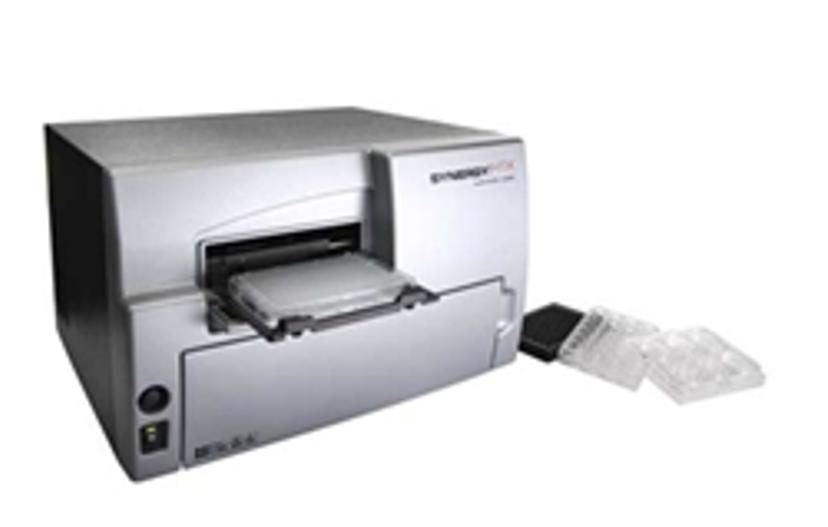
The BioTek Synergy HTX Multi-Mode Microplate Reader
Professor Dores’ work looks into the interaction between melanocortin-2 receptors and this accessory protein in cartilaginous fish. “What we’re finding is that their receptor can function without the accessory protein. However, when we co-express the melanocortin-2 receptor of cartilaginous fish with the accessory protein it works better. So what we’re starting to get at is the origin of the interaction between the accessory protein and receptor.” To investigate this, the melanocortin-2 receptor nucleotide sequence is expressed in mammalian cell lines. The receptor is then either expressed with or without the accessory protein, “we wait two days for the sequences introduced to be transcribed into mRNA, then protein.” In this time “the receptor is potentially on the surface of the cell and it could be there with this accessory protein.”
On the third day of the experiment the cells are stimulated with hormone. Interaction between the hormone and melanocortin-2 receptor is measured using a CRE luciferase reporter system – after a four-hour stimulation with hormone, a reagent for luciferase is added – if the hormone and receptor interact then light will be emitted that is proportional to the amount of hormone used to stimulate the cell. Professor Dores highlighted that it is important to “accurately detect the light that is given off.” For this final step of the experiment, Professor Dores uses the BioTek Synergy HTX Multi-Mode Microplate Reader to measure luminescence, which he describes as being “incredibly sensitive.”
Professor Dores commented on the benefits of this cost-effective method and microplate reader technology, “this is a less expensive assay than directly measuring cAMP and it’s incredibly reproducible. By eliminating all the pipetting steps associated with directly measuring cAMP, we’re cutting down on error and it lets us create beautiful dose response curves.” He also highlighted that the method is student friendly; “undergraduates can actually do this assay because it’s so straight forward”, enabling lots of data to be generated efficiently.
Future research
In the future Professor Dores hopes to use the BioTek Synergy HTX for a cell surface ELISA to determine how much of the receptor gets to the surface of the cell. “This is very relevant to what we are doing because the accessory protein not only makes the receptor active – without the accessory protein, the melanocortin-2 receptor in humans simply doesn’t not work – but it actually chaperones the receptor to the plasma membrane. So if we do point mutations in the accessory protein we can evaluate how those point mutations affect either activation or trafficking from the ER to the plasma membrane.”
Related products
Request Quote for All Products
Agilent BioTek Synergy HTX Multimode Reader
Agilent TechnologiesThe Agilent BioTek Synergy HTX is a compact, economical multimode reader for 6- to 384-well microplates and Take3 microvolume plates. The unique dual optics design provides superior performance for UV-Vis absorbance, fluorescence, luminescence, and AlphaScreen/AlphaLISA workflows. With incubation and shaking, plus a dual reagent injector module, the system will meet all your assay requirements now and in the future. Synergy HTX is controlled by the easy-to-use, yet powerful, Gen5 software for data collection, analysis, exporting and reporting.