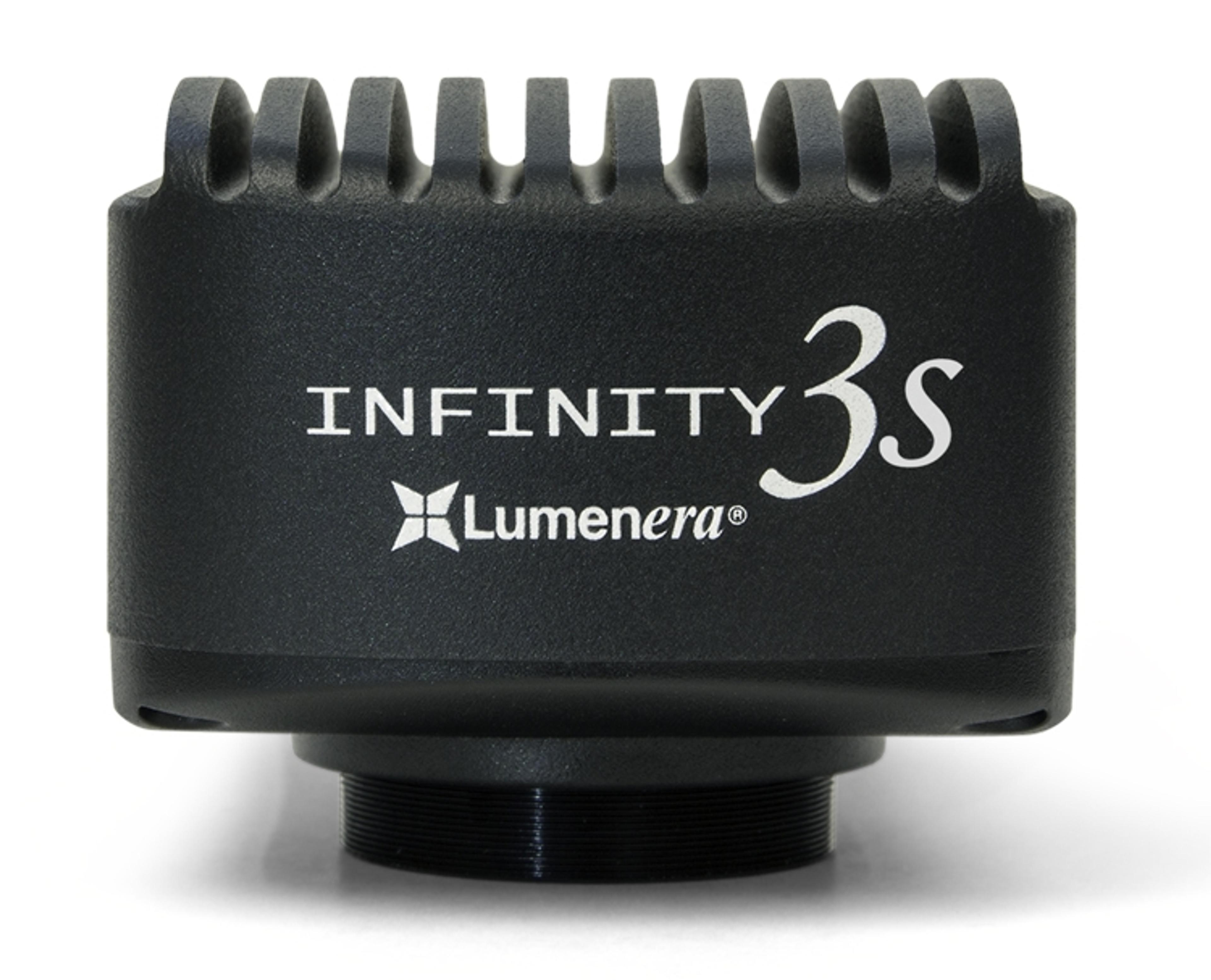
Introducing the New INFINITY3S-1UR from Lumenera

Featuring ultra-sensitive, excellent dynamic range with 60 fps at full resolution

1 Mar 2016

Lynsey Forsyth
Post Doc / Research Fellow

Product news

Lumenera’s INFINITY3S-1UR is a high-speed, ultra-sensitive research grade microscopy camera with 1.4 megapixel resolution. The camera incorporates Sony’s new ICX825 CCD sensor, producing much higher dynamic range and sensitivity over the popular ICX285 sensor. The INFINITY3S-1UR has the unmatched light sensitivity needed for challenging low light applications such as fluorescence and NIR imaging. Lumenera's high-speed USB 3.0 data interface provides maximum allowable throughput where full resolution images can be sent to a host computer at an industry leading 60 fps**.

The Sony ICX825 CCD sensor produces a 70% improvement in sensitivity over the popular ICX285 sensor. This sensor technology offers extremely high quantum efficiency, high dynamic range, 6.45 x 6.45 μm pixels and very low noise of 5.9 e-. The research-grade designation of the INFINITY3S-1UR is a testament to low noise electronics, high-grade components and unique thermal management techniques.

• 6 dB increase in dynamic range vs ICX285
• Increased sensitivity thus reducing exposure time and reducing photo bleaching in fluorescence applications
• Increased frame rate of over 60 fps vs 30 fps for the ICX285

INFINITY Software: The INFINITY3S-1UR comes with Lumenera's fully-featured INFINITY ANALYZE, an image capture and analysis software package offering camera control, measurement, annotation, tiling and post capture enhancement. Camera and software combine to create a complete microscopy imaging solution for your application.

High Speed USB 3.0 Interface: The INFINITY3S-1UR uses the latest USB 3.0 technology at 5 Gbits/sec to deliver the fastest image transfer - even at its highest resolution. Lumenera's USB 3.0 cameras are backwards compatible with USB 2.0 for those not needing the full speed of the camera.

Key Features:

  • Industry leading Sony EXview HAD ll sensor technology with 70% improvement in sensitivity over ICX285
  • Color or monochrome ICX825 CCD Global Shutter sensor with 2/3” optical format providing a resolution of 1392 x 1040 using 6.45 x 6.45 μm pixels
  • 5.9 e- read noise
  • 14-bit pixel depth for 16,384 tonal values per channel
  • 60 fps at 1.4 megapixel (monochrome version); 45 fps at 1.4 megapixel (color version)**
  • High-speed USB 3.0 interface for plug and play installation on any computer
  • GPIO for control of peripherals and synchronization
  • 128 MB of onboard memory for frame buffering results in reliable image delivery

Recommended Applications:

  • Low Light Fluorescence
  • Immunofluorescence
  • Brightfield, Darkfield, DIC/Phase techniques
  • DNA Analysis
  • Live Cell Imaging
  • Whole Slide Imaging
  • Near-Infrared DIC
  • Histology, Pathology and Cytology
  • Calcium/Ion Imaging
  • Forensic Analysis
  • Semiconductor Inspection
  • Metallurgical Microscopy
  • Gel Documentation

Links

Tags

Cell / Tissue CultureCell culture or tissue culture is used to study the biology of cells or tissues and to isolate cellular products in an environment which can be manipulated and well defined. Accurately control your culture environment with bioreactors or culture incubators, bind your cells to a surface or together with an extracellular matrix. Distinguish cell types with differential media or proliferate cells with certain characteristics using selective media. Enrich your media with supplements such as growth factors, sera and vitamins. Find the best cell and tissue culture products, kits and equipment in our peer-reviewed product directory: compare products, check customer reviews and receive pricing direct from manufacturers.Cell-Based AssaysCell-based assays are used to monitor the presence, quantity and activities of a desired cellular analyte including drug molecules or biomarkers. This can reveal information on cell health (apoptosis, cytotoxicity, viability and proliferation assays), cell metabolism, cell migration and cell signaling mechanisms. Find the best cell-based assay products, kits and equipment with our peer reviewed product directory: compare products, check customer reviews and receiving pricing direct from manufacturers.BiomarkersBiomarkers are biological markers which can be measured and evaluated to indicate a biological state. The use of biomarkers in research and diagnosis can indicate a normal or disease state or drug response of cells / tissues. Biomarkers include genetic markers, cell surface markers such as antigens, antibodies or receptors and secreted molecules such as cytokines. An assay system is required for identification of biomarkers. :Plate ProcessingAutomated plate processing is used in microplate technologies for high-throughput, speed and efficiency. Plate processing systems include microplate handlers for moving plates, heat sealers, stackers and carousels for storage, retrieval and delivery, microplate washers and piercers. Useful features of plate processors include walk-away automation, compatibility and easy integration with microplate systems.Light MicroscopyLight microscopes or optical microscopes are used to visualize microscale objects under magnification, including cells, clinical specimens and materials. Lab equipment for light microscopy includes confocal microscopes, fluorescence microscopes, zoom and stereo microscopes. Microscope slides and imaging reagents are available for visualizing samples, as well as various microscope stages and incubators for large or temperature-sensitive samples. Find the best light microscopes in our peer-reviewed product directory: compare products, check customer reviews and receive pricing direct from manufacturers.ImmunofluorescenceFluorescence MicroscopyFluorescence microscopy has become an essential tool in biology, as well as in materials science. The application of many fluorochromes has made it possible to identify cells and sub-microscopic cellular components with a high degree of specificity. Using multiple fluorescence labels, different probes can simultaneously identify several target molecules.Live Cell ImagingLive cell imaging is the study of living cells using microscopes and high-content imaging systems. This technique provides in-depth insight into fast and complex biological processes, by allowing dynamic imaging of living cells instead of acquiring an individual image at a single point in time.MicroscopyMicroscopy is a technique used to observe small objects in detail, from cells to materials, using light or electron microscopes. It enables researchers to examine structures with high resolution, aiding in fields such as biology, medicine, and materials science. With advanced microscopy techniques, scientists can gain insights into cellular processes, tissue structures, and material properties. Explore the best microscopy solutions in our peer-reviewed product directory, compare products, read customer reviews, and get pricing directly from manufacturers.Genetics