Integrating microplate evaporators with liquid handling robots

7 Jan 2022

Ellie Abbott
Biochemist

Product news

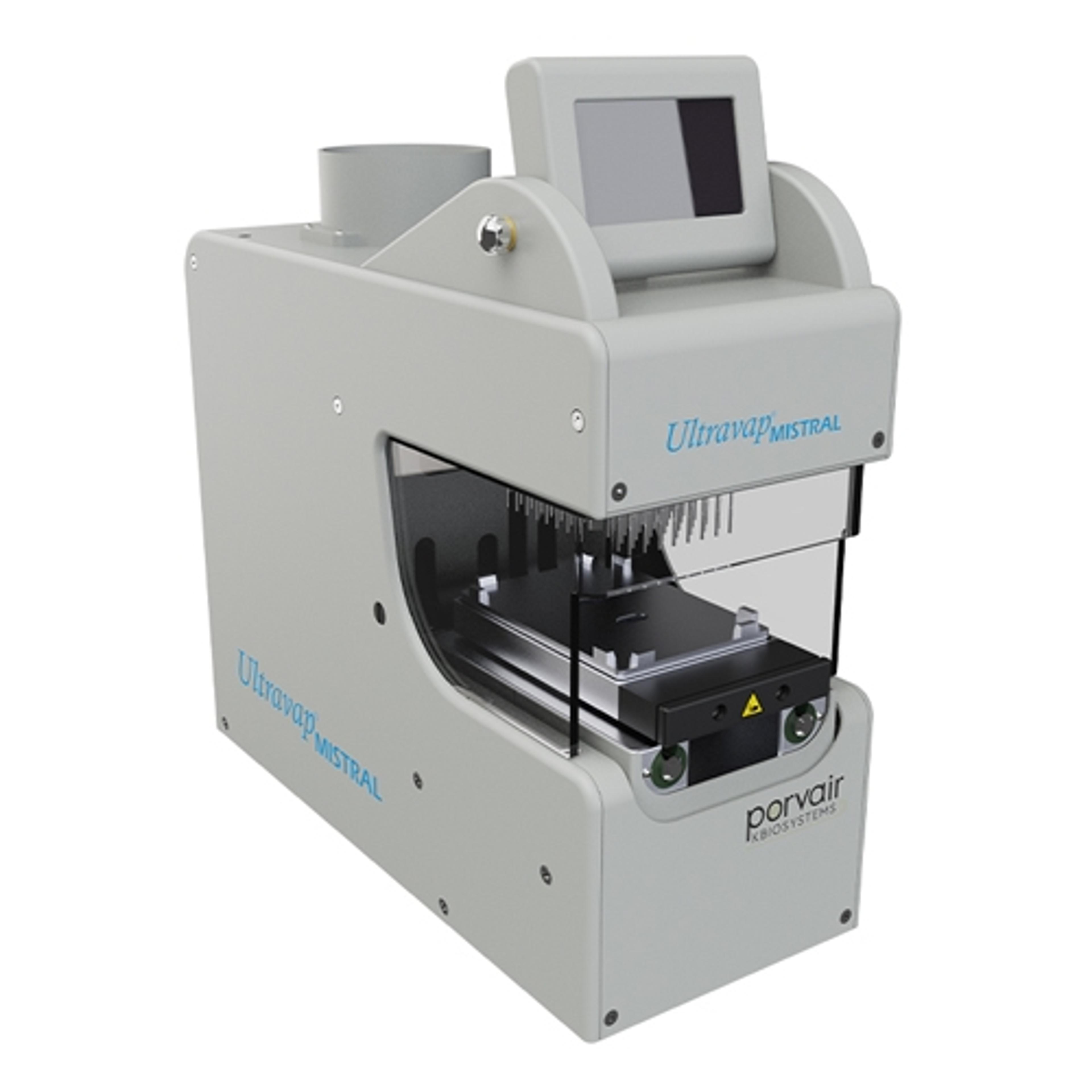
The Ultravap® Mistral family of microplate evaporators from Porvair Sciences are used in labs worldwide to remove the traditional laboratory ‘bottleneck’ of solvent evaporation from 12- to 384-well microplates and vials up to 15cm tall.

The latest generation of Ultravap® Mistral evaporators are designed with new flat front profile and platform shuttle enabling easy interfacing with liquid-handling robots for increased automation efficiency. Reproducible sample throughput is achieved by proprietary advances in gas injection technology to directly and consistently deliver heated gas in each well and tube. It is however the full RS232 control of every parameter achieved through powerful operating software combined with its open-access design - that enables the Ultravap® Mistral to be easily integrated with liquid handling robots to gain the full benefit of automating microplate dry-down.

The Ultravap® Mistral XT-150 is Porvair’s most advanced evaporator yet, giving significant throughput advantages to laboratories routinely tasked with sample preparation. Faster than centrifugal evaporation for single plates and tube racks, significant increases in sample throughput are achieved through advanced evaporator head technology and an innovative manifold design, which directly injects heated nitrogen (temperatures up to 80C) into each individual well of the microplate simultaneously.

The Ultravap® Mistral core software has been specially coded to allow simultaneous control of multiple operating units from a single, primary Ultravap® Mistral evaporator. Using the latest CAN interface technology, Ultravap® Mistral units can be connected together in series. A method selected on a primary unit will be automatically distributed over the CAN Bus to all downstream units to run the programme simultaneously.

Want the latest science news straight to your inbox? Become a SelectScience member for free today>>
Links

Tags

MicroplatesMicroplates are multi-well plates used to increase the throughput of biological investigations. The number of wells microplates contain can range from 6 to 3243 wells, with the 96-well format being the most commonly used. Microplates can come tailored for a range of applications including cell culture, PCR, filtration, storage, non-binding surface, protein crystallization, as well as pre-coated, deep well and normal Standard microplates. Additionally, options for microplate colors include clear , black, white or black with clear bottom and white with clear bottom for absorbance microplate reader applications. Find the best microplates for your lab in our peer-reviewed product directory: compare products, check customer reviews and receive pricing direct from manufacturers.Microplate Readers / DetectorsMicroplate readers are used to automate the detection and analysis of labeled or label-free components in microplates during assays or live-cell monitoring. Microplate readers are generally distinguished by their mode of detection. Types include absorbance, luminescence, fluorescence intensity, fluorescence polarization, TRF / FRET and multimode microplate readers. Microplate readers deliver a high throughput of samples by reading multiple wells simultaneously, with the 96-well format the most commonly used. As a result, microplate readers are often used in the drug discovery, bioassays, research and pharmaceutical industries for screening applications. Microplate loading can also be automated, with robotic microplate stackers to increase throughput. Find the best microplate readers in our peer-reviewed product directory: compare products, check customer reviews and receive pricing direct from manufacturers.Automated Liquid HandlingAutomated liquid handling equipment is used to mix, dilute and dispense allotted volumes of liquid into microplates and other vessels automatically. The robotic, liquid handling arms can dispense from single channel to 3456 multichannel as well as operate nanoliter dispensing, enabling high throughput of samples. Find the best automated liquid handlers in our peer-reviewed product directory: compare products, check customer reviews and receive pricing direct from manufacturers.Evaporators and Freeze DryersCentrifugal evaporation is used for solvent removal from a sample. This is a useful technique for sample concentration or sample drying. Many centrifugal evaporators are modular with a central vacuum pump for generating low pressure. Useful features of evaporators or vacuum ovens include minimal solvent bumping, solvent resistance, computer control, temperature regulation and benchtop design.AutomationAutomation in laboratories and manufacturing processes enhances efficiency, precision, and scalability by reducing the need for manual intervention. It plays a critical role in improving productivity, minimizing human error, and accelerating workflows in fields like diagnostics, drug development, and industrial testing. Automation technologies include robotic systems, automated liquid handlers, and process control systems that streamline complex tasks and ensure consistent, reproducible results. Explore our peer-reviewed product directory to discover the best automation solutions, compare options, read user reviews, and get prices directly from manufacturers.Liquid HandlingLiquid handling involves the precise transfer, mixing, and dispensing of liquids in laboratory settings. It is essential for accurate and consistent results in biological, chemical, and pharmaceutical research. Automated liquid handling systems improve efficiency and reduce human error in sample preparation and analysis. Explore liquid handling tools in our peer-reviewed product directory; compare products, read customer reviews, and get pricing directly from manufacturers.Solvent Evaporation