Integrated Imager Automates Cell Confluence and Growth Monitoring

8 Jan 2010
Sarah Sarah
Marketing / Sales

Product news

Hamilton Robotics introduces a new Cell Imager for automated cell growth monitoring in the company’s CellHOST culture system. The Cell Imager accurately measures cell confluence and growth in 96-well plates and is ideal for measuring hybridoma clones in antibody screening for therapeutic and diagnostic research and development.

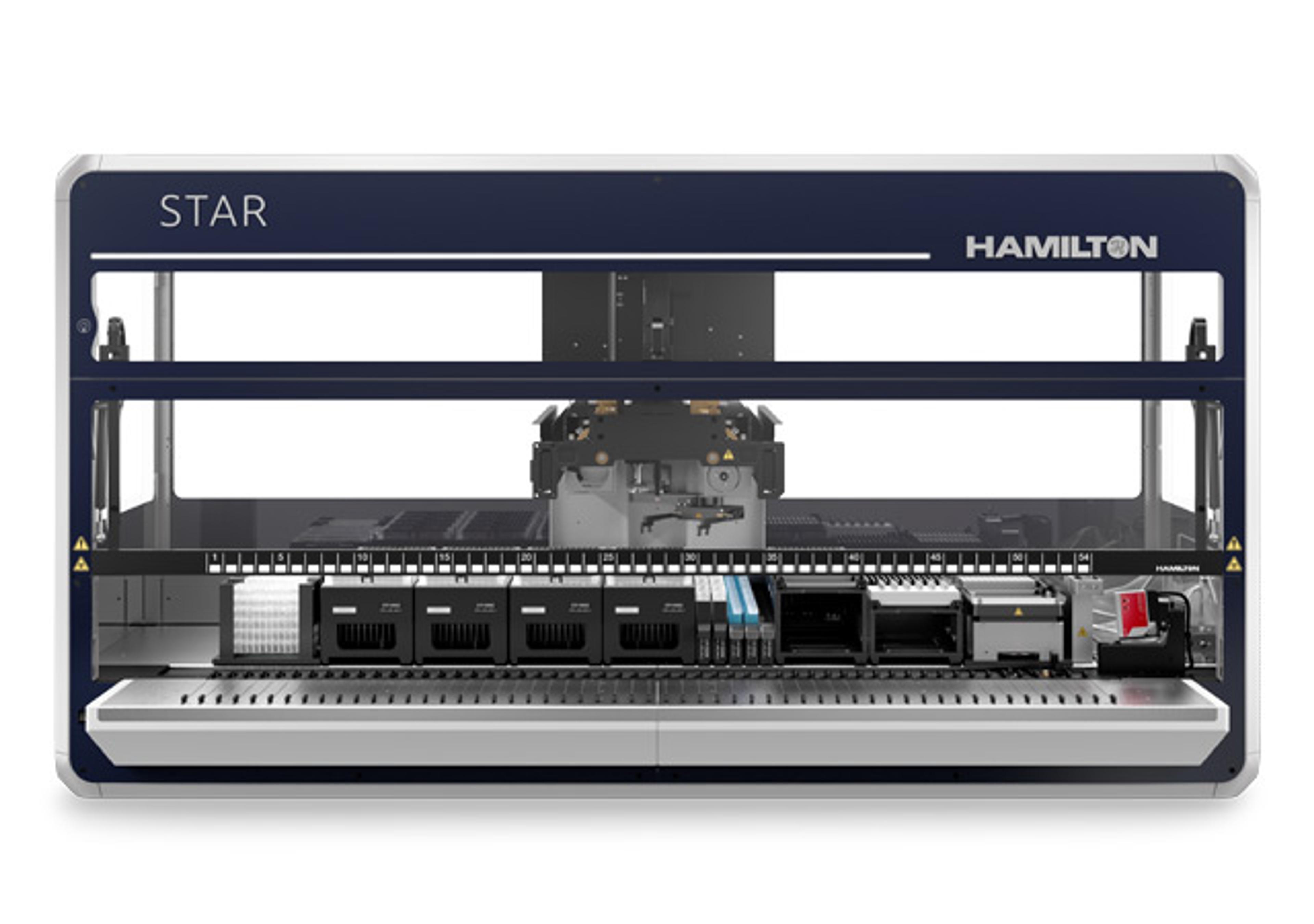
This dedicated imaging module optimizes the cell culture workflow and process by providing timely information with which to make decisions on media changes and subculture steps. The compact Cell Imager can be placed directly on the MICROLAB® STAR workstation deck, and imaging and pipetting are done in the same position for maximum space economy. The design of the Cell Imager eliminates the need for a gripper, which is required for movement of plates to and from other systems on the market.

The Hamilton Cell Imager reads an entire 96-well plate in approximately five minutes. Two positions allow one plate to be imaged while another is processed. The Cell Imager’s software provides live data tracking for a simultaneous overview of cell confluence in all plate wells. The software is easy to use and provides graphical data presentation. It may also be integrated with Hamilton’s Venus Software.

“Our integrated Cell Imager allows researchers to process cells on demand, rather than on a set schedule,” explained Daniel Caminada, Ph.D., cell biology product manager for Hamilton. “This instrument is optimized for hybridoma cell selection and is the fastest and most economical tool for this application.”

Microlab STAR

Hamilton

Experience Automation Your Way. The Microlab STAR Line automates liquid handling tasks from simple to complex with exceptional precision and flexibility so that you can increase throughput, reduce errors, and gain confidence in results.

(75)

Links

Tags

Cell / Tissue CultureCell culture or tissue culture is used to study the biology of cells or tissues and to isolate cellular products in an environment which can be manipulated and well defined. Accurately control your culture environment with bioreactors or culture incubators, bind your cells to a surface or together with an extracellular matrix. Distinguish cell types with differential media or proliferate cells with certain characteristics using selective media. Enrich your media with supplements such as growth factors, sera and vitamins. Find the best cell and tissue culture products, kits and equipment in our peer-reviewed product directory: compare products, check customer reviews and receive pricing direct from manufacturers.MicroplatesMicroplates are multi-well plates used to increase the throughput of biological investigations. The number of wells microplates contain can range from 6 to 3243 wells, with the 96-well format being the most commonly used. Microplates can come tailored for a range of applications including cell culture, PCR, filtration, storage, non-binding surface, protein crystallization, as well as pre-coated, deep well and normal Standard microplates. Additionally, options for microplate colors include clear , black, white or black with clear bottom and white with clear bottom for absorbance microplate reader applications. Find the best microplates for your lab in our peer-reviewed product directory: compare products, check customer reviews and receive pricing direct from manufacturers.Gel Doc / Image AnalysisGel documentation (gel doc) or gel imaging systems are used for the analysis of proteins, antibodies and nucleic acid immobilized in polyacrylamide or agarose gels, membranes or microarrays. Explore a range of a gel imaging systems, densitometers, scanners, transilluminators or UV lamp + CCD cameras for your image analysis solutions. Colorimetric, fluorescent and/or radioisotopic samples can be visualized and documented for further analysis. See gel doc / Image analysis software for quantitative 1D and 2D analysis of your samples. Find the best gel doc / image analysis products in our peer-reviewed product directory: compare products, check customer reviews and receive pricing direct from manufacturers.Microplate Readers / DetectorsMicroplate readers are used to automate the detection and analysis of labeled or label-free components in microplates during assays or live-cell monitoring. Microplate readers are generally distinguished by their mode of detection. Types include absorbance, luminescence, fluorescence intensity, fluorescence polarization, TRF / FRET and multimode microplate readers. Microplate readers deliver a high throughput of samples by reading multiple wells simultaneously, with the 96-well format the most commonly used. As a result, microplate readers are often used in the drug discovery, bioassays, research and pharmaceutical industries for screening applications. Microplate loading can also be automated, with robotic microplate stackers to increase throughput. Find the best microplate readers in our peer-reviewed product directory: compare products, check customer reviews and receive pricing direct from manufacturers.Plate ProcessingAutomated plate processing is used in microplate technologies for high-throughput, speed and efficiency. Plate processing systems include microplate handlers for moving plates, heat sealers, stackers and carousels for storage, retrieval and delivery, microplate washers and piercers. Useful features of plate processors include walk-away automation, compatibility and easy integration with microplate systems.
Integrated Imager Automates Cell Confluence and Growth Monitoring