
‘Inspire your potential by keeping yourself up to date about the latest research breakthroughs’
Plant biotechnology post grad, Sarannia Thanganathan, discusses her passion for research and how to overcome the challenges faced as a scientist
26 Apr 2022
Editorial article

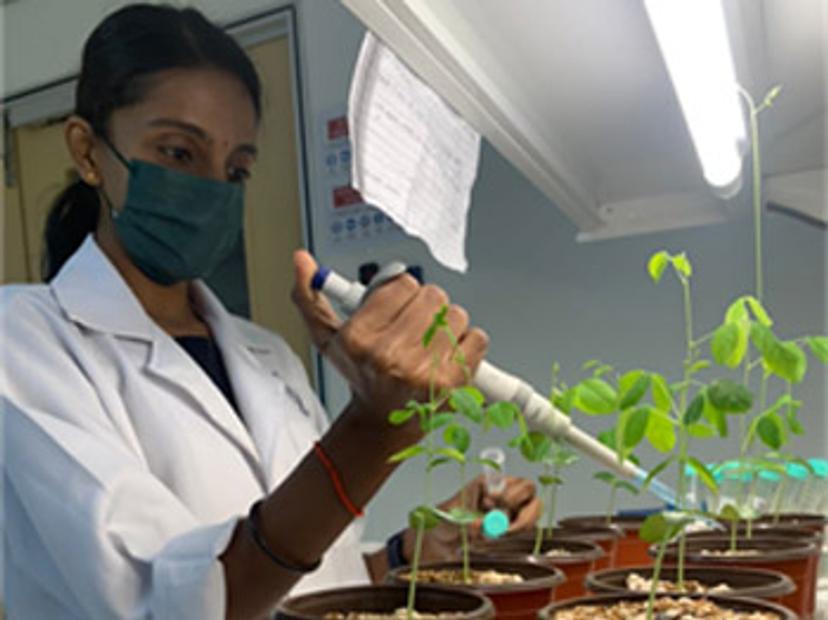
Lab product reviews can change the world by helping other scientists find the best equipment to accelerate their vital work. Here at SelectScience®, we are dedicated to promoting peer-to-peer communication that will make the difference - but we couldn't do it without our esteemed reviewers. In this regular feature, we put the spotlight on some of our most dedicated and impactful reviewers and find out what inspires them to keep sharing their knowledge with the global scientific community.
This week’s Reviewer in the Spotlight is Sarannia Thanganathan, a postgraduate specializing in molecular biology and microbiology at Quest International University, Perak, Malaysia. Sarannia’s current research in plant biotechnology involves molecular biology and transgenic work with Carica papaya and Arabidopsis thaliana plants. Here, Sarannia shares her learnings from the challenges she’s faced as a scientist, how she wants to spread optimism and inspire others to engage in the molecular biology field, and how she wants to advance her research skills in cell biology and plant tissue culture.
How did you become interested in your research topic?
I became interested in my current research topic due to my passion for molecular biology. Since starting my research, I have learned from the challenges I’ve faced, and this has strengthened my love for research. Learning many new things and skills from my research has made me curious to read more about transgenic work-related studies, especially those involving abiotic stresses. RNA-sequence studies have driven my passion for research that involves transcriptome study which is challenging but exciting.
What are the main challenges you have encountered as a researcher?
As a researcher, one of the main challenges I faced was to optimize my RNA extraction process, which took me 3 months! The process was really challenging, yet it has strengthened my skills as a scientist and taught me not to give up easily. The COVID-19 pandemic and movement control order (MCO) implemented in Malaysia was another challenge. The pandemic delayed my research progress for a year because I was not able to enter the institute due to the COVID-19 waves in my country. I had to find alternate ways to work which took several months to implement. Currently, the research work is being carried out smoothly despite all the hurdles faced over the past two years.
Do you have any advice for others who are just starting their science career?
Firstly, try to figure out what you are passionate about. Don’t simply get into a field based on previous experience. Try to inspire your potential by keeping yourself up to date about the latest research breakthroughs and reading a lot to improve your writing skills. Avoid limiting yourself to the existing job and try to explore yourself and get to know what you really like to do. Science is a wide field, so try to have a clearer picture of your interest so that you will enjoy doing your work despite the hurdles and challenges that you will face in your field. Most importantly, give importance to personal branding. Build up your profile on platforms such as LinkedIn, Twitter, and Instagram by sharing your thoughts or topics of interest in a science field.

Why do you read and write lab product reviews?
I read lab product reviews to opt for suitable products to be used in my research. Reviews provided by other scientists on the products they used will help others save time and resources.
Reviews provided by other scientists on the products they used will help others save time and resources
What is your favorite piece of lab equipment and why?
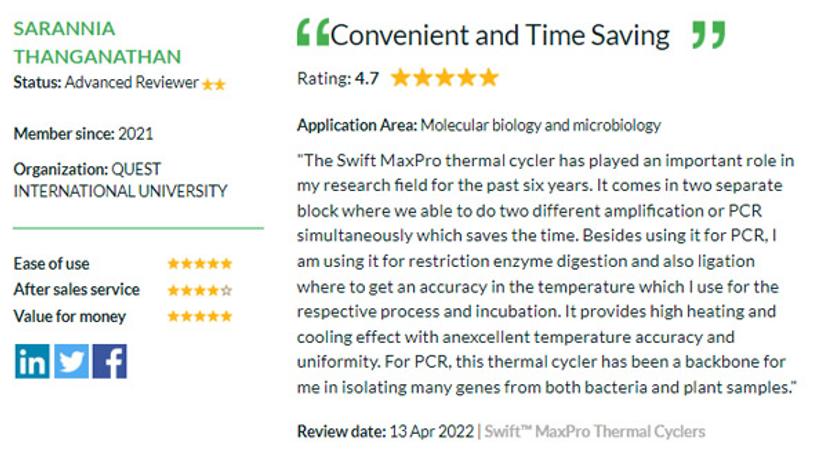
The Swift™ MaxPro Thermal Cycler by Esco Technologies Inc is one of my favorite lab equipment because of its efficiency and reliability in producing results. I’ve been using it for years. It is also the very first lab equipment that I operated on my own, so I have a special and unique attachment to it!
Another favorite piece of equipment of mine is the refrigerated centrifuge because it saves me a lot of time in the lab. When comes to RNA work, it always needs special attention to prevent RNA degradation. This equipment is a life-saver, and I can get my work done faster and more smoothly.
What is the next step you’re hoping to take in your career?
As a naturally inquisitive person who loves research, I am aiming to be a research scientist in the future. My passion for a variety of different research fields has deepened my potential and I find that extremely exciting. Aspiring research experience by entering the workforce for a few years before pursuing a Ph.D. program will be my next step. Therefore, I am looking forward to applying for a research scientist position at biotech companies.
Would you like to feature in our Reviewer Spotlight? Write your review here to be in with a chance >>
Related products
Request Quote for All Products
Swift™ MaxPro Thermal Cyclers
Esco Technologies IncSwift MaxPro is the Esco's Most Popular 2nd Generation Thermal Cyclers, which Combines Outstanding Flexibility and Ease of Use with Excellent Temperature Performance.