Identify proteins you could not identify before using new products from Promega

19 May 2009
Nadine Davies
Marketing / Sales

Product news

Promega introduces an innovative and simplified in-gel digestion procedure utilizing ProteaseMAX Surfactant. This new procedure offers the researcher multiple benefits:

Save time: Digestions complete in only one hour.
Eliminate gel extraction steps: Protein digestion and peptide recovery is complete in a single step.
More data: Recover longer peptides which tend to remain in the gel in conventional in-gel digestion protocols.

In addition to ProteaseMAX Surfactant, Promega now offers the following new products:

• Immobilized Trypsin
• Chymotrypsin Sequencing Grade
• Lys-C Sequencing Grade

Immobilized Trypsin offers fast digestion of purified proteins or complex mixtures. Digestions are complete in as little as 30 minutes and the protocol is easily scalable to accommodate multiple protein concentrations. Chymotrypsin and Lys-C can both be used alone or in combination with other proteases to produce protein digests for peptide mapping applications or protein identification by peptide mass fingerprinting or MS/MS spectral matching. Both proteases are suitable for digestion reactions in-solution or in-gel.

Request your free sample of Immobilized Trypsin, just visit us at ASMS booth #63 to find out how.

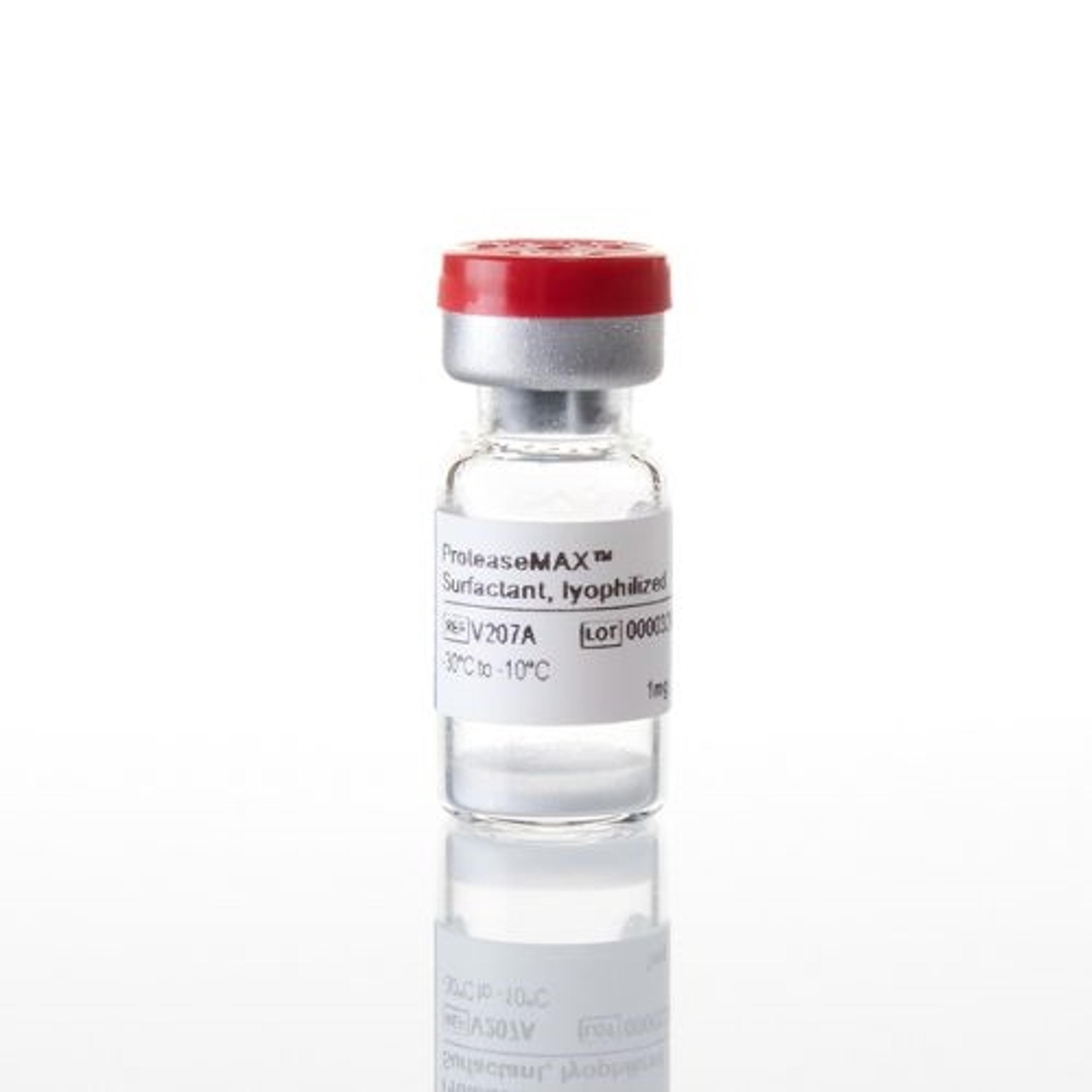
ProteaseMAX™ Surfactant, Trypsin Enhancer

Promega Corp.

ProteaseMax™ Surfactant is a high-quality reagent for use in protein and peptide sample preparation.   ProteaseMax™ Surfactant solubilizes proteins and ensures fast and improved protein digestion with trypsin or chymotrypsin. It is designed to degrade over the course of a digestion reaction, yielding products that are compatible with downstream methods such as mass spectrometry (MS) and liquid chromatography (LC). For in-gel protein digestion, ProteaseMax™ Surfactant also improves the recovery of peptides. ProteaseMax™ Surfactant can be used with existing in-gel or in-solution digestion protocols.  

(0)

Links

Tags

LC-MSLC-MS (liquid chromatography-mass spectrometry) systems and equipment are used for separation and quantitative analysis of complex mixtures, combining liquid chromatography and mass spectrometry. Quantify proteins, contaminants, pesticides or screen for drug metabolites with a high level of sensitivity. LC-MS systems and equipment include reverse phase, normal phase and specialized columns integrated with various MS detectors such as time-of-flight (TOF), quadrupole, orbitrap or ion trap mass analyzers. LC-MS/MS instruments equipped with a qTOF or triple quadrupole analyzer give greater sensitivity and resolving power to your analysis. Find the best LC-MS equipment in our peer-reviewed product directory: compare products, check customer reviews and receive pricing direct from manufacturers.Mass SpectrometryMass spectrometry (MS) is a powerful analytical technique used to identify and quantify molecules based on the mass-to-charge ratio of gas-phase ions. It provides detailed information about the structure, composition, and properties of compounds and is widely used across fields such as environmental monitoring, materials science, drug discovery and development, food and beverage testing, and wider chemical research. Key MS techniques include tandem mass spectrometry (MS/MS), liquid chromatography–mass spectrometry (LS-MS) and inductively coupled plasma (ICP-MS). Choosing from these wide range of techniques and technologies can be a daunting task, so keep up to date with scientific applications, performance expectations, and customer reviews here all in one place. Visit our product directory to receive quotes direct from the manufacturer. ProteomicsProteomics is the systemic bioinformatics study of proteins and amino acids, including their structure, size, function and identification. Tools used in proteomics include chromatography, blotting and gels, protein arrays, mass spectrometry and ELISA and associated analysis software. Analyzers and proteomic systems should be sensitive, high resolution, fast and may be automated for high-throughput.Protein PurificationProtein purification is a vital step in drug discovery, therapeutics, biotech and life science research. The purification process typically involves subcellular or membrane protein extraction with cell lysis kits, separation of proteins from cell debris by filtration or spin columns, and the isolation of proteins of interest from other proteins and impurities with affinity purification (including fusion protein tags and antibody binding proteins A, G and L), immunoprecipitation or chromatographic methods, such as ion exchange, size exclusion and immobilized metal affinity chromatography. All purification methods come in multiple formats for your laboratory needs, including agarose or magnetic beads, resins, columns and filter plates. Find the best protein purification equipment in our peer-reviewed product directory: compare products, check customer reviews and receive pricing direct from manufacturers.
Identify proteins you could not identify before using new products from Promega