
How to avoid filter tips that disrupt PCR
Labcon shares how elements found in some filter tip brands may explain unexpected assay failure
20 Mar 2023
Research has shown that the quality of filter tips is critical to supporting contamination-free processing of samples. Surprisingly, filter tips can also be the source of contamination in an experiment. A recent series of studies illustrated that specific elements found in some filter tip brands may explain unexpected assay failure. Additionally, filter tips manufactured by Labcon were found to have the lowest level of several elements that are known to have effects on common experimental techniques.
Inductively Coupled Plasma Mass Spectrometry (ICP-MS) was used to perform an elemental analysis on 68 common interferents to determine the risk posed to specific clinical and research assays. This rigorous testing, the first of its kind, was performed on different polymeric filters found in commercially available brands of filter tips to quantify potential elements, additives, contaminants, leachables, and extractables. Experimental interference can come from the presence of certain inorganic elements, heavy metals, or sealing additives. The testing also incorporated a filter material performance analysis to qualify the performance capabilities in specific environments.
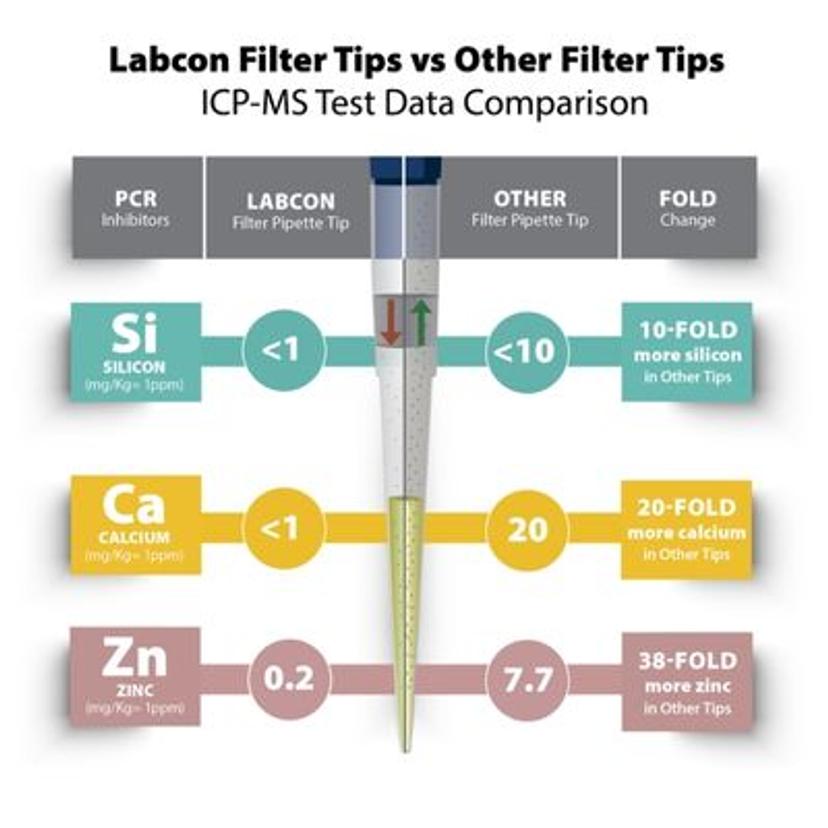
Some of the ICP-MS results and assay analysis focused on negative effects on the Polymerase Chain Reaction (PCR) technique. Filter tips may come with claims of being PCR inhibitor free, but impurities that make them less suitable for certain sensitive assays may be present. Elements like calcium, silicon, and zinc pose clear risks and can alter experimental outcomes. Studies show that the PCR amplification process is impacted by specific elements that affect DNA polymerization, primer annealing, or fluorescence signal deviation used for detection and quantification in qPCR. Specifically, calcium may act as a Taq polymerase inhibitor in PCR, with effects on DNA amplification caused by competitive binding resulting in less efficient amplification [1]. ICP-MS results indicate filter tips manufactured by competitors can have up to 20-fold more calcium when compared to Labcon filter tips. The element zinc may also act as a Taq polymerase inhibitor in PCR, with effects believed to cause worsened enzyme performance [2]. A similar analysis on zinc’s presence in filters yielded a 38-fold higher level of zinc in competing tips compared to Labcon filter tips. Silicon has also been identified as a disruptive ion to PCR, with a mechanism potentially traced to Taq polymerase adhering to silicon during amplification [3]. Silicon was found to have a 10-fold higher level in competing filter tip alternatives relative to Labcon filter tips.
Increased reliance on filter tips has led to new, innovative standards of quality and improved experimental outcomes in investigational, preclinical, and clinical settings. Filter tip use in Clinical Laboratory Improvement Amendments (CLIA) Labs performing diagnostics, genotyping, and tissue culture puts greater need for trustworthy consumables to provide accurate clinical diagnoses and avoid compromised results. High quality Labcon filter tips, made in California, are proven to be superior in multiple measures of potentially inhibitory elements. Labcon filter tips’ ability to deliver contamination-free performances ensures accuracy, precision, and reproducibility in your results, and supports the next generation of improved liquid handling techniques.
References:
Mccord, B., Pionzio, A. and Thompson, R. (2015). Analysis of the Effect of a Variety of PCR Inhibitors on the Amplification of DNA using Real Time PCR, Melt Curves and STR Analysis. [online] Available at: https://www.ojp.gov/pdffiles1/nij/grants/249148.pdf.
Kuffel, A., Gray, A. and Daeid, N.N. (2021). Impact of metal ions on PCR inhibition and RT-PCR efficiency. International Journal of Legal Medicine, [online] 135(1), pp.63–72. Available at: https://link.springer.com/article/10.1007%2Fs00414-020-02363-4.
Wang, W., Wang, H.-B., Li, Z.-X. and Guo, Z.-Y. (2006). Silicon inhibition effects on the polymerase chain reaction: a real-time detection approach. Journal of Biomedical Materials Research. Part A, [online] 77(1), pp.28–34. Available at: https://pubmed.ncbi.nlm.nih.gov/16345097/.