
How to accelerate downstream processes in AAV manufacturing
Discover the impact of mass photometry in AAV process development in this exclusive interview with a viral vector expert
9 Jan 2024

ABL, an Institut Mérieux Company, is a contract development and manufacturing organization (CDMO) providing GMP viral vectors from early stage to market. In this article, Dr. Quentin Bazot, Head of Innovation and Development from ABL, shares insights into his experience with the SamuxMP mass photometer from Refeyn. He speaks about the impact of this technology on ABL's adeno-associated virus (AAV) process development workflows, its integration into their lab, and how it has accelerated their analytical workflows. He will also discuss how ABL has been using mass photometry for its downstream AAV characterization workflows.
About ABL and the SamuxMP
Q: Can you briefly introduce ABL? How does it bring value to the gene therapy space?
A: ABL Europe is a pure-play CDMO specialized in the development and manufacturing of viral vectors. From development to market, we provide GMP viral vectors, contributing to the success of our clients in the gene therapy and immunotherapy space. We have two sites in France – one in Strasbourg and one in Lyon, where I'm based.
Q: How did you first hear about mass photometry and the SamuxMP?
A: I first heard about the SamuxMP in a webinar focused on AAV analytics and innovation, in May 2022. I then saw the instrument at the Bioprocessing Summit in March 2023 and attended a talk showcasing advantages of the SamuxMP for AAV characterization. We got excited about the speed and the ease of use of the instrument and planned an evaluation in April 2023. We fell in love with the technology and acquired it in July.
Q: How has the mass photometer been received among your peers and within your team?
A: Very well, I must say. We have all been impressed by the SamuxMP, especially about its ease of use and the precision of the results. Our process development team really likes it, as the instrument is very user-friendly and provides quick results, and we believe it's a game changer for AAV analytics.
Downstream AAV sample characterization with the SamuxMP
Q: On a typical day, how do you use mass photometry for your AAV analytics?
A: Currently, we use mass photometry in our process development lab for AAV analytics, for early characterization as well as process development for the downstream paths. Specifically, we analyze AAV samples after the chromatography step (capture), as well as during the polishing step. In the polishing stage, we enrich the sample with full AAV capsids by removing the empty and partially filled capsids. Mass photometry helps us optimize the polish protocols.
Mass photometry has also helped optimize the protocols for the upstream path. After AAV production in cell cultures, we assess the AAV production efficiency. Sometimes, we do come across surprises, which the SamuxMP helps us identify. In one project, for example, we saw that the partially filled AAV capsids were way more abundant than desired. Thanks to the SamuxMP, we could identify this rapidly and went back to the plasmid design. We changed the type of plasmid and the construct design, which led to drastically lower production of partials during plasmid expression, simplifying our downstream processing and purification workflows.
Q: Why is it problematic to have a high percentage of partials or overfilled capsids in samples?
A: Separating empty and full AAVs with chromatography is already a challenge, and if there are also partials in the mix, it adds a layer of complexity. Partially filled AAV capsids are difficult to eliminate from the samples. Overfilled capsids also represent a challenge – these are difficult to separate from the full AAVs. The AAV load in these populations is often unknown and needs to be characterized, which raises concerns over product safety. Therefore, the optimization of constructs and AAV production in cultures to yield low amounts of partials or over-filled capsids, is a really good investment.
Q: Have you noticed significant improvements in your analytical workflows since using mass photometry?
A: Absolutely. Previously, we were predominantly relying on chromatograms alone to assess empty-full ratios in our AAV samples and to assess whether an experiment worked. For further analysis, we would send the samples to the Quality Control (QC) lab, and it would take time to get results.
With the SamuxMP, we evaluate all the samples ourselves and rapidly assess whether we have successfully enriched the samples with full AAVs. Once we’re confident that the quality of our AAV preparations is aligned with expectations, we send it to QC for further analysis with orthogonal methods.
Performance & comparison of mass photometry with gold standard methods
Q: What capabilities of the SamuxMP do you find most useful?
A: We like that the SamuxMP is serotype-agnostic. It works well with all the AAV serotypes that we tested, and its minimal sample volume and concentration requirements are impressive compared to traditional methods like AUC or cryoTEM. It provides accurate measurements of empty-full AAV capsid ratios.
Q: Could you describe your experience with the software for acquisition and data analysis?
A: Both the AcquireMP and DiscoverMP software applications amazed us as they’re very user-friendly – one can become an expert in acquiring and analyzing mass photometry data quickly. We're currently using the SamuxMP in our process lab and as a next step, we plan to implement it also in QC. For this, we are planning to acquire the software package for GMP environments.
The AAV field has been eagerly anticipating the arrival of mass photometry to GMP environments. We believe it will become a gold standard in the coming years.
Q: How does it compare to other techniques and complement current methods in your lab?
A: We're generating data to compare mass photometry with gold standards like AUC and cryoTEM. Early indications show that it’s much quicker and equally accurate. Partners who've compared mass photometry to other methods themselves vouch for its accuracy. It's a game changer in AAV characterization, for us as well as our clients.
Want the latest science news straight to your inbox? Become a SelectScience member for free today>>
Related products
Request Quote for All Products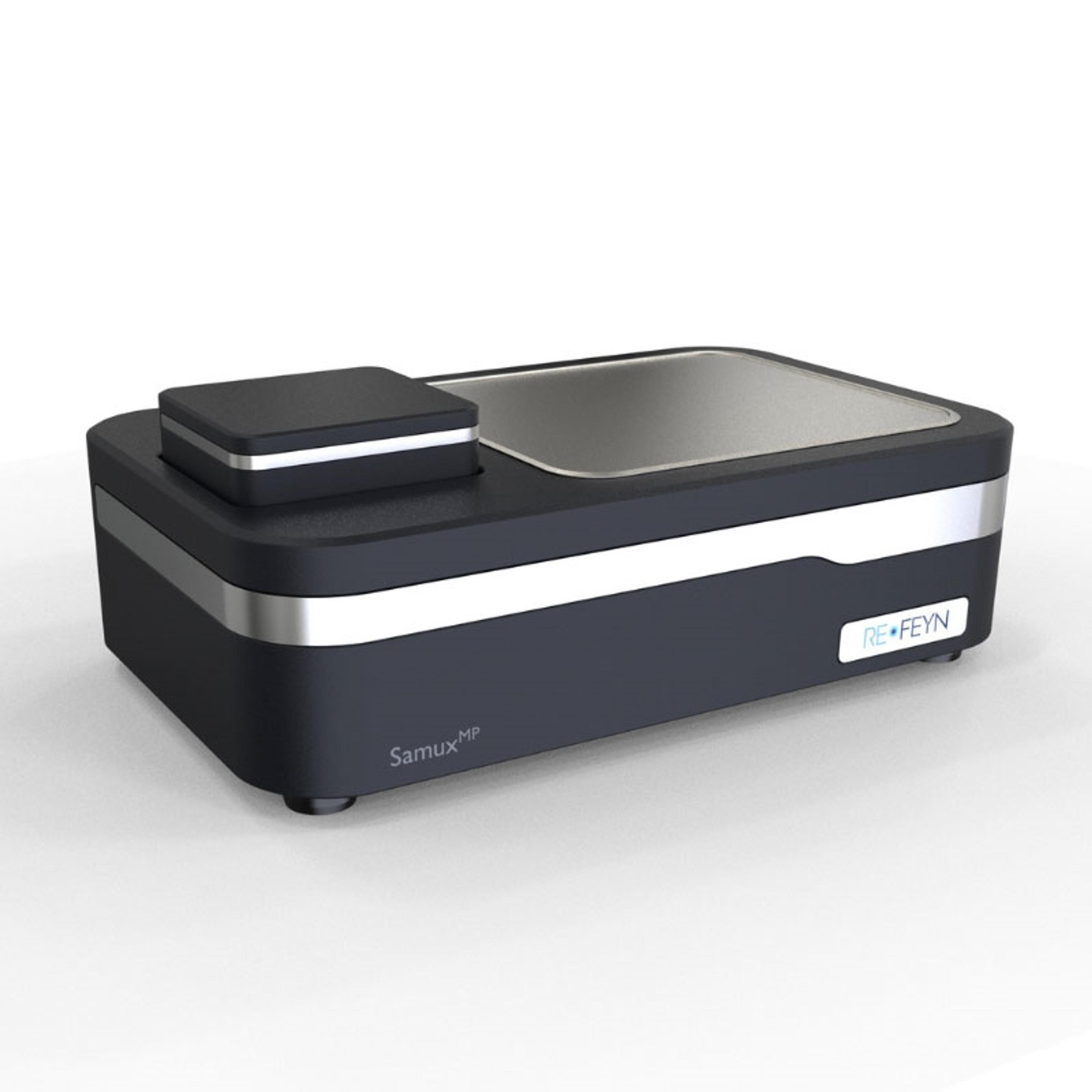
SamuxMP
RefeynThe Refeyn SamuxMP is a mass photometer optimised for adeno-associated virus (AAV) characterisation and is an essential analytical tool for laboratories working with AAVs. The SamuxMP precisely measures the empty/full capsid ratio for AAVs of any serotype. SamuxMP mass photometry measurements are rapid and require very little sample.